

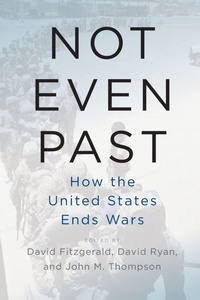
Not Even Past
How the United States Ends Wars
1st Edition
Published on 20. March 2020
Book
Paperback/Softback
286 pages
978-1-78920-225-0 (ISBN)
Description
Offers essential perspectives on the Cold War and post-9/11 eras and explores the troubling implications of the American tendency to fight wars without end.
"Featuring lucid and penetrating essays by a stellar roster of scholars, the volume provides deep insights into one of the grand puzzles of the age: why the U.S. has so often failed to exit wars on its terms."- Fredrik Logevall, Laurence D. Belfer Professor of International Affairs, Harvard University
Vietnam, Iraq, Afghanistan: Taken together, these conflicts are the key to understanding more than a half century of American military history. In addition, they have shaped, in profound ways, the culture and politics of the United States-as well as the nations in which they have been fought. This volume brings together international experts on American history and foreign affairs to assess the cumulative impact of the United States' often halting and conflicted attempts to end wars.
From the introduction:
The refusal to engage in historical thinking, that form of reflection deeply immersed in the US experience of war and intervention, means that this cultural amnesia is related to a strategic incoherence and, in these wars, the United States has failed in its strategic objectives because it did not define, precisely, what they were. If Vietnam was the tragedy, Iraq and Afghanistan were repeated failures. The objectives and the national interests were elusive beyond issues of credibility, identity, and revenge; the end point was undefined because it was not clear what the point was. What did the United States want from these wars? What did it want to leave behind?
"Featuring lucid and penetrating essays by a stellar roster of scholars, the volume provides deep insights into one of the grand puzzles of the age: why the U.S. has so often failed to exit wars on its terms."- Fredrik Logevall, Laurence D. Belfer Professor of International Affairs, Harvard University
Vietnam, Iraq, Afghanistan: Taken together, these conflicts are the key to understanding more than a half century of American military history. In addition, they have shaped, in profound ways, the culture and politics of the United States-as well as the nations in which they have been fought. This volume brings together international experts on American history and foreign affairs to assess the cumulative impact of the United States' often halting and conflicted attempts to end wars.
From the introduction:
The refusal to engage in historical thinking, that form of reflection deeply immersed in the US experience of war and intervention, means that this cultural amnesia is related to a strategic incoherence and, in these wars, the United States has failed in its strategic objectives because it did not define, precisely, what they were. If Vietnam was the tragedy, Iraq and Afghanistan were repeated failures. The objectives and the national interests were elusive beyond issues of credibility, identity, and revenge; the end point was undefined because it was not clear what the point was. What did the United States want from these wars? What did it want to leave behind?
Reviews / Votes
"[This is] an important study to begin to think about the strategic failures of the United States and a gateway for authors to make recommendations. There is no easy fix, and perhaps there is no answer... Instead of ending conflicts, the United States transitions into another phase or pretends otherwise." * Journal of Military History"We have endless books on the origins of America's wars, but far fewer that examine the crucial question of how the conflicts are terminated. Not Even Past is therefore hugely welcome. Featuring lucid and penetrating essays by a stellar roster of scholars, the volume provides deep insights into one of the grand puzzles of the age: why the U.S. has so often failed to exit wars on its terms." * Fredrik Logevall, Laurence D. Belfer Professor of International Affairs, Harvard University
"The accessible essays in this volume comprise a timely contribution to the current scholarship. The continued presence of the United States in Afghanistan makes it all the more salient." * Sarah Kreps, Cornell University
"Not Even Past is that rare edited collection where each successive essay holds to the standard of the rest, bringing with it insights and delights in every chapter. This book provides a very important and historically informed perspective." * Jeffrey A. Engel, Southern Methodist University
More details
Language
English
Place of publication
Oxford
United Kingdom
Target group
Professional and scholarly
Product notice
Paperback (trade)
Illustrations
Bibliography; Index
Dimensions
Height: 229 mm
Width: 152 mm
Thickness: 16 mm
Weight
421 gr
ISBN-13
978-1-78920-225-0 (9781789202250)
DOI
10.3167/9781789202151
Copyright in bibliographic data and cover images is held by Nielsen Book Services Limited or by the publishers or by their respective licensors: all rights reserved.
Schweitzer Classification
Other editions
Additional editions
E-Book
03/2020
1st Edition
Berghahn Books
€19.49
Available for download
E-Book
03/2020
1st Edition
Berghahn Books
€19.49
Available for download
Persons
David Fitzgerald is a Lecturer in the School of History, University College Cork, Ireland. His books include Learning to Forget: US Army Counterinsurgency Doctrine from Vietnam to Iraq (Stanford, 2013) and Obama, US Foreign Policy and the Dilemmas of Intervention (with David Ryan, Palgrave Macmillan, 2014).
Content
Acknowledgments
Introduction
David Ryan and David Fitzgerald
Part I: Vietnam
Chapter 1. The Importance of Being Popular: Richard Nixon, Henry Kissinger, and Domestic Support for the Vietnam War
Sarah Thelen
Chapter 2. The Things They Carry: Vietnam and the Legacies of the American War
Edwin A. Martini
Chapter 3. "His Epitaph Is Also Ours": Robert McNamara, the Iraq and Afghanistan Wars, and the Vietnam War's Contested Usable Past
David Kieran
Chapter 4. After the Fall of Saigon: Strategic Implications of America's Involvement in Vietnam
Robert K. Brigham
Part II: Iraq and Afghanistan
Chapter 5. The Ironies of Overwhelming "Victory": Exits and the Dislocation of the Gulf War
David Ryan
Chapter 6. Failing to End: Obama and Iraq
David Fitzgerald and David Ryan
Chapter 7. A "Responsible End" to the Afghan War: The Politics and Pitfalls of Crafting "Success" Narratives
Jeffrey H. Michaels
Chapter 8. Flawed Afghanization: Underestimating and Misunderstanding the Taliban
Antonio Giustozzi
Part III: The Cultural and Strategic Costs of War in the Early Twenty-First Century
Chapter 9. Changing the Subject: How the United States Responds to Strategic Failure
Andrew J. Bacevich
Chapter 10. How Wars Do Not End: The Challenges for Twenty-First Century US Foreign Policy and Intervention
Scott Lucas
Chapter 11. Coming Home: Soldier Homecomings and the All-Volunteer Force in American Society and Culture
David Fitzgerald
Chapter 12. How the United States Ends Wars
Marilyn B. Young
Index
Introduction
David Ryan and David Fitzgerald
Part I: Vietnam
Chapter 1. The Importance of Being Popular: Richard Nixon, Henry Kissinger, and Domestic Support for the Vietnam War
Sarah Thelen
Chapter 2. The Things They Carry: Vietnam and the Legacies of the American War
Edwin A. Martini
Chapter 3. "His Epitaph Is Also Ours": Robert McNamara, the Iraq and Afghanistan Wars, and the Vietnam War's Contested Usable Past
David Kieran
Chapter 4. After the Fall of Saigon: Strategic Implications of America's Involvement in Vietnam
Robert K. Brigham
Part II: Iraq and Afghanistan
Chapter 5. The Ironies of Overwhelming "Victory": Exits and the Dislocation of the Gulf War
David Ryan
Chapter 6. Failing to End: Obama and Iraq
David Fitzgerald and David Ryan
Chapter 7. A "Responsible End" to the Afghan War: The Politics and Pitfalls of Crafting "Success" Narratives
Jeffrey H. Michaels
Chapter 8. Flawed Afghanization: Underestimating and Misunderstanding the Taliban
Antonio Giustozzi
Part III: The Cultural and Strategic Costs of War in the Early Twenty-First Century
Chapter 9. Changing the Subject: How the United States Responds to Strategic Failure
Andrew J. Bacevich
Chapter 10. How Wars Do Not End: The Challenges for Twenty-First Century US Foreign Policy and Intervention
Scott Lucas
Chapter 11. Coming Home: Soldier Homecomings and the All-Volunteer Force in American Society and Culture
David Fitzgerald
Chapter 12. How the United States Ends Wars
Marilyn B. Young
Index