

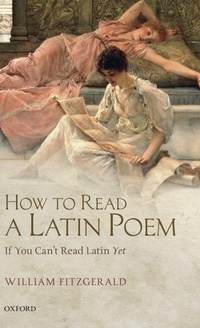
How to Read a Latin Poem
If You Can't Read Latin Yet
Published on 21. February 2013
Book
Hardback
290 pages
978-0-19-965786-5 (ISBN)
Description
Latin is very much alive in the poetry written by the great Latin poets, and this book is about their poetry, their language, and their culture. Fitzgerald shows the reader with little or no knowledge of the Latin language how it works as a unique vehicle for poetic expression and thought. Moving between close analysis of particular Latin poems and more general discussions of Latin poets, literature, and society, Fitzgerald gives the un-Latined reader an insider's view of how Latin poetry feels and what makes it worth reading, even today. His book explores what can be said and done in a poetry and a language that are both very different from English and yet have profoundly influenced it. He takes the reader through the whole range of Latin poetry from the trivial, obscene, and vicious, to the sublime, the passionate, and the uplifting. Individual chapters focus on particular authors (such as Vergil and Horace) or on themes (love, hate, civil war), and together they explain why we should care about what the poets of ancient Rome had to say.
If you have ever wondered what all the fuss was about, see for yourselves!
If you have ever wondered what all the fuss was about, see for yourselves!
Reviews / Votes
It deserves strong support from all classicists, who should consult it themselves (for personal stimulation and as a way of enlivening their lectures) and recommend it warmly to others who will benefit from it. This book will do much for the popularity of the Latin languagge and Roman verse and will do much to help them survive and stay healthy. * Paul Murgatroyd, Latomus * In this book William Fitzgerald acts as an expert guide through a carefully arranged selection of examples. ... the spirit of rediscovery which Fitzgerald invokes in his introduction will enchant the previously initiated. * Astrid Voigt, Museum Helveticum * William Fitzgerald is a distinguished professor of Latin. He writes with charm and lucidity [...] This books helps remind one of how poetry can be incredibly rich without being incomprehensible. * Charles Moore, Daily Telegraph * mercurial and bold. Fitzgerald animates the dead language, covering acres but often highlighting details, such as the expressive power of word order, or English derivations ... This attempt to return to Latin without being elitist and stuffy highlights a fault line in our discipline. The glass ceiling is still there; this book helps to demonstrate how we might smash it and why we should. * Roger Rees, Times Higher Education * William Fitzgerald's book on Latin poetry for those who "can't read Latin yet" takes us right to the heart of Latin literature [...] Fitzgerald's book makes demands, but the dividends are immense. * The Scotsman, Michael Kerrigan * The book can be warmly recommended to all curious about Roman poetry, even to those who have no intention of learning (or remembering) Latin any time soon. * Roy Gibson, Times Literary Supplemen *More details
Language
English
Place of publication
Oxford
United Kingdom
Target group
College/higher education
Professional and scholarly
This volume is intended to be accessible to general and non-academic readers interested in poetry or the ancient world, and will also be of interest to students and scholars of Classical Studies and Latin literature.
Dimensions
Height: 222 mm
Width: 145 mm
Thickness: 21 mm
Weight
543 gr
ISBN-13
978-0-19-965786-5 (9780199657865)
Copyright in bibliographic data and cover images is held by Nielsen Book Services Limited or by the publishers or by their respective licensors: all rights reserved.
Schweitzer Classification
Other editions
Additional editions
E-Book
01/2013
1st Edition
OUP Oxford
€50.49
Available for download
Person
William Fitzgerald is Professor of Latin at King's College, London.
Content
INTRODUCTION; GUIDE TO THE PRONUNCIATION OF LATIN; PRELUDE: TO THE READER; EPILOGUE; GUIDE TO FURTHER READING; GLOSSARY