

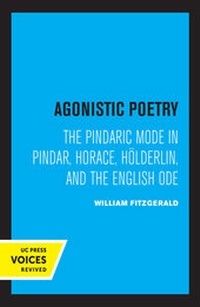
Agonistic Poetry
The Pindaric Mode in Pindar, Horace, Hoelderlin, and the English Ode
1st Edition
Will be published approx. on 27. August 2021
Book
Hardback
258 pages
978-0-520-36744-9 (ISBN)
Description
Pindar's poetry, although revered, remains one of the least read among great classical works, even within classical scholarship. His epinikion, or victory ode, is an unfamiliar genre, largely represented only by Pindar himself. Engaging with his work requires facing the challenges of his complex language, thought process, and narrative style. Despite such obstacles, Pindar has long been acknowledged as an essential poet, a symbol of inspiration and originality whose work has provided a model for poets seeking a break from conventional "classical" forms. Yet, Pindar's reputation as both a bold innovator and a flatterer of elite athletes has created a dual image of his character and work.
In this study, the focus shifts from Pindar as a historical figure to the lasting significance of his poetic mode, which extends to modern works. Pindar's work is frequently invoked in discussions of lyric poetry to illustrate that lyricism can be more than subjective or inward; his poetry demonstrates a communal voice, albeit one that arises not from a predefined community but through the act of poetic resistance. By modeling community as an agon, or contest, the study explores how poetry can reflect communal forces rather than fixed groups. This approach contrasts with perspectives that interpret lyric poetry through individualistic or self-contained struggles, as seen in the theories of Harold Bloom and certain deconstructive readings, positioning the poetic voice instead as a dynamic, communal force.
The analysis here extends beyond Pindar's ancient Greek context to examine the Pindaric mode's influence on the English ode and in the poetry of figures such as Hoelderlin, as well as others like Claudel in French literature. While considering historical influences, this work does not aim to trace direct literary lineages; instead, it highlights shared problematics and poetic strategies. Through close readings, this study reframes the Pindaric tradition, not as a set of stylistic cliches but as a source of complex, communal expression within the broader field of lyric and odic poetry.
This title is part of UC Press's Voices Revived program, which commemorates University of California Press's mission to seek out and cultivate the brightest minds and give them voice, reach, and impact. Drawing on a backlist dating to 1893, Voices Revived makes high-quality, peer-reviewed scholarship accessible once again using print-on-demand technology. This title was originally published in 1987.
In this study, the focus shifts from Pindar as a historical figure to the lasting significance of his poetic mode, which extends to modern works. Pindar's work is frequently invoked in discussions of lyric poetry to illustrate that lyricism can be more than subjective or inward; his poetry demonstrates a communal voice, albeit one that arises not from a predefined community but through the act of poetic resistance. By modeling community as an agon, or contest, the study explores how poetry can reflect communal forces rather than fixed groups. This approach contrasts with perspectives that interpret lyric poetry through individualistic or self-contained struggles, as seen in the theories of Harold Bloom and certain deconstructive readings, positioning the poetic voice instead as a dynamic, communal force.
The analysis here extends beyond Pindar's ancient Greek context to examine the Pindaric mode's influence on the English ode and in the poetry of figures such as Hoelderlin, as well as others like Claudel in French literature. While considering historical influences, this work does not aim to trace direct literary lineages; instead, it highlights shared problematics and poetic strategies. Through close readings, this study reframes the Pindaric tradition, not as a set of stylistic cliches but as a source of complex, communal expression within the broader field of lyric and odic poetry.
This title is part of UC Press's Voices Revived program, which commemorates University of California Press's mission to seek out and cultivate the brightest minds and give them voice, reach, and impact. Drawing on a backlist dating to 1893, Voices Revived makes high-quality, peer-reviewed scholarship accessible once again using print-on-demand technology. This title was originally published in 1987.
More details
Edition
First Edition
Language
English
Place of publication
Berkerley
United States
Target group
Professional and scholarly
Product notice
Cloth over boards
Dimensions
Height: 210 mm
Width: 148 mm
Thickness: 20 mm
Weight
454 gr
ISBN-13
978-0-520-36744-9 (9780520367449)
Copyright in bibliographic data and cover images is held by Nielsen Book Services Limited or by the publishers or by their respective licensors: all rights reserved.
Schweitzer Classification
Other editions
Additional editions
William Fitzgerald
Agonistic Poetry
The Pindaric Mode in Pindar, Horace, Hölderlin, and the English Ode
E-Book
07/2023
1st Edition
Naval Institute Press
€23.49
Available for download
Person
William Fitzgerald is a university lecturer in classics and fellow at Gonville and Caius College, University of Cambridge.