

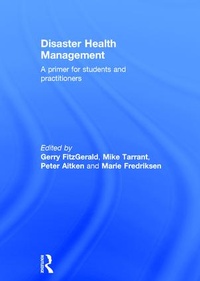
Disaster Health Management
A Primer for Students and Practitioners
Published on 14. September 2016
Book
Hardback
352 pages
978-1-138-91116-1 (ISBN)
Description
Disaster health is an emerging field that focuses on developing prevention, preparation, response and recovery systems for dealing with health problems that result from a disaster. As disasters worldwide differ in their nature, scope and cultural context, a thorough understanding of the fundamental tenets of sound disaster health management is essential for both students and practitioners to participate confidently and effectively in the field.
Disaster Health Management is the first comprehensive textbook to provide a standard guide to terminology and management systems across the entire spectrum of disaster health. Authored by experienced educators, researchers and practitioners in disaster health management, this textbook provides an authoritative overview of:
The conceptual basis for disaster management
Systems and structures for disaster management
Managing disasters through the continuum of preparedness, response and recovery
The variations associated with both natural and technological disasters
The strategic considerations associated with leadership, research, education and future directions.
Using Australasian systems and structures as examples of generic principles which will find application globally, Disaster Health Management is an essential text for both undergraduate and postgraduate students, as well as for professionals involved in all aspects of disaster management.
Disaster Health Management is the first comprehensive textbook to provide a standard guide to terminology and management systems across the entire spectrum of disaster health. Authored by experienced educators, researchers and practitioners in disaster health management, this textbook provides an authoritative overview of:
The conceptual basis for disaster management
Systems and structures for disaster management
Managing disasters through the continuum of preparedness, response and recovery
The variations associated with both natural and technological disasters
The strategic considerations associated with leadership, research, education and future directions.
Using Australasian systems and structures as examples of generic principles which will find application globally, Disaster Health Management is an essential text for both undergraduate and postgraduate students, as well as for professionals involved in all aspects of disaster management.
More details
Language
English
Place of publication
London
United Kingdom
Publishing group
Taylor & Francis Ltd
Target group
College/higher education
Professional and scholarly
Illustrations
70 s/w Abbildungen, 6 s/w Photographien bzw. Rasterbilder, 29 s/w Zeichnungen, 100 s/w Tabellen
100 Tables, black and white; 29 Line drawings, black and white; 6 Halftones, black and white; 70 Illustrations, black and white
Dimensions
Height: 246 mm
Width: 174 mm
Weight
816 gr
ISBN-13
978-1-138-91116-1 (9781138911161)
Copyright in bibliographic data and cover images is held by Nielsen Book Services Limited or by the publishers or by their respective licensors: all rights reserved.
Schweitzer Classification
Other editions
New editions
Gerry FitzGerald | Stacey Pizzino | Penelope Burns
Disaster Health Management
A Primer for Students and Practitioners
Book
01/2024
2nd Edition
Routledge
€207.70
Shipment within 10-20 days
Additional editions
Gerry FitzGerald | Mike Tarrant | Marie Fredriksen
Disaster Health Management
A Primer for Students and Practitioners
Book
09/2016
Routledge
€84.36
Article exhausted; check for reprint
Persons
Gerry FitzGerald is Professor of Public Health in the Faculty of Health at Queensland University of Technology (QUT), Australia, and Director of the Centre for Emergency and Disaster Management.
Mike Tarrant holds adjunct appointments including Associate Professor in the Faculty of Health at QUT and in the Department of Tropical Medicine at James Cook University, Townsville, Australia.
Peter Aitken is an Associate Professor in the School of Public Health, Tropical Medicine and Rehabilitation Sciences at James Cook University, Australia.
Marie Fredriksen is Lecturer in the Faculty of Health at QUT and a Paramedic with the Queensland Ambulance Service, Australia.
Mike Tarrant holds adjunct appointments including Associate Professor in the Faculty of Health at QUT and in the Department of Tropical Medicine at James Cook University, Townsville, Australia.
Peter Aitken is an Associate Professor in the School of Public Health, Tropical Medicine and Rehabilitation Sciences at James Cook University, Australia.
Marie Fredriksen is Lecturer in the Faculty of Health at QUT and a Paramedic with the Queensland Ambulance Service, Australia.
Content
Part A: The Conceptual Basis of Disaster Management
1. Definitions and Terminology
2. Disaster Trends and Impact
3. Concepts and Principles
Part B: Key Elements of Disaster Management
4. Disaster Management Systems
5. Legal and Ethical Aspects of Disaster Management
6. Risk and its Management
7. Business Continuity Management (BCM)
8. Risk and Crisis Communication During Health Disasters
9. Community Engagement
Part C: Healthcare Considerations
10. The Healthcare System and Disaster Management
11. Healthcare Considerations in Disasters
Part D: Getting Ready
12. Prevention and Mitigation
13. Planning
14. Preparedness
Part E: Incident Management
15. Incident Assessment and Evaluation
16. Incident Management
17. External Assistance in Disasters
Part F: Recovering
18. Community Recovery
19. Psychosocial Aspects of Disasters
Part G: Unique Challenges of Particular Disasters
20. Natural Disasters
21. Manmade Disasters
22. Complex Events
Part H: Strategic Considerations
23. Leadership
24. Evaluation and Learning 25. Education, Training and Research 26. Future Challenges
1. Definitions and Terminology
2. Disaster Trends and Impact
3. Concepts and Principles
Part B: Key Elements of Disaster Management
4. Disaster Management Systems
5. Legal and Ethical Aspects of Disaster Management
6. Risk and its Management
7. Business Continuity Management (BCM)
8. Risk and Crisis Communication During Health Disasters
9. Community Engagement
Part C: Healthcare Considerations
10. The Healthcare System and Disaster Management
11. Healthcare Considerations in Disasters
Part D: Getting Ready
12. Prevention and Mitigation
13. Planning
14. Preparedness
Part E: Incident Management
15. Incident Assessment and Evaluation
16. Incident Management
17. External Assistance in Disasters
Part F: Recovering
18. Community Recovery
19. Psychosocial Aspects of Disasters
Part G: Unique Challenges of Particular Disasters
20. Natural Disasters
21. Manmade Disasters
22. Complex Events
Part H: Strategic Considerations
23. Leadership
24. Evaluation and Learning 25. Education, Training and Research 26. Future Challenges