

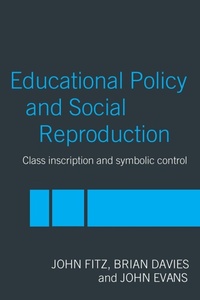
Education Policy and Social Reproduction
Class Inscription & Symbolic Control
1st Edition
Published on 3. October 2005
Book
Paperback/Softback
168 pages
978-0-415-24005-5 (ISBN)
Description
This book takes a theoretically informed look at British education policy over the last sixty years when secondary schooling for all children became an established fact for the first time. Comprehensive schools largely replaced a system based on academic selection. Now, under choice and competition policies, all schools are subject to the rigours of local education markets. What impact did each of these successive policy frameworks have on structures of opportunities for families and their children? How and to what extent was the experience of secondary school students shaped and what influenced the qualifications they obtained and their life chances after schooling?
The authors locate their work within two broad strands in the sociology of education. Basil Bernstein's work on the realisation of power and control in and through pedagogic discourse and social reproduction provides a theoretical framework for exploring the character of and continuities and change in education and training policies.
The book is an important contribution to debates about the extent to which education is a force for change in class divided societies. The authors also set out to re-establish social class at the centre of educational analysis at a time when emphasis has been on identity and identity formation, arguing for their interdependence. This book will be an important resource for students, policy analysts and policymakers wishing to think through and understand the longer term impact of programmes that have shaped secondary schooling in Britain and elsewhere.
The authors locate their work within two broad strands in the sociology of education. Basil Bernstein's work on the realisation of power and control in and through pedagogic discourse and social reproduction provides a theoretical framework for exploring the character of and continuities and change in education and training policies.
The book is an important contribution to debates about the extent to which education is a force for change in class divided societies. The authors also set out to re-establish social class at the centre of educational analysis at a time when emphasis has been on identity and identity formation, arguing for their interdependence. This book will be an important resource for students, policy analysts and policymakers wishing to think through and understand the longer term impact of programmes that have shaped secondary schooling in Britain and elsewhere.
Reviews / Votes
"The book would be useful to students on Education Studies - a growth in many of our universities.' - Dr Meg Maguire, Kings College, LondonMore details
Language
English
Place of publication
London
United Kingdom
Publishing group
Taylor & Francis Ltd
Target group
College/higher education
Postgraduate
Illustrations
5 s/w Zeichnungen, 9 s/w Tabellen
9 Tables, black and white; 5 Line drawings, black and white
Dimensions
Height: 234 mm
Width: 156 mm
Thickness: 9 mm
Weight
263 gr
ISBN-13
978-0-415-24005-5 (9780415240055)
Copyright in bibliographic data and cover images is held by Nielsen Book Services Limited or by the publishers or by their respective licensors: all rights reserved.
Schweitzer Classification
Other editions
Additional editions
John Fitz | Brian Davies | John Evans
Education Policy and Social Reproduction
Class Inscription & Symbolic Control
E-Book
11/2005
Routledge
€59.49
Available for download
John Fitz | Brian Davies | John Evans
Education Policy and Social Reproduction
Class Inscription & Symbolic Control
E-Book
11/2005
Routledge
€59.49
Available for download
John Fitz | Brian Davies | John Evans
Education Policy and Social Reproduction
Class Inscription & Symbolic Control
Book
10/2005
1st Edition
Routledge
€231.20
Shipment within 15-20 days
Persons
John Fitz, Brian Davies, John Evans
Content
1. Understanding policy, understanding pedagogic discourse Introduction Bernstein's sociology, a language for policy On our omissions 2. Framing Equality? The Education Act 1944 Introduction Policy frameworks The 1944 legislation A governing partnership? Tripartism: a very British settlement? Conclusions 3. Selection, class and opportunity Introduction Selection and social class Selection and social class and school composition Greater equality of opportunity? Whatever Happened To The Likely Lads? Conclusions 4. Comprehensive schooling: Challenging inequality ? Introduction Going comprehensive from the ground up What was driving the change? 10/65 and after: Comprehensive Schooling and its challenges Neighbourhoods and differentiation between schools Conclusions 5. Educational Systems and Social Mobility Social mobility and education Social mobility, selection and comprehensivisation Social Mobility, Meritocracy and Education Conclusion 6. Bernstein, social reproduction and intergenerational transmission Introduction Pedagogic discourse; family, school and work Pedagogic discourse, policy and reproduction Pedagogic discourse: its key features Sifting and Sorting Privileging practices Resources Conclusions 7. Something happened: the policy framework post 1988 Introduction Centralisation: reasserting central authority, putting on the pressure Choice and diversity: power to parents? Conclusion 8. Diversity: selection and stratification? Introduction From diversity to plurality 'New' Labour and school diversity The Early Years Specialist Schools Academies Beacon Schools and Leading Edge Partnerships Federations and Diversity Pathfinders Faith-based schools The modernisation of comprehensive schools School diversity and social equity Conclusions 9. Further reading Bibliography