

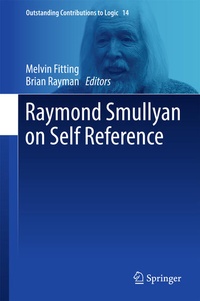
Raymond Smullyan on Self Reference
Published on 22. January 2018
Book
Hardback
VIII, 195 pages
978-3-319-68731-5 (ISBN)
Description
Celebrates Raymond Smullyan, a mathematician, philosopher, musician, and inventor of logic puzzles, who has made a lasting impact on the study of mathematical logic Is the first book honoring Raymond Smullyan's contributions to self-reference, with new approaches by his peers Collects tributes to Professor Raymond Smullyan's work on self-reference by leading logicians Presents new approaches to self-reference
More details
Series
Edition
1st ed. 2017
Language
English
Place of publication
Cham
Switzerland
Publishing group
Springer International Publishing
Target group
Professional and scholarly
Illustrations
5 s/w Abbildungen, 18 farbige Abbildungen
VIII, 195 p. 23 illus., 18 illus. in color.
Dimensions
Height: 241 mm
Width: 160 mm
Thickness: 17 mm
Weight
477 gr
ISBN-13
978-3-319-68731-5 (9783319687315)
DOI
10.1007/978-3-319-68732-2
Schweitzer Classification
Other editions
Additional editions
Melvin Fitting | Brian Rayman
Raymond Smullyan on Self Reference
Book
06/2019
Springer
€117.69
Shipment within 10-15 days
Melvin Fitting | Brian Rayman
Raymond Smullyan on Self Reference
E-Book
01/2018
Springer
€106.99
Available for download
Persons
Profile Editor 1:
Profile Editor 2:
Brian Rayman works for New York City's Department of Education. He holds Mathematics Education and Public Policy degrees from New York University and Columbia University, respectively. Since his days as an undergraduate, Brian has deeply embraced Professor Smullyan's works in recreational mathematics and Eastern philosophy. As a high school mathematics teacher, heintegrated Raymond's work into his curriculum and invited him to speak to his students. Raymond kindly accepted and after two hours, students were no longer sure where mathematics ended and magic began, and vice versa. Today, he considers his most significant accomplishment as being counted among Raymond's friends and performing magic tricks that nearly made Raymond's eyes pop out. Brian lives in Carroll Gardens, Brooklyn, with his wife and two sons.
Melvin Fitting began his scientific career in 1968 and became Professor Emeritus in 2013, working for the entire time at the City University of New York. His work as a logician has included set theory, automated theorem proving, computer language semantics, and philosophical logic. Some of his books in these areas are well known, while others are not as well known as he would like. Following the example of his thesis advisor, Raymond Smullyan, retirement has not meant the end of a research career.
Profile Editor 2:
Brian Rayman works for New York City's Department of Education. He holds Mathematics Education and Public Policy degrees from New York University and Columbia University, respectively. Since his days as an undergraduate, Brian has deeply embraced Professor Smullyan's works in recreational mathematics and Eastern philosophy. As a high school mathematics teacher, heintegrated Raymond's work into his curriculum and invited him to speak to his students. Raymond kindly accepted and after two hours, students were no longer sure where mathematics ended and magic began, and vice versa. Today, he considers his most significant accomplishment as being counted among Raymond's friends and performing magic tricks that nearly made Raymond's eyes pop out. Brian lives in Carroll Gardens, Brooklyn, with his wife and two sons.
Content
Introduction; Melvin Fitting.- Formal Systems, Logics, and Programs; Robert L. Constable.- Adaptive Fault Diagnosis using Self-Referential Reasoning; Robert Cowen.- Russell's Paradox, Godel's Theorem ; Melvin Fitting.- Dance of the Starlings ; Henk Barendregt ; Jorg Endrullis ; Jan Willem Klop ; Johannes Waldmann.- Some Tweets About Mockingbirds; Rick Statman.- What I Tell You Three Times Is True ; Martin Davis.- Gödel, Lucas, and the Soul-Searching Selfie ; Vann Mc Gee.- An Island Tale for Young Anthropologists; Andrew G. Buchanan & John H. Conway.- Making the `hardest logic puzzle ever' a bit harder ; Walter Carnielli.- Bibliography; Raymond Smullyan.