

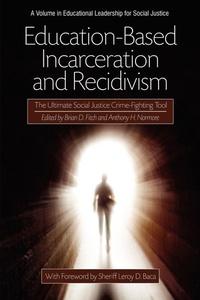
Education-Based Incarceration and Recidivism
The Ultimate Social Justice Crime Fighting Tool
Will be published approx. on 23. December 2011
Book
Paperback/Softback
236 pages
978-1-61735-710-7 (ISBN)
Description
Education-Based Incarceration and Recidivism: The Ultimate Social Justice Crime Fighting Tool takes a penetrating look at the needs and challenges of society's disenfranchised jail populations. It is incumbent to encourage public awareness of the causes that underlie the destructive cycles plaguing these populations, including the abuse and neglect that cycle through generations. When effectively addressed through education the economic burden on society is lightened and an advocacy to increase understanding engenders a humane response. When connecting education-based incarceration to leadership and social justice, several issues come to mind, beginning with the universal understanding that definitions of social justice are based on a variety of factors, like political orientation, religious background, and political and social philosophy. An increased body of researchers in educational leadership, ethics, law, sociology, corrections, law enforcement, criminal justice, and public health agree that social justice is concerned with equal justice, not just in the courts, but in all aspects of society. Social justice demands that people promote a just society where people have equal rights and opportunities; everyone, from the poorest person on the margins of society to the wealthiest deserves an even playing field.
The intended audience for this book includes academics, national and international law enforcement agencies, and correctional institutions interested in establishing and assessing the effectiveness of an education-based incarceration program. This book can be used by educators and students interested in studying organizational leadership, correctional theory, recidivism, social and restorative justice, and education-based incarceration.
The intended audience for this book includes academics, national and international law enforcement agencies, and correctional institutions interested in establishing and assessing the effectiveness of an education-based incarceration program. This book can be used by educators and students interested in studying organizational leadership, correctional theory, recidivism, social and restorative justice, and education-based incarceration.
More details
Series
Language
English
Place of publication
Charlotte
United States
Publishing group
Emerald Publishing Inc
Target group
Professional and scholarly
Dimensions
Height: 234 mm
Width: 156 mm
Thickness: 13 mm
Weight
365 gr
ISBN-13
978-1-61735-710-7 (9781617357107)
Copyright in bibliographic data and cover images is held by Nielsen Book Services Limited or by the publishers or by their respective licensors: all rights reserved.
Schweitzer Classification
Other editions
Additional editions
Brian D. Fitch | Anthony H. Normore
Education-Based Incarceration and Recidivism
The Ultimate Social Justice Crime Fighting Tool
E-Book
02/2012
1st Edition
Information Age Publishing
from
€62.33
Available for download
Content
Series Editor Preface; Jeffrey S. Brooks, Prologue, Brian D. Fitch and Anthony H. Normore.
Foreword; Leroy D. Baca.
Acknowledgments.
Part I. The Culture And Politics Of Corrections: A Social Justice Phemonenon.
Chapter 1. A Review of Evidence: The Case for Evidence-Based Incarceration; Brian D. Fitch and Rakel Delevi.
Chapter 2. History and Politics of Correctional Education; Amy Widestrom, David R. Werner, and Sylvester "Bud" Pues.
Chapter 3. Assessing Educational Need to Individualize Learning in an Incarcerated Setting; Brian Mattson, M. C. Esposito, and Carolyn Eggleston.
Part II. The Human Side Of Education-based Incarceration: Understanding Recidivism.
Chapter 4. Prison Education: The Inmate as Student; David R. Werner, Amy Widestrom, and Sylvester "Bud" Pues.
Chapter 5. Impact of Correctional Staff Attitudes on Inmate Education; Raquel Warley.
Chapter 6. Disruptive Innovation: The Role of Technology in Advancing Educational Achievement Among Inmate Populations; Brian D. Fitch, Brian Mattson, and Jeff Mulhaussen.
Chapter 7. The Reentry Process-Linking Inmates to Community Services: Parallels to the Transition of Youth With Disabilities to a Quality Adult Life; Jessica Nolan Daugherty, Laura S. Abrams, and Gary Greene.
Part III. Promising And Proven Best Practice: Global Perspectives.
Chapter 8. Maximizing Benefits of Correctional Educational Programs: Best Practices; M. C. Esposito, Anthony H. Normore, and Arthur A. Jones.
Chapter 9. International and Comparative Survey of Best Practices in Correctional Education; Arthur A. Jones, Richard Gordon, and Richard Haesly.
Chapter 10. Teaching Strategies and Practices for Correctional Education; Sara A.M. Silva, Kimberly B. Hughes, Selene Kurland, June Kizu, and Sylvester "Bud" Pues.
Part IV. Implications For The Future Of Correctional Education.
Chapter 11. Summary, Conclusions, and Recommendations; Anthony H. Normore, Brian D. Fitch, and Sarah Camp.
About the Authors.
Foreword; Leroy D. Baca.
Acknowledgments.
Part I. The Culture And Politics Of Corrections: A Social Justice Phemonenon.
Chapter 1. A Review of Evidence: The Case for Evidence-Based Incarceration; Brian D. Fitch and Rakel Delevi.
Chapter 2. History and Politics of Correctional Education; Amy Widestrom, David R. Werner, and Sylvester "Bud" Pues.
Chapter 3. Assessing Educational Need to Individualize Learning in an Incarcerated Setting; Brian Mattson, M. C. Esposito, and Carolyn Eggleston.
Part II. The Human Side Of Education-based Incarceration: Understanding Recidivism.
Chapter 4. Prison Education: The Inmate as Student; David R. Werner, Amy Widestrom, and Sylvester "Bud" Pues.
Chapter 5. Impact of Correctional Staff Attitudes on Inmate Education; Raquel Warley.
Chapter 6. Disruptive Innovation: The Role of Technology in Advancing Educational Achievement Among Inmate Populations; Brian D. Fitch, Brian Mattson, and Jeff Mulhaussen.
Chapter 7. The Reentry Process-Linking Inmates to Community Services: Parallels to the Transition of Youth With Disabilities to a Quality Adult Life; Jessica Nolan Daugherty, Laura S. Abrams, and Gary Greene.
Part III. Promising And Proven Best Practice: Global Perspectives.
Chapter 8. Maximizing Benefits of Correctional Educational Programs: Best Practices; M. C. Esposito, Anthony H. Normore, and Arthur A. Jones.
Chapter 9. International and Comparative Survey of Best Practices in Correctional Education; Arthur A. Jones, Richard Gordon, and Richard Haesly.
Chapter 10. Teaching Strategies and Practices for Correctional Education; Sara A.M. Silva, Kimberly B. Hughes, Selene Kurland, June Kizu, and Sylvester "Bud" Pues.
Part IV. Implications For The Future Of Correctional Education.
Chapter 11. Summary, Conclusions, and Recommendations; Anthony H. Normore, Brian D. Fitch, and Sarah Camp.
About the Authors.