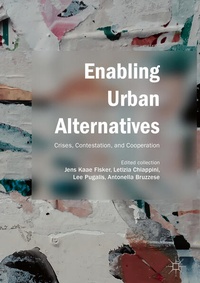
This book asks how thinking, governing, performing, and producing the urban differently can assist in enabling the creation of alternative urban futures. It is a timely response to the ongoing crises and pressing challenges that inhabitants of cities, towns, and villages worldwide are faced with in the midst of what has been widely dubbed as 'an urban age'. Starting from the premise that current urban development patterns are unsustainable in every sense of the word, the book explores how alternative patterns can be pursued by the wide variety of actors - from governments and international institutions to slum-dwellers and social movements - involved in the on-going production of our shared urban condition. The challenges addressed include exclusion and segregation; persisting poverty and increasing inequality; urban sprawl and changing land use patterns; and the spatial frames of urban policy. As such the book appeals to urban scholars, policy makers, activists, and others concerned with shaping the future of our cities and of urban life in general. Additionally, it is of interest to students in urban planning, architecture and design, human geography, urban sociology, and related fields.
Reviews / Votes
"Smart, critical, and refreshingly open minded, the voices collected here offer much needed new perspectives through which to consider urban problems. Neither polemic nor prescription,
Enabling Urban Alternatives
is instead a hopeful instigation." (Prof. Gordon Douglas, Urban & Regional Planning, San Jose State University, USA)
"Now more than ever we must explore alternative urban futures - if we hope to build an urban world that is socially just, environmentally sustainable and capable of maintaining the diversity of urban life.
Enabling Urban Alternatives
is a timely collection of essays, each of which grapples in a critically constructive way with the challenge of generating changes in our cities that are conducive to different urban forms and practices. This book shows the potential of interdisciplinarity in nourishing and enriching our way of thinking about cities; it also builds a unique framework for understanding alternative practices of urban life beyond the usual divide(s) between the Global North/Global South and the like. As such, it is of immediate relevance to anyone - from policy makers and activists to students and scholars - committed to promoting progressive change for people in cities around the world." (Prof. Serena Vicari, Università degli Studi di Milano-Bicocca, Italy)
Edition
Language
Place of publication
Target group
Professional and scholarly
Illustrations
12 s/w Abbildungen
XIV, 292 p. 12 illus.
Dimensions
Height: 216 mm
Width: 153 mm
Thickness: 22 mm
Weight
ISBN-13
978-981-13-1530-5 (9789811315305)
DOI
10.1007/978-981-13-1531-2
Schweitzer Classification
Jens Kaae Fisker is a post-doctoral fellow with the Danish Centre for Rural Research at the University of Southern Denmark, Denmark.
Letizia Chiappini is a PhD candidate in Urban Studies (UrbEur Doctorate) at the University of Milano Bicocca, Italy, and in the Geographies of Globalization research group at the University of Amsterdam (joint doctorate), The Netherlands.
Lee Pugalis is Professor of Urban Studies at the University of Technology Sydney, Australia.
Antonella Bruzzese is Associate Professor at the Politecnico di Milano, Italy, where she teaches and does research and consultancy activities.
INTRODUCTION.- Chapter 1 Introducing Urban Alternatives.- PART 1 THINKING THE URBAN DIFFERENTLY.- Chapter 2 'Children of the Freeway': Overcoming Structure and Restriction in the Pursuit of Alternative Space.- Chapter 3 Reimagined Strategic Terrains of Urban Politics: Enabling Alternative Urban Futures.- Chapter 4 Spatial Dissensus: Spatial Self-Organisation at Wards Corner.- PART 2 GOVERNING THE URBAN DIFFERENTLY.- Chapter 5 Temporary Use: Sliding into Informality or Fostering Democratic Experimentation?.- Chapter 6 Alternative Spaces of Governance: Mobilising New Cultural Politics in Berlin.- Chapter 7 The Game of Participation in Amsterdam East: An Alternative to the Neoliberal or a Neoliberal Alternative?.- PART 3 PERFORMING AND PRODUCING THE URBAN DIFFERENTLY.- Chapter 8 Urban Alternatives Through Cooperation: Autonomous Geographies and Recreational Running in Sofia, Bulgaria.- Chapter 9 Alternative Spatial Styles: An Exploration of Sociospatial Youth Culture in Turin, Italy.- Chapter 10 Space and Temporality of Urban Alternatives: Lessons Learnt From Milanese Cases of Self-Organised Reappropriation of Abandoned Urban Spaces.- Chapter 11 Carving Enclaves of Alternative Urbanisms in Hong Kong.- Chapter 12 The Production of Space by an Esoteric Spiritual Community: The Case of Damanhur, Italy.- CONCLUSION.- Chapter 13 Enabling Alternative Urban Futures.