

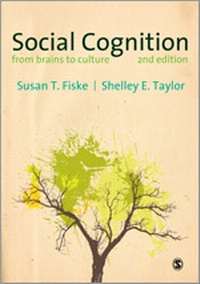
Social Cognition
From Brains to Culture
2nd Edition
Published on 15. January 2013
Book
Hardback
592 pages
978-1-4462-5814-9 (ISBN)
Description
'Since its very first edition, Social Cognition has been the undisputed bible of the field, and this new edition is the best one yet. Insightful, authoritative, and beautifully written by two of the field's most eminent researchers, it is an indispensable guide for students and scientists alike. The book that came first remains first.' -Daniel Gilbert, Harvard University, UK 'This latest edition of the best overview of social cognition research somehow succeeds in lifting the bar higher still for its competitors. It is authoritative yet readable, and has depth as well as breadth -- an irresistible invitation to the field!' - Miles Hewstone, University of Oxford, UK
In Social Cognition: From Brains to Culture 2nd Edition, Fiske and Taylor carefully integrate the many new threads of social cognition research that have emerged in the intervening years since the previous edition, including developments within social neuroscience, cultural psychology and some areas of applied psychology, and continue to tell a powerful and comprehensive story about what social cognition is and why it's a significant phenomenon in society today. Every updated chapter now includes more figures and tables, glossary entries, and further readings. A supplemental test bank including some full-text journal articles corresponding to chapters in the book is available online at: www.sagepub.co.uk/fiskeandtaylor.
This textbook will be indispensable to students of social cognition and social psychology worldwide, at undergraduate or graduate level.
In Social Cognition: From Brains to Culture 2nd Edition, Fiske and Taylor carefully integrate the many new threads of social cognition research that have emerged in the intervening years since the previous edition, including developments within social neuroscience, cultural psychology and some areas of applied psychology, and continue to tell a powerful and comprehensive story about what social cognition is and why it's a significant phenomenon in society today. Every updated chapter now includes more figures and tables, glossary entries, and further readings. A supplemental test bank including some full-text journal articles corresponding to chapters in the book is available online at: www.sagepub.co.uk/fiskeandtaylor.
This textbook will be indispensable to students of social cognition and social psychology worldwide, at undergraduate or graduate level.
Reviews / Votes
'It's hard to be both cutting edge and introductory at the same time, providing a codification of the rich though short history of a field while laying out a future research agenda, but the combination of this latest edition of the landmark Social Cognition text with the newly minted Handbook of Social Cognition (and the forthcoming Major Works) does it all. Scholars and policy makers in law, medicine, education, and politics are becoming avid consumers of social cognition research precisely because it is the best existing guide to human nature, showing how people are more than meat machines or slaves to our past, illuminating the mechanisms by which we transform our external world to form meaningful bases for our acts and decisions in response to it'John Bargh
Yale University
'If you are not afraid to renew your gaze at social cognition, or even social psychology, you must read this book.
It is fascinating to see how this book challenges topics we thought we knew perfectly, and how it introduces new knowledge with a sense of history'
Jacques-Philippe Leyens
Catholic University of Louvain at Louvain-la-Neuve
'This book covers and illustrates the entire lifespan of social cognition research, thereby bridging it to theories in social psychology, to insights from social neuroscience and culture, and to various societal domains in which social cognition can make a real difference. It is a must-read for any scientist interested in the social mind'
Paul van Lange
VU University Amsterdam
'Since its very first edition, Social Cognition has been the undisputed bible of the field, and this new edition is the best one yet. Insightful, authoritative, and beautifully written by two of the field's most eminent researchers, it is an indispensable guide for students and scientists alike. The book that came first remains first'
Daniel Gilbert
Harvard University
'This is the latest edition of a classic volume that helped to establish the subfield of social cognition. Perfectly pitched and lucidly written, the book provides an engaging and highly informative tour of the heartland of social psychology'
Tony Manstead
Cardiff University
'This latest edition of the best overview of social cognition research somehow succeeds in lifting the bar higher still for its competitors. It is authoritative yet readable, and has depth as well as breadth -- an irresistible invitation to the field!'
Miles Hewstone
Professor of Social Psychology University of Oxford, UK
'The must-have source for social cognition is now even better! Integrating insights from social, cognitive and cultural psychology as well as neuroscience, Fiske and Taylor provide a comprehensive framework for understanding how people make sense of themselves and others. The volume offers fresh, accessible and applicable answers to psychology's most pressing questions' -
Hazel Markus
Stanford University, USA 'This fine textbook is appropriate for undergraduate and graduate students interested in learning about social cognition specifically, or social psychology more generally. Students who have already taken a course in the latter will have an opportunity to reflect on ways that social thought and feelings (affect) influence social behaviour. However, those students who have never studied social psychology proper will be at no disadvantage if Social Cognition is their first exposure to it. Besides an index and references section, the text also has a helpful glossary containing definitions for the keywords interspersed throughout its 15 chapters. Instructors will find the work to be an excellent classroom resource - well written, scholarly, often humorous, sometimes wry, and full of excellent examples - as well as a helpful source to the burgeoning research touching on social thought, culture, and brain processes.' -- Dana S. Dunn
More details
Edition
2nd Revised edition
Language
English
Place of publication
London
United Kingdom
Target group
College/higher education
Edition type
Revised edition
Dimensions
Height: 232 mm
Width: 186 mm
Weight
1211 gr
ISBN-13
978-1-4462-5814-9 (9781446258149)
Copyright in bibliographic data and cover images is held by Nielsen Book Services Limited or by the publishers or by their respective licensors: all rights reserved.
Schweitzer Classification
Other editions
New editions
Book
12/2016
3rd Edition
SAGE Publications Ltd
€209.82
Article exhausted; check for reprint
Persons
Susan T. Fiske is Eugene Higgins Professor, Psychology and Public Affairs, Princeton University (Ph.D., Harvard University; honorary doctorates, Universite Catholique de Louvain-la-Neuve, Belgium; Universiteit Leiden, Netherlands; Universitaet Basel, Switzerland; Universidad de Granada, Spain). She attended Harvard/Radcliffe College, majoring in Social Relations, where she met her graduate advisor and lifelong collaborator, Shelley Taylor. After her doctorate in social psychology, she worked at Carnegie-Mellon and the University of Massachusetts, Amherst, before moving to Princeton in 2000.
She investigates social cognition, especially cognitive stereotypes and emotional prejudices, at cultural, interpersonal, and neural levels. Author of about 400 articles and chapters, she is most known for work on social cognition, theories and research on how people think about each other: the continuum model of impression formation, the power-as-control theory, the ambivalent sexism theory, and the stereotype content model (SCM).
Her current SCM work focuses on the two fundamental dimensions of social cognition, perceived warmth (friendly, trustworthy) and perceived competence (capable, assertive). Upstream, perceived social structure predicts these stereotypes (cooperation-competition predicts warmth; status predicts competence). Downstream, specific emotions follow each warmth-x-competence quadrant (pride, disgust, envy, pity) and predict specific behaviors (active and passive help or harm). Using representative sample surveys, lab experiments, and neuro-imaging, Fiske lab has focused on varieties of dehumanization predicted by the SCM: dehumanizing allegedly disgusting homeless people, Schadenfreude toward the enviable rich, as well as paternalistic pity and prescriptive prejudices toward older people, disabled people, and women in traditional roles. Current work uses natural language analyses to explore spontaneous descriptions of others. Adversarial collaborations on research and adversarial alignments on theory are current projects to advance her science.
The U.S. Supreme Court cited her gender-bias testimony, and she testified before President Clinton's Race Initiative Advisory Board. These influenced her edited volume, Beyond Common Sense: Psychological Science in the Courtroom. Currently an editor of the Annual Review of Psychology, PNAS, Policy Insights from Behavioral and Brain Sciences, and Handbook of Social Psychology, she has written the upper-level texts Social Beings: Core Motives in Social Psychology (4/e) and Social Cognition: From Brains to Culture 6/e). She also co-wrote The Human Brand: How We Relate to People, Products, and Companies, which applies her models to how people perceive corporations. Her general-interest book, funded by a Guggenheim and the Russell Sage Foundation, is Envy Up and Scorn Down: How Status Divides Us.
She has been elected to the National Academy of Sciences, the American Academy of Arts and Sciences, and the American Philosophical Society. In 2020, she and Shelley Taylor shared the, Frontiers of Knowledge Award in Social Sciences, BBVA Foundation, Bilbao, Spain, for the 1984 publication of Social Cognition, all editions citation total 19,000. She has served as President of the Association for Psychological Science (APS), President of the Federation of Associations in Behavioral and Brain Sciences, as well as its FABBS Foundation, and President of the Society for Personality and Social Psychology. She has won Distinguished Scientific Contribution Awards from APA, SPSP, and SESP. Because it takes a village, her many graduate students and lab alumni conspired for her to win Princeton's Graduate Mentoring Award. She is grateful to be the only person so far to have won the three APS Awards: James (basic science), Cattell (applied science), and Mentoring.
Shelley E. Taylor, Ph.D. is Distinguished Professor of Psychology at the University of California, Los Angeles. Her research examines the psychological and social origins and moderators of psychological and biological responses to stress and their health consequences. She focuses especially on socioemotional resources, including optimism, mastery, self-esteem, and social support, and the genetic, early environmental, and neural bases of these resources. Professor Taylor also studies how positive illusions can be protective of mental and physical health. Professor Taylor received her Ph.D. from Yale University. She is a member of the National Academy of Sciences, the Institute of Medicine, and the American Academy of Arts and Sciences. Her work is published in a broad array of psychological and biologically-oriented journals.
She investigates social cognition, especially cognitive stereotypes and emotional prejudices, at cultural, interpersonal, and neural levels. Author of about 400 articles and chapters, she is most known for work on social cognition, theories and research on how people think about each other: the continuum model of impression formation, the power-as-control theory, the ambivalent sexism theory, and the stereotype content model (SCM).
Her current SCM work focuses on the two fundamental dimensions of social cognition, perceived warmth (friendly, trustworthy) and perceived competence (capable, assertive). Upstream, perceived social structure predicts these stereotypes (cooperation-competition predicts warmth; status predicts competence). Downstream, specific emotions follow each warmth-x-competence quadrant (pride, disgust, envy, pity) and predict specific behaviors (active and passive help or harm). Using representative sample surveys, lab experiments, and neuro-imaging, Fiske lab has focused on varieties of dehumanization predicted by the SCM: dehumanizing allegedly disgusting homeless people, Schadenfreude toward the enviable rich, as well as paternalistic pity and prescriptive prejudices toward older people, disabled people, and women in traditional roles. Current work uses natural language analyses to explore spontaneous descriptions of others. Adversarial collaborations on research and adversarial alignments on theory are current projects to advance her science.
The U.S. Supreme Court cited her gender-bias testimony, and she testified before President Clinton's Race Initiative Advisory Board. These influenced her edited volume, Beyond Common Sense: Psychological Science in the Courtroom. Currently an editor of the Annual Review of Psychology, PNAS, Policy Insights from Behavioral and Brain Sciences, and Handbook of Social Psychology, she has written the upper-level texts Social Beings: Core Motives in Social Psychology (4/e) and Social Cognition: From Brains to Culture 6/e). She also co-wrote The Human Brand: How We Relate to People, Products, and Companies, which applies her models to how people perceive corporations. Her general-interest book, funded by a Guggenheim and the Russell Sage Foundation, is Envy Up and Scorn Down: How Status Divides Us.
She has been elected to the National Academy of Sciences, the American Academy of Arts and Sciences, and the American Philosophical Society. In 2020, she and Shelley Taylor shared the, Frontiers of Knowledge Award in Social Sciences, BBVA Foundation, Bilbao, Spain, for the 1984 publication of Social Cognition, all editions citation total 19,000. She has served as President of the Association for Psychological Science (APS), President of the Federation of Associations in Behavioral and Brain Sciences, as well as its FABBS Foundation, and President of the Society for Personality and Social Psychology. She has won Distinguished Scientific Contribution Awards from APA, SPSP, and SESP. Because it takes a village, her many graduate students and lab alumni conspired for her to win Princeton's Graduate Mentoring Award. She is grateful to be the only person so far to have won the three APS Awards: James (basic science), Cattell (applied science), and Mentoring.
Shelley E. Taylor, Ph.D. is Distinguished Professor of Psychology at the University of California, Los Angeles. Her research examines the psychological and social origins and moderators of psychological and biological responses to stress and their health consequences. She focuses especially on socioemotional resources, including optimism, mastery, self-esteem, and social support, and the genetic, early environmental, and neural bases of these resources. Professor Taylor also studies how positive illusions can be protective of mental and physical health. Professor Taylor received her Ph.D. from Yale University. She is a member of the National Academy of Sciences, the Institute of Medicine, and the American Academy of Arts and Sciences. Her work is published in a broad array of psychological and biologically-oriented journals.
Content
Introduction
PART ONE: BASIC CONCEPTS IN SOCIAL COGNITION
Dual Modes in Social Cognition
Attention and Encoding
Representation in Memory
PART TWO: TOPICS IN SOCIAL COGNITION: FROM SELF TO SOCIETY
Self in Social Cognition
Attribution Processes
Heuristics and Shortcuts: Efficiency in Inference and Decision-Making
Accuracy and Efficiency in Social Inference
Cognitive Structures of Attitudes
Cognitive Processing of Attitudes
Stereotyping: Cognition and Bias
Prejudice: Interplay of Cognitive and Affective Biases
PART THREE: BEYOND COGNITION
From Social Cognition to Affect
From Affect to Social Cognition
Behaviour and Cognition
PART ONE: BASIC CONCEPTS IN SOCIAL COGNITION
Dual Modes in Social Cognition
Attention and Encoding
Representation in Memory
PART TWO: TOPICS IN SOCIAL COGNITION: FROM SELF TO SOCIETY
Self in Social Cognition
Attribution Processes
Heuristics and Shortcuts: Efficiency in Inference and Decision-Making
Accuracy and Efficiency in Social Inference
Cognitive Structures of Attitudes
Cognitive Processing of Attitudes
Stereotyping: Cognition and Bias
Prejudice: Interplay of Cognitive and Affective Biases
PART THREE: BEYOND COGNITION
From Social Cognition to Affect
From Affect to Social Cognition
Behaviour and Cognition