

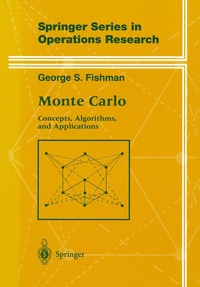
Monte Carlo
Concepts, Algorithms, and Applications
Published on 25. April 1996
Book
Hardback
XXV, 698 pages
978-0-387-94527-9 (ISBN)
Description
This book provides an introduction to the Monte Carlo method suitable for a one-or two-semester course for graduate and advanced undergraduate students in the mathematical and engineering sciences. It also can serve as a reference for the professional analyst. In the past, my inability to provide students with a single source book on this topic for class and for later professional reference had left me repeatedly frustrated, and eventually motivated me to write this book. In addition to focused accounts of major topics, the book has two unifying themes: One concerns the effective use of information and the other concerns error control and reduction. The book describes how to incorporate information about a problem into a sampling plan in a way that reduces the cost of estimating its solution to within a specified error bound. Although exploiting special structures to reduce cost long has been a hallmark of the Monte Carlo method, the propen sity of users of the method to discard useful information because it does not fit traditional textbook models repeatedly has impressed me. The present account aims at reducing the impediments to integrating this information. Errors, both statistical and computational, abound in every Monte Carlo sam pling experiment, and a considerable methodology exists for controlling them.
More details
Series
Edition
1st ed. 1996. Corr. 4th printing 2003
Language
English
Place of publication
New York
United States
Target group
Primary & secondary/elementary & high school
Graduate
Illustrations
20 s/w Abbildungen
XXV, 698 p. 20 illus.
Dimensions
Height: 241 mm
Width: 183 mm
Thickness: 44 mm
Weight
1428 gr
ISBN-13
978-0-387-94527-9 (9780387945279)
DOI
10.1007/978-1-4757-2553-7
Schweitzer Classification
Other editions
Additional editions

Book
05/2011
Springer
€96.29
Shipment within 15-20 days
Content
1 Introduction.- 2 Estimating Volume and Count.- 3 Generating Samples.- 4 Increasing Efficiency.- 5 Random Tours.- 7 Generating Pseudorandom Numbers.- Author Index.