

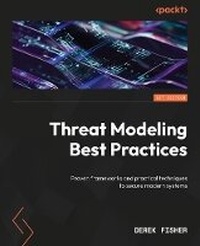
Threat Modeling Best Practices
Proven frameworks and practical techniques to secure modern systems
Published on 31. October 2025
Book
Paperback/Softback
322 pages
978-1-80512-825-0 (ISBN)
Description
Build threat modeling skills with practical advanced techniques to enhance risk analysis, optimize security measures, and stay ahead of emerging threats in the complex cybersecurity landscape
Free with your book: DRM-free PDF version + access to Packt's next-gen Reader*
Key Features
Identify and mitigate security threats across software, cloud, mobile, IoT, and supply chains using STRIDE, PASTA, and MITRE ATT&CK
Learn from real-world case studies showing practical threat modeling applications across industries
Build threat modeling programs with the right team, tools, SDLC integration, and continuous improvement
Book DescriptionThreat modeling has become a cornerstone of modern cybersecurity, yet it is often overlooked, leaving security gaps that attackers can exploit. With the rise in system complexity, cloud adoption, AI-driven threats, and stricter compliance requirements, security teams need a structured approach to proactively spot and stop risks before attackers do. This book delivers exactly that, offering actionable insights for applying industry best practices and emerging technologies to secure systems. It breaks down the fundamentals of threat modeling and walks you through key frameworks and tools such as STRIDE, MITRE ATT&CK, PyTM, and Attack Paths, helping you choose the right model and create a roadmap tailored to your business. You'll learn how to use leading threat modeling tools, identify and prioritize potential threats, and integrate these practices into the software development life cycle to detect risks early. The book also examines how AI can enhance analysis and streamline security decision-making for faster, stronger defenses.
By the end, you'll have everything you need to build systems that anticipate and withstand evolving threats, keeping your organization secure in an ever-changing digital landscape.
*Email sign-up and proof of purchase requiredWhat you will learn
Create foundational threat modeling artifacts like Data Flow Diagrams and security architecture diagrams to visualize system threats
Understand the relationship between vulnerabilities (exploitable weaknesses) and threats (sources of harm)
Analyze real-world case studies to see how threat modeling is applied in industry incidents
Evaluate and compare popular threat modeling tools, both open source and commercial
Explore advanced topics, including threat modeling for cloud environments and integrating with DevSecOps
Who this book is forThis book is for cybersecurity professionals, security consultants, penetration testers, and compliance managers seeking to integrate threat modeling into their assessment methodologies and client engagements. It's also ideal for software architects, DevOps engineers, risk managers, and organizational leaders responsible for identifying, assessing, and mitigating security risks in their technological environments. Whether you're new to threat modeling or looking to enhance your existing expertise, this book helps you with foundational knowledge as well as advanced techniques.
Free with your book: DRM-free PDF version + access to Packt's next-gen Reader*
Key Features
Identify and mitigate security threats across software, cloud, mobile, IoT, and supply chains using STRIDE, PASTA, and MITRE ATT&CK
Learn from real-world case studies showing practical threat modeling applications across industries
Build threat modeling programs with the right team, tools, SDLC integration, and continuous improvement
Book DescriptionThreat modeling has become a cornerstone of modern cybersecurity, yet it is often overlooked, leaving security gaps that attackers can exploit. With the rise in system complexity, cloud adoption, AI-driven threats, and stricter compliance requirements, security teams need a structured approach to proactively spot and stop risks before attackers do. This book delivers exactly that, offering actionable insights for applying industry best practices and emerging technologies to secure systems. It breaks down the fundamentals of threat modeling and walks you through key frameworks and tools such as STRIDE, MITRE ATT&CK, PyTM, and Attack Paths, helping you choose the right model and create a roadmap tailored to your business. You'll learn how to use leading threat modeling tools, identify and prioritize potential threats, and integrate these practices into the software development life cycle to detect risks early. The book also examines how AI can enhance analysis and streamline security decision-making for faster, stronger defenses.
By the end, you'll have everything you need to build systems that anticipate and withstand evolving threats, keeping your organization secure in an ever-changing digital landscape.
*Email sign-up and proof of purchase requiredWhat you will learn
Create foundational threat modeling artifacts like Data Flow Diagrams and security architecture diagrams to visualize system threats
Understand the relationship between vulnerabilities (exploitable weaknesses) and threats (sources of harm)
Analyze real-world case studies to see how threat modeling is applied in industry incidents
Evaluate and compare popular threat modeling tools, both open source and commercial
Explore advanced topics, including threat modeling for cloud environments and integrating with DevSecOps
Who this book is forThis book is for cybersecurity professionals, security consultants, penetration testers, and compliance managers seeking to integrate threat modeling into their assessment methodologies and client engagements. It's also ideal for software architects, DevOps engineers, risk managers, and organizational leaders responsible for identifying, assessing, and mitigating security risks in their technological environments. Whether you're new to threat modeling or looking to enhance your existing expertise, this book helps you with foundational knowledge as well as advanced techniques.
More details
Language
English
Place of publication
Birmingham
United Kingdom
Target group
Professional and scholarly
US School Grade: College Graduate Student
Dimensions
Height: 235 mm
Width: 191 mm
Thickness: 18 mm
Weight
604 gr
ISBN-13
978-1-80512-825-0 (9781805128250)
Copyright in bibliographic data and cover images is held by Nielsen Book Services Limited or by the publishers or by their respective licensors: all rights reserved.
Schweitzer Classification
Other editions
Additional editions
Derek Fisher
Threat Modeling Best Practices
Proven frameworks and practical techniques to secure modern systems
E-Book
10/2025
Packt Publishing
from
€29.99
Available for download
Person
Derek Fisher has nearly 30 years of experience in cybersecurity and engineering, having worked across a wide range of sectors including finance, healthcare, military, and commercial industries. His extensive background encompasses roles in hardware, software, and cybersecurity engineering, positioning him as a leader in securing complex systems and infrastructures. Derek is the author of several notable books, such as The Application Security Program Handbook and the Alicia Connected series-a unique initiative aimed at educating children about cybersecurity through engaging stories. His contributions extend to his Substack and YouTube channel, where he shares expert insights and fosters community engagement in the ever-evolving field of cybersecurity. Beyond his written work, Derek serves as an advisor to Temple University's Cyber Defense and Information Assurance (Cyber DIA) program and teaches software security as an adjunct professor. His courses, offered to both graduate and undergraduate students, reflect his commitment to developing the next generation of cybersecurity professionals. As a sought-after speaker and panelist, Derek regularly discusses topics like product security, vulnerability management, threat modeling, DevSecOps, and cybersecurity career growth. Passionate about empowering future cybersecurity leaders, Derek actively engages in initiatives that promote grassroots education and mentorship. He collaborates with peers and industry stakeholders to create opportunities for aspiring professionals, ensuring that the cybersecurity community continues to thrive and innovate.
Content
Table of Contents
Threat Modeling Methodologies
Understanding and Evaluating Threats during Threat Modeling
Prioritizing Risks Found in Threat Modeling
Threat Modeling of Software
Threat Modeling Cloud and Infrastructure
Threat Modeling the Supply Chain
Mobile and IoT Threat Modeling
AI and the Threat Modeling of LLMs
Building a Threat Modeling Practice
Future Directions in Threat Modeling
Threat Modeling Methodologies
Understanding and Evaluating Threats during Threat Modeling
Prioritizing Risks Found in Threat Modeling
Threat Modeling of Software
Threat Modeling Cloud and Infrastructure
Threat Modeling the Supply Chain
Mobile and IoT Threat Modeling
AI and the Threat Modeling of LLMs
Building a Threat Modeling Practice
Future Directions in Threat Modeling