

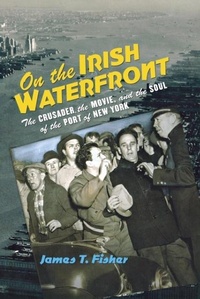
On the Irish Waterfront
The Crusader, the Movie, and the Soul of the Port of New York
Published on 15. September 2010
Book
Paperback/Softback
392 pages
978-0-8014-7684-6 (ISBN)
Description
Site of the world's busiest and most lucrative harbor throughout the first half of the twentieth century, the Port of New York was also the historic preserve of Irish American gangsters, politicians, longshoremen's union leaders, and powerful Roman Catholic pastors. This is the demimonde depicted to stunning effect in Elia Kazan's On the Waterfront (1954) and into which James T. Fisher takes readers in this remarkable and engaging historical account of the classic film's backstory.
Fisher introduces readers to the real "Father Pete Barry" featured in On the Waterfront, John M. "Pete" Corridan, a crusading priest committed to winning union democracy and social justice for the port's dockworkers and their families. A Jesuit labor school instructor, not a parish priest, Corridan was on but not of Manhattan's West Side Irish waterfront. His ferocious advocacy was resisted by the very men he sought to rescue from the violence and criminality that rendered the port "a jungle, an outlaw frontier," in the words of investigative reporter Malcolm Johnson. Driven off the waterfront, Corridan forged creative and spiritual alliances with men like Johnson and Budd Schulberg, the screenwriter who worked with Corridan for five years to turn Johnson's Pulitzer Prize-winning 1948 newspaper expose into a movie. Fisher's detailed account of the waterfront priest's central role in the film's creation challenges standard views of the film as a post facto justification for Kazan and Schulberg's testimony as ex-communists before the House Committee on Un-American Activities.
On the Irish Waterfront is also a detailed social history of the New York/New Jersey waterfront, from the rise of Irish American entrepreneurs and political bosses during the World War I era to the mid-1950s, when the emergence of a revolutionary new mode of cargo-shipping signaled a radical reorganization of the port. This book explores the conflicts experienced and accommodations made by an insular Irish-Catholic community forced to adapt its economic, political, and religious lives to powerful forces of change both local and global in scope.
Fisher introduces readers to the real "Father Pete Barry" featured in On the Waterfront, John M. "Pete" Corridan, a crusading priest committed to winning union democracy and social justice for the port's dockworkers and their families. A Jesuit labor school instructor, not a parish priest, Corridan was on but not of Manhattan's West Side Irish waterfront. His ferocious advocacy was resisted by the very men he sought to rescue from the violence and criminality that rendered the port "a jungle, an outlaw frontier," in the words of investigative reporter Malcolm Johnson. Driven off the waterfront, Corridan forged creative and spiritual alliances with men like Johnson and Budd Schulberg, the screenwriter who worked with Corridan for five years to turn Johnson's Pulitzer Prize-winning 1948 newspaper expose into a movie. Fisher's detailed account of the waterfront priest's central role in the film's creation challenges standard views of the film as a post facto justification for Kazan and Schulberg's testimony as ex-communists before the House Committee on Un-American Activities.
On the Irish Waterfront is also a detailed social history of the New York/New Jersey waterfront, from the rise of Irish American entrepreneurs and political bosses during the World War I era to the mid-1950s, when the emergence of a revolutionary new mode of cargo-shipping signaled a radical reorganization of the port. This book explores the conflicts experienced and accommodations made by an insular Irish-Catholic community forced to adapt its economic, political, and religious lives to powerful forces of change both local and global in scope.
Reviews / Votes
"Amply fills in the gaps among organized crimepublic officials and the street priests and Catholic hierarchy... also provides new insights into the long-debated claim that the film was intended by its screenwriterBudd Schulbergand its directorElia Kazanas a justification for their naming names of former Communist associates in their testimony before the House Un-American Activities Committee. He also clarifies the context of the famous utterance of Mayor Frank Hague of Jersey City: 'I am the law.' It turns out Mayor Hague was not flaunting his legendary power (he did not have to). He was intervening to get jobs for two truants rather than complying with legalities by sending them back to school.-Sam Roberts(New York Times) Fisher captures with great clarity and encyclopedic detail the multilayered and fascinating history of the New York-New Jersey waterfront depicted in Elia Kazan's Oscar-winning 1954 film, On the Waterfront. Fisher's impeccable research delves into the real-life stories behind the characters, particularly Pete Corridan, the crusading Catholic priest who tried to reform the longshoremen's union and the recently deceased Budd Schulberg, who adapted Malcolm Johnson's 1949 Pulitzer Prize-winning 'Crime on the Waterfront' newspaper series for the screen. Fisher considers every angle of the story astutely and meticulously, setting it well in its mid-20th-century American context. This engaging narrative is essential reading for both labor historians and cinema buffs, plus anyone studying the waterfront, working-class and immigrant history, anticommunism, blacklisting, and the House Un-American Activities Committee.
(Library Journal) Fisher has spent more than a decade studying the culture, history and soul of the docks and piers that once lined the West Side of Manhattan and the riverfront of Jersey City and Hoboken. He also has researched the making of the film and the controversies it touched off long before it appeared in theaters in 1954. As a result, Fisher probably knows more about the waterfront than any living person who has not-as I assume he hasn't, although one never knows-stood in line at a shape-up. Fisher has poured all that knowledge into a glorious book that ought to change how movie critics view Schulberg's cinematic creation and how cultural historians interpret working-class culture in New York and New Jersey during the middle years of the 20th century.
- Terry Golway (America) It may be hard for some to imagine an era when the waterfronts clustered around New York City constituted America's dominant commercial port. Yet as late as the 1950s the region's 900 piers-spread over Manhattan's West Side, South Brooklyn, and Hoboken and Jersey City, N.J.-handled more cargo than any port in the world. This is the setting for James T. Fisher's On the Irish Waterfront, a fascinating work of history that explores the rise of New York's commercial port from the early 1900s to the 1950s and the corruption that eventually infiltrated all levels of the cargo business, until a crusading priest helped to put a stop to it-and inspired a classic film along the way.
- Edward T. O'Donnell (Wall Street Journal)
More details
Series
Language
English
Place of publication
Ithaca
United States
Product notice
Paperback (trade)
Illustrations
12 halftones, 1 map - 1 Index
Dimensions
Height: 236 mm
Width: 160 mm
Thickness: 24 mm
Weight
562 gr
ISBN-13
978-0-8014-7684-6 (9780801476846)
Copyright in bibliographic data and cover images is held by Nielsen Book Services Limited or by the publishers or by their respective licensors: all rights reserved.
Schweitzer Classification
Other editions
Additional editions

James T. Fisher
On the Irish Waterfront
The Crusader, the Movie, and the Soul of the Port of New York
E-Book
01/2011
Cornell University Press
€8.49
Available for download
Person
James T. Fisher is Professor of Theology and American Studies, Fordham University. He is author of Communion of Immigrants: A History of Catholics in America, Dr. America: The Lives of Thomas A. Dooley, 1927-1961, and The Catholic Counterculture in America, 1933-1962. Visit James T. Fisher's blog at: irishwaterfront.wordpress.com.
Content
Prologue: Pete Barry's Punch
Introduction: The Port's Irish PlacesPart I. Boys of the Irish Waterfront
1. Chelsea's King Joe
2. The Boss
3. Becoming Mr. Big
4. The Longshoreman's GrandsonPart II. The Soul of the Port
5. A Labor Priest in the Catholic Metropolis
6. The Crusader
7. Covering the Waterfront
8. The Hollywood Prince
9. Meeting across the River
10. Priest and Worker
11. An Intimacy with ViolencePart III. Waterfront Apotheosis
12. A Season for Testimony
13. "The Hook"
14. Good Citizens
15. Saving the Picture
16. The Mile Square City's Moment
17. The Priest in the Movie
18. "The Corruption Goes Deep"
19. The Poetry of SuccessEpilogue: Souls of the (Port) Apostolate
Acknowledgments
Notes
Index
Introduction: The Port's Irish PlacesPart I. Boys of the Irish Waterfront
1. Chelsea's King Joe
2. The Boss
3. Becoming Mr. Big
4. The Longshoreman's GrandsonPart II. The Soul of the Port
5. A Labor Priest in the Catholic Metropolis
6. The Crusader
7. Covering the Waterfront
8. The Hollywood Prince
9. Meeting across the River
10. Priest and Worker
11. An Intimacy with ViolencePart III. Waterfront Apotheosis
12. A Season for Testimony
13. "The Hook"
14. Good Citizens
15. Saving the Picture
16. The Mile Square City's Moment
17. The Priest in the Movie
18. "The Corruption Goes Deep"
19. The Poetry of SuccessEpilogue: Souls of the (Port) Apostolate
Acknowledgments
Notes
Index