

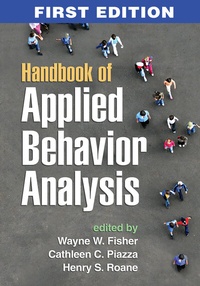
Handbook of Applied Behavior Analysis
1st Edition
Published on 11. December 2013
Book
Paperback/Softback
544 pages
978-1-4625-1338-3 (ISBN)
Description
Describing the state of the science of applied behavior analysis (ABA), this comprehensive handbook provides detailed information about theory, research, and intervention. The contributors are leading ABA authorities who present current best practices in behavioral assessment and demonstrate evidence-based strategies for supporting positive behaviors and reducing problem behaviors. Conceptual, empirical, and procedural building blocks of ABA are reviewed and specific applications described in education, autism treatment, safety skills for children, and other areas. The volume also addresses crucial professional and ethical issues, making it a complete reference and training tool for ABA practitioners and students.
Reviews / Votes
"Fisher, Piazza, and Roane have assembled leading behavior analysts to provide a strong foundation in applied behavior analysis (ABA). Readers will gain both an understanding of the science and an appreciation for how ABA can benefit education, school psychology, autism treatment, behavioral medicine, and other disciplines. A major strength of the book is the high caliber of the contributing authors. This handbook will be a useful text for graduate courses, particularly those in the growing number of university programs focused on training individuals in advanced ABA."--Robert H. Horner, PhD, Alumni-Knight Endowed Professor of Special Education, University of Oregon"This is an authoritative volume for practitioners, graduate students, and academicians. Authors include many top contributors to the field, who address basic principles; assessment and intervention; and specific applications in such areas as autism, education, addiction, and gerontology. The Handbook is well organized and chock full of valuable information. A great go-to resource."--Travis Thompson, PhD, Special Education Program, University of Minnesota
"The Handbook brings together the collective expertise of leading scientists and practitioners who cover the full range of topics relevant to applied behavior analysis. The breadth and depth of topics covered make this volume unique; I have no doubt that it will become a 'must-have' book for students, practitioners, and researchers alike."--Louis Hagopian, PhD, Program Director, Neurobehavioral Unit, Kennedy Krieger Institute; Department of Psychiatry and Behavioral Sciences, Johns Hopkins University School of Medicine
-
More details
Language
English
Place of publication
New York
United States
Publishing group
Guilford Publications
Target group
College/higher education
Professional and scholarly
Behavior analysts and trainees working with children and adults, including special educators, school and clinical psychologists, autism specialists, and behavioral medicine professionals. Will serve as a primary text for graduate-level courses and certification programs in ABA or as a supplemental text for courses on treating problem behavior.
Dimensions
Height: 254 mm
Width: 178 mm
Weight
950 gr
ISBN-13
978-1-4625-1338-3 (9781462513383)
Copyright in bibliographic data and cover images is held by Nielsen Book Services Limited or by the publishers or by their respective licensors: all rights reserved.
Schweitzer Classification
Other editions
New editions
Wayne W. Fisher | Cathleen C. Piazza | Henry S. Roane
Handbook of Applied Behavior Analysis, Second Edition
Book
08/2021
2nd Edition
Guilford Press
€89.50
Shipment within 15-20 days
Additional editions
Wayne W. Fisher | Cathleen C. Piazza | Henry S. Roane
Handbook of Applied Behavior Analysis
Book
08/2011
1st Edition
Guilford Publications
€141.12
Article exhausted; check for reprint
Persons
Wayne W. Fisher, PhD, BCBA-D, is the H. B. Munroe Professor of Behavioral Research in the Munroe-Meyer Institute and the Department of Pediatrics at the University of Nebraska Medical Center, and Director of the Center for Autism Spectrum Disorders at the Munroe-Meyer Institute. Dr. Fisher's research interests include preference, choice, and the assessment and treatment of autism and severe behavior disorders. He is a recipient of the Bush Leadership Fellowship Award and the American Psychological Association (Division 25) award for distinguished contributions to applied behavioral research.
Cathleen C. Piazza, PhD, is a Professor at the Munroe-Meyer Institute and the Department of Pediatrics at the University of Nebraska Medical Center, where she is also Director of the Pediatric Feeding Disorders Program. Dr. Piazza's research examines various aspects of feeding behavior in children with disabilities, with a focus on behavioral approaches to assessment and treatment.
Henry S. Roane, PhD, BCBA-D, is Associate Professor in the Departments of Pediatrics and Psychiatry at SUNY Upstate Medical University and Director of the University's Family Behavior Analysis Clinic. He is currently an Associate Editor for Behavior Analysis in Practice and serves on the boards of directors of the Behavior Analysis Certification Board and the Society for the Experimental Analysis of Behavior. Dr. Roane's research and clinical interests focus on the assessment and treatment of severe behavior disorders, preference identification, and program development.
Cathleen C. Piazza, PhD, is a Professor at the Munroe-Meyer Institute and the Department of Pediatrics at the University of Nebraska Medical Center, where she is also Director of the Pediatric Feeding Disorders Program. Dr. Piazza's research examines various aspects of feeding behavior in children with disabilities, with a focus on behavioral approaches to assessment and treatment.
Henry S. Roane, PhD, BCBA-D, is Associate Professor in the Departments of Pediatrics and Psychiatry at SUNY Upstate Medical University and Director of the University's Family Behavior Analysis Clinic. He is currently an Associate Editor for Behavior Analysis in Practice and serves on the boards of directors of the Behavior Analysis Certification Board and the Society for the Experimental Analysis of Behavior. Dr. Roane's research and clinical interests focus on the assessment and treatment of severe behavior disorders, preference identification, and program development.
Content
I. Introduction
1. Applied Behavior Analysis: History, Philosophy, Principles, and Basic Methods, Wayne W. Fisher, Rebecca A. Groff, and Henry S. RoaneII. Basic Principles and Concepts
2. Respondent (Pavlovian) Conditioning, John W. Donahoe and Rocio Vegas
3. Basic Operant Contingencies: Main Effects and Side Effects, A. Charles Catania
4. Schedules of Reinforcement, F. Charles Mace, Jamie L. Pratt, Amanda N. Zangrillo, and Mark W. Steege
5. Stimulus Control and Generalization, Joseph E. Spradlin and Jennifer L. Simon
6. Designing Instructional Programming for Early Reading Skills, Kathryn J. Saunders III. Measurement, Design, and Methodological Issues
7. Defining and Measuring Behavior, SungWoo Kahng, Einar T. Ingvarsson, Anna M. Quigg, Kimberly E. Seckinger, and Heather M. Teichman
8. Single-Case Experimental Designs, Henry S. Roane, Joel E. Ringdahl, Michael E. Kelley, and Ashley C. GloverIV. Behavioral Assessment
9. Identifying and Enhancing the Effectiveness of Positive Reinforcement, Cathleen C. Piazza, Henry S. Roane, and Amanda Karsten
10. Functional and Structural Approaches to Behavioral Assessment of Problem Behavior, David P. Wacker, Wendy K. Berg, Jay W. Harding, and Linda J. Cooper-Brown
11. Indirect Behavioral Assessments: Interviews and Rating Scales, Michael E. Kelley, Robert H. LaRue, Henry S. Roane, and Dana M. Gadaire
12. Direct Observation, Rachel H. Thompson and John C. Borrero
13. Functional Analysis: History and Methods, Alison M. Betz and Wayne W. FisherV. Interventions for Increasing Desirable Behavior
14. Differential Reinforcement Procedures, Gregory P. Hanley and Jeffrey H. Tiger
15. Building Complex Repertoires from Discrete Behaviors by Establishing Stimulus Control, Behavioral Chains, and Strategic Behavior, George H. Noell, Nathan A. Call, and Scott P. Ardoin
16. Teaching Verbal Behavior, Matt Tincani, Andy Bondy, and Shannon Crozier
17. Staff Training and Management, Dennis H. Reid, Niamh P. O'Kane, and Kenneth M. MacurikVI. Interventions for Decreasing Problem Behavior
18. Developing Antecedent Interventions for Problem Behavior, Richard G. Smith
19. Developing Function-Based Extinction Procedures for Problem Behavior, Timothy R. Vollmer and Elizabeth Athens
20. Developing Function-Based Reinforcement Procedures for Problem Behavior, Wayne W. Fisher and Kelly Bouxsein
21. Developing Function-Based Punishment Procedures for Problem Behavior, Dorothea C. Lerman and Lisa M. Toole
22. Token Economies, Kyle W. Boerke and David Reitman VII. Subspecialties
23. Behavioral Approaches to Education, Brian K. Martens, Edward J. Daly III, John C. Begeny, and Amanda VanDerHeyden
24. Behavioral Treatment of Autism, Tiffany Kodak and Laura L. Grow
25. Teaching Safety Skills to Children, Raymond G. Miltenberger and Amy C. Gross
26. Behavioral Pediatrics: Integrating Applied Behavior Analysis with Pediatric Medicine, Patrick C. Friman and Cathleen C. Piazza
27. Behavior Analysis and Treatment of Drug Addiction, Kenneth Silverman, Barbara J. Kaminski, Stephen T. Higgins, and Joseph V. Brady
28. Behavioral Gerontology, Linda A. LeBlanc, Paige B. Raetz, and Leilani FelicianoVIII. Professional Issues
29. Behavior Analysis and Ethics,William O'Donohue and Kyle E. Ferguson
30. Training and Professional Certification in Applied Behavior Analysis, Gerald L. Shook and James M. Johnston
1. Applied Behavior Analysis: History, Philosophy, Principles, and Basic Methods, Wayne W. Fisher, Rebecca A. Groff, and Henry S. RoaneII. Basic Principles and Concepts
2. Respondent (Pavlovian) Conditioning, John W. Donahoe and Rocio Vegas
3. Basic Operant Contingencies: Main Effects and Side Effects, A. Charles Catania
4. Schedules of Reinforcement, F. Charles Mace, Jamie L. Pratt, Amanda N. Zangrillo, and Mark W. Steege
5. Stimulus Control and Generalization, Joseph E. Spradlin and Jennifer L. Simon
6. Designing Instructional Programming for Early Reading Skills, Kathryn J. Saunders III. Measurement, Design, and Methodological Issues
7. Defining and Measuring Behavior, SungWoo Kahng, Einar T. Ingvarsson, Anna M. Quigg, Kimberly E. Seckinger, and Heather M. Teichman
8. Single-Case Experimental Designs, Henry S. Roane, Joel E. Ringdahl, Michael E. Kelley, and Ashley C. GloverIV. Behavioral Assessment
9. Identifying and Enhancing the Effectiveness of Positive Reinforcement, Cathleen C. Piazza, Henry S. Roane, and Amanda Karsten
10. Functional and Structural Approaches to Behavioral Assessment of Problem Behavior, David P. Wacker, Wendy K. Berg, Jay W. Harding, and Linda J. Cooper-Brown
11. Indirect Behavioral Assessments: Interviews and Rating Scales, Michael E. Kelley, Robert H. LaRue, Henry S. Roane, and Dana M. Gadaire
12. Direct Observation, Rachel H. Thompson and John C. Borrero
13. Functional Analysis: History and Methods, Alison M. Betz and Wayne W. FisherV. Interventions for Increasing Desirable Behavior
14. Differential Reinforcement Procedures, Gregory P. Hanley and Jeffrey H. Tiger
15. Building Complex Repertoires from Discrete Behaviors by Establishing Stimulus Control, Behavioral Chains, and Strategic Behavior, George H. Noell, Nathan A. Call, and Scott P. Ardoin
16. Teaching Verbal Behavior, Matt Tincani, Andy Bondy, and Shannon Crozier
17. Staff Training and Management, Dennis H. Reid, Niamh P. O'Kane, and Kenneth M. MacurikVI. Interventions for Decreasing Problem Behavior
18. Developing Antecedent Interventions for Problem Behavior, Richard G. Smith
19. Developing Function-Based Extinction Procedures for Problem Behavior, Timothy R. Vollmer and Elizabeth Athens
20. Developing Function-Based Reinforcement Procedures for Problem Behavior, Wayne W. Fisher and Kelly Bouxsein
21. Developing Function-Based Punishment Procedures for Problem Behavior, Dorothea C. Lerman and Lisa M. Toole
22. Token Economies, Kyle W. Boerke and David Reitman VII. Subspecialties
23. Behavioral Approaches to Education, Brian K. Martens, Edward J. Daly III, John C. Begeny, and Amanda VanDerHeyden
24. Behavioral Treatment of Autism, Tiffany Kodak and Laura L. Grow
25. Teaching Safety Skills to Children, Raymond G. Miltenberger and Amy C. Gross
26. Behavioral Pediatrics: Integrating Applied Behavior Analysis with Pediatric Medicine, Patrick C. Friman and Cathleen C. Piazza
27. Behavior Analysis and Treatment of Drug Addiction, Kenneth Silverman, Barbara J. Kaminski, Stephen T. Higgins, and Joseph V. Brady
28. Behavioral Gerontology, Linda A. LeBlanc, Paige B. Raetz, and Leilani FelicianoVIII. Professional Issues
29. Behavior Analysis and Ethics,William O'Donohue and Kyle E. Ferguson
30. Training and Professional Certification in Applied Behavior Analysis, Gerald L. Shook and James M. Johnston