

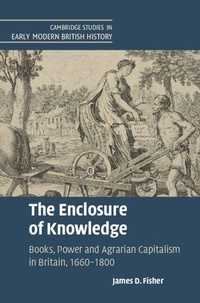
The Enclosure of Knowledge
Books, Power and Agrarian Capitalism in Britain, 1660-1800
Published on 21. July 2022
Book
Hardback
346 pages
978-1-316-51798-7 (ISBN)
Description
The rise of agrarian capitalism in Britain is usually told as a story about markets, land and wages. The Enclosure of Knowledge reveals that it was also about books, knowledge and expertise. It argues that during the early modern period, farming books were a key tool in the appropriation of the traditional art of husbandry possessed by farm workers of all kinds. It challenges the dominant narrative of an agricultural 'enlightenment', in which books merely spread useful knowledge, by showing how codified knowledge was used to assert greater managerial control over land and labour. The proliferation of printed books helped divide mental and manual labour to facilitate emerging social divisions between labourers, managers and landowners. The cumulative effect was the slow enclosure of customary knowledge. By synthesising diverse theoretical insights, this study opens up a new social history of agricultural knowledge and reinvigorates long-term histories of knowledge under capitalism.
Reviews / Votes
'... it is no doubt true that this history of the enclosure of knowledge about farming 'has profound significance for our understanding of how modern capitalism developed' (275). Fisher has provided us with an important reminder of this significance and a useful discussion of a remarkably extensive set of books on agriculture and has packaged it all in interesting and articulate prose.' Jim Handy, Agricultural History 'The copious publication of agricultural literature in Britain during the late seventeenth and eighteenth centuries has received very little sustained attention since the studies of George Fussell several decades ago, a body of work now not much consulted ... Hence James D. Fisher's work on this theme ... is very welcome, and he has done a very thorough survey of the available works (made possible now through electronic depositories).' Paul Warde, Journal of Modern History '... a splendid book rethinking the intellectual and cultural history of books and pamphlets about agriculture and the countryside in the long eighteenth century. It is written with great clarity and considerable verve, sweeping the reader through a fascinating story about the transformation of agricultural knowledge over time.' John Broad, Cultural and Social HistoryMore details
Series
Language
English
Place of publication
Cambridge
United Kingdom
Illustrations
Worked examples or Exercises
Dimensions
Height: 235 mm
Width: 157 mm
Thickness: 23 mm
Weight
652 gr
ISBN-13
978-1-316-51798-7 (9781316517987)
Copyright in bibliographic data and cover images is held by Nielsen Book Services Limited or by the publishers or by their respective licensors: all rights reserved.
Schweitzer Classification
Other editions
Additional editions
James D. Fisher
The Enclosure of Knowledge
Books, Power and Agrarian Capitalism in Britain, 1660-1800
Book
05/2024
Cambridge University Press
€37.80
Shipment within 15-20 days
James D. Fisher
The Enclosure of Knowledge
Books, Power and Agrarian Capitalism in Britain, 1660-1800
E-Book
07/2022
Cambridge University Press
€78.99
Available for download
E-Book
07/2022
Cambridge University Press
€78.99
Available for download
Person
James D. Fisher is a historian of early modern Britain. He is a postdoctoral research fellow at the University of Exeter (2020-23), and has previously taught history at King's College London, Royal Holloway, and the University of East London. James is trained in disciplines across the humanities and sciences, including political philosophy and physics.
Content
Introduction: Pen over Plough; 1. Rethinking Agricultural Books, Knowledge and Labour; 2. Learning without Books: The Mystery of Husbandry; 3. Standing on the Shoulders of Peasants: The Appropriation of the Art of Husbandry; 4. Learning without Labour: Codification and Managerial Knowledge; 5. Dividing Head & Hand: Gentleman Farmers, Agriculturists and Expertise; 6. Monopolising Knowledge: Professionalisation, Education and Stewards; 7. The Master Should Know More: Book-Farming, Power and Resistance; Conclusion: New Histories of Knowledge.