

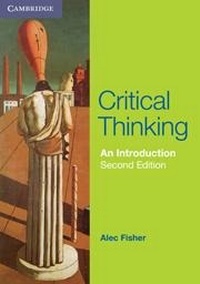
Critical Thinking
An Introduction
2nd Edition
Published on 22. September 2011
Book
Paperback/Softback
302 pages
978-1-107-40198-3 (ISBN)
Description
This second edition has been extensively revised with updated examples and a brand new chapter on how to obtain reliable information from the internet. Studying critical thinking involves trying to change the ways in which most of us think. In this second edition of the popular 'Critical Thinking: An Introduction', Alec Fisher concentrates on developing critical thinking skills explicitly and directly. His aim is to teach the ability to interpret, analyse and evaluate ideas and arguments and to show how these skills can be transferred to other studies and everyday life. A new chapter covers getting reliable information from the internet and examples and passages have been replaced by completely new material. The book is also suitable for the independent learner.
More details
Series
Edition
2nd Revised edition
Language
English
Place of publication
Cambridge
United Kingdom
Target group
Primary & secondary/elementary & high school
Edition type
Revised edition
Product notice
Paperback (trade)
Illustrations
Worked examples or Exercises
Dimensions
Height: 246 mm
Width: 174 mm
Thickness: 20 mm
Weight
544 gr
ISBN-13
978-1-107-40198-3 (9781107401983)
Copyright in bibliographic data and cover images is held by Nielsen Book Services Limited or by the publishers or by their respective licensors: all rights reserved.
Schweitzer Classification
Other editions
Additional editions
E-Book
07/2013
2nd Edition
Cambridge University Press
€20.49
Available for download
Previous edition
Book
11/2001
Cambridge University Press
€20.43
Article exhausted; check for reprint
Content
1. What is critical thinking and how to improve it; 2. Identifying reasons and conclusions: the language of reasoning; 3. Understanding reasoning: different patterns of reasoning; 4. Understanding reasoning: assumptions, context and a thinking map; 5. Clarifying and interpreting expressions and ideas; 6. The acceptability of reasons: including their credibility; 7. Judging the credibility of sources skilfully; 8. Evaluating inferences: deductive validity and other grounds; 9. evaluating inferences: assumptions and other relevant arguments; 10. Reasoning about causal explanations; 11. Decision-making: options, consequences, values and risks; 12. Critical thinking about the internet (how to get reliable information from the internet); Questions appendix; Answers to questions; Glossary; Bibliography; Index.