

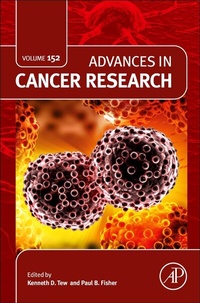
Advances in Cancer Research: Volume 152
Published on 6. August 2021
Book
Hardback
426 pages
978-0-12-824125-7 (ISBN)
Description
Advances in Cancer Research, Volume 152, the latest release in this ongoing, well-regarded serial, provides invaluable information on the exciting and fast-moving field of cancer research.
More details
Series
Language
English
Place of publication
San Diego
United States
Publishing group
Elsevier Science Publishing Co Inc
Target group
Professional and scholarly
Researchers and students in the basic and clinical sciences of cancer biology and oncology, plus related areas in genetics, immunology, pharmacology, cell biology, and molecular biology.
Dimensions
Height: 229 mm
Width: 152 mm
Weight
450 gr
ISBN-13
978-0-12-824125-7 (9780128241257)
Copyright in bibliographic data and cover images is held by Nielsen Book Services Limited or by the publishers or by their respective licensors: all rights reserved.
Schweitzer Classification
Other editions
Additional editions
Persons
Paul B. Fisher, MPh, PhD, FNAI, Professor and Chairman, Department of Human and Molecular Genetics, Director, VCU Institute of Molecular Medicine Thelma Newmeyer Corman Chair in Cancer Research in the VCU Massey Cancer Center, VCU, School of Medicine, Richmond, VA, and Emeritus Professor, Columbia University, College of Physicians & Surgeons, New York, NY. Dr. Fisher is among the top 10% of NIH funded investigators over the past 35-years, published approximately 625 papers and reviews, and has 55 issued patents. He pioneered novel gene/discovery approaches (subtraction hybridization), developed innovative therapeutic approaches (Cancer Terminator Viruses), presented numerous named and distinguished lectures, founded several start-up companies, was Virginia Outstanding Scientist of 2014 and elected to the National Academy of Inventors in 2018. Dr. Fisher is a prominent nationally and internationally recognized cancer research scientist focusing on understanding the molecular and biochemical basis of cancer development and progression to metastasis and using this garnered information to develop innovative approaches for diagnosing and treating cancer. He discovered and patented novel genes and gene promoters relevant to cancer growth control, differentiation and apoptosis. His discoveries include the first cloning of p21 (CDK inhibitor), human polynucleotide phosphorylase, mda-9/syntenin (a pro-metastatic gene), mda-5 and mda-7/IL-24, which has shown promising clinical activity in Phase I/II clinical trials in patients with advanced cancers. Dr. Fisher alsohas a documented track record as a successful seasoned entrepreneur. He was Founder and Director of GenQuest Incorporated, a functional genomics company, which merged with Corixa Corporation in 1998, traded on NASDAQ and was acquired by GlaxoSmithKline in 2006. He discovered the cancer-specific PEG-Prom, which is the core technology of Cancer Targeting Systems (CTS, Inc.), a Virginia/Maryland-based company (at Johns Hopkins Medical Center) focusing on imaging and therapy ("theranostics?) of metastatic cancer (2014) by Drs. Fisher and Martin G. Pomper. He co-founded InVaMet Therapeutics (IVMT) and InterLeukin Combinatorial Therapies (ILCT) with Dr. Webster K. Cavenee (UCSD) (2017/2018). Professor & Chairman, Dept of Cell & Molecular Pharmacology John C. West Chair of Cancer Research, Medical University of South Carolina, USAThe Tew laboratory maintains an interest in using redox pathways as a platform to develop therapeutic strategies through drug discovery/development and biomarker identification. We interrogate how reactive oxygen and nitrogen species (ROS/RNS) impact cancer cells and develop novel drugs that impact on glutathione based pathways. Our research efforts have been integral to studies that have identified glutathione S-transferases (GST) as important in drug resistance, catalytic detoxification and as arbiters of kinase-mediated cell signaling events. In addition, we have been instrumental in defining how GSTP contributes to the process by which cells respond to ROS by selective addition of glutathione to specific protein clusters, so called S-glutathionylation. Each of these research areas has had broad impact on a number of cancer disciplines. Moreover, we have also been seminally involved in the Phase I to III clinical testing of three oncology drugs, Telcyta, Telintra and NOV-002. Other ongoing translational efforts have produced two ongoing clinical trials to measure the effectiveness of serum S-glutathionylated serine proteinase inhibitors as possible biomarkers for exposure to hydrogen peroxide mouthwashes and radiation.
Volume editor
Department of Cellular, Molecular and Genetic Medicine, VCU Institute of Molecular Medicine, VCU Massey Comprehensive Cancer Center, Virginia Commonwealth University, School of Medicine, Virginia, United States
John C. West Chair in Cancer Research Hollings Cancer Ctr MUSC, Charleston SC.
Content
1. Acetylcholinesterase and human cancers
Stephen D. Richbart, Justin C. Merritt, Nicholas A. Nolan, and Piyali Dasgupta
2. Head and neck cancer: Current challenges and future perspectives
Gh. Rasool Bhat, Rosalie G. Hyole, and Jiong Li
3. Metabolic control of cancer progression as novel targets for therapy
Sarmistha Talukdar, Luni Emdad, Rajan Gogna, Swadesh K. Das, and Paul B. Fisher
4. Targeting heat shock protein 90 for anti-cancer drug development
Anthony Aswad and Tuoen Liu
5. DNA methylation inhibitors: Retrospective and perspective view
Md Gias Uddin and Tamer E. Fandy
6. Roles of the tumor suppressor inhibitor of growth family member 4 (ING4) in cancer
Aymen Shatnawi, Dina I. Abu Rabe, and Daniel E. Frigo
7. Protein Tyrosine Phosphatases: A new paradigm in an old signaling system?
Colin L. Welsh, Preeti Pandey, and Lalima G. Ahuja
8. Cisplatin chemotherapy and renal function
Jie Zhang, Zhi-wei Ye, Kenneth D. Tew, and Danyelle M. Townsend
9. Astrocyte elevated gene-1 (AEG-1): A key driver of hepatocellular carcinoma (HCC)
Indranil Banerjee, Paul B. Fisher, and Devanand Sarkar
10. Reductive stress in cancer
Leilei Zhang and Kenneth D. Tew
Stephen D. Richbart, Justin C. Merritt, Nicholas A. Nolan, and Piyali Dasgupta
2. Head and neck cancer: Current challenges and future perspectives
Gh. Rasool Bhat, Rosalie G. Hyole, and Jiong Li
3. Metabolic control of cancer progression as novel targets for therapy
Sarmistha Talukdar, Luni Emdad, Rajan Gogna, Swadesh K. Das, and Paul B. Fisher
4. Targeting heat shock protein 90 for anti-cancer drug development
Anthony Aswad and Tuoen Liu
5. DNA methylation inhibitors: Retrospective and perspective view
Md Gias Uddin and Tamer E. Fandy
6. Roles of the tumor suppressor inhibitor of growth family member 4 (ING4) in cancer
Aymen Shatnawi, Dina I. Abu Rabe, and Daniel E. Frigo
7. Protein Tyrosine Phosphatases: A new paradigm in an old signaling system?
Colin L. Welsh, Preeti Pandey, and Lalima G. Ahuja
8. Cisplatin chemotherapy and renal function
Jie Zhang, Zhi-wei Ye, Kenneth D. Tew, and Danyelle M. Townsend
9. Astrocyte elevated gene-1 (AEG-1): A key driver of hepatocellular carcinoma (HCC)
Indranil Banerjee, Paul B. Fisher, and Devanand Sarkar
10. Reductive stress in cancer
Leilei Zhang and Kenneth D. Tew