

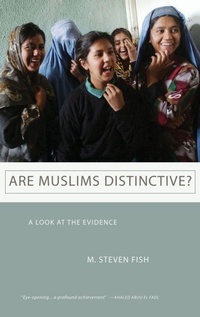
Are Muslims Distinctive?
A Look at the Evidence
1st Edition
Published on 24. February 2011
Book
Hardback
408 pages
978-0-19-976920-9 (ISBN)
Description
How, if at all, do Muslims and non-Muslims differ? The question spurs spirited discussion among people the world over, in Muslim and non-Muslim lands alike, but we still lack answers based on sound empirical evidence. This book engages a set of the biggest issues using rigorous methods and data drawn from around the globe. It reveals that in some areas Muslims and non-Muslims differ less than is commonly imagined, and shows that Muslims are not unusually religious or inclined to favor the fusion of religious and political authority. Nor are Muslims especially prone to mass political violence. Yet in some areas Muslims and non-Muslims diverge: Gender inequality is more severe among Muslims, Muslims are unusually intolerant of homosexuality and other controversial behaviors, and democracy is rare in the Muslim world. Other areas of divergence bear the marks of a Muslim advantage: Violent crime and class-based inequities are less severe among Muslims than non-Muslims.
Committed to discovering social facts rather than either stoking prejudices or stroking political sensibilities, Are Muslims Distinctive? represents the first major scientific effort to assess how Muslims and non-Muslims differ--and do not differ--in the contemporary world. Its findings have vital implications for human welfare, interfaith understanding, and the foreign policies of the United States and other Western countries.
Committed to discovering social facts rather than either stoking prejudices or stroking political sensibilities, Are Muslims Distinctive? represents the first major scientific effort to assess how Muslims and non-Muslims differ--and do not differ--in the contemporary world. Its findings have vital implications for human welfare, interfaith understanding, and the foreign policies of the United States and other Western countries.
Reviews / Votes
Scholars, academics and other open-minded intellectuals will certainly find Fish's work both enlightening and fascinating. * S Parvez Manzoor, The Muslim World Book Review * Outstanding Academic Titles 2012, as selected by CHOICE Magazine (December 2012). * CHOICE *More details
Language
English
Place of publication
New York
United States
Target group
College/higher education
Scholars and students of political science, international relations, religion and politics, and Islam. Policymakers and public officials; particularly those concerned with Islam, Muslims, and religion and politics.
Illustrations
14 b/w illus.
Dimensions
Height: 240 mm
Width: 161 mm
Thickness: 26 mm
Weight
766 gr
ISBN-13
978-0-19-976920-9 (9780199769209)
Copyright in bibliographic data and cover images is held by Nielsen Book Services Limited or by the publishers or by their respective licensors: all rights reserved.
Schweitzer Classification
Other editions
Additional editions
Book
02/2011
1st Edition
Oxford University Press Inc
€61.00
Shipment within 15-20 days
E-Book
02/2011
1st Edition
OUP eBook
€20.99
Available for download
E-Book
02/2011
OUP USA
€26.49
Available for download
Person
M. Steven Fish is Professor of Political Science at the University of California, Berkeley. He has served as a Senior Fulbright Fellow and Visiting Professor at the Airlangga University in Indonesia and the European University at St. Petersburg in Russia. His books include The Handbook of National Legislatures (coauthored with Matthew Kroenig) and Democracy Derailed in Russia.
Content
List of Appendices, Figures, and Tables ; Acknowledgments ; How to Read the Tables in this Book ; Chapter 1: Introduction ; Chapter 2: Personal Religiosity and Religion in Politics ; Chapter 3: Social Capital and Personal Morality ; Chapter 4: Corruption and Crime ; Chapter 5: Large-Scale Political Violence and Terrorism ; Chapter 6: Sex-Based and Class Inequality ; Chapter 7: Democracy ; Chapter 8: Conclusion ; An Afterthought