

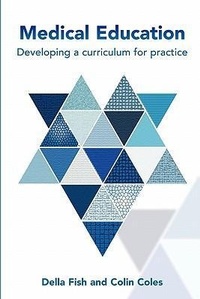
Medical Education: Developing a Curriculum for Practice
Developing a Curriculum for Practice
Published on 16. November 2005
Book
Paperback/Softback
272 pages
978-0-335-21622-2 (ISBN)
Description
"This book is written by two eminent educators and clinicians in medicine, and provides a wealth of information and food for thought for those who have responsibility for curriculum development."
Journal of Orthodontics
What are the contemporary problems facing curriculum designers and developers?
What are the key questions that ought to be addressed with regard to curriculum design for medical practice?
How might a curriculum for practice in medical education be developed?
Medical Education offers a detailed response to these questions and shows what form a curriculum for practice should take and how one can be developed. These ideas are presented in a highly practical and readable account that is essential reading for those involved in educating the doctors of the future and for policy makers in the field of medical education. It also offers useful advice for those in related fields of health care.The authors show that recent developments of curricula for postgraduate doctors have been founded on the misguided view (promoted by politicians and policy makers) that medical practice is routine, straightforward and able to be reduced to simple protocols that professionals must learn and follow. In this view, doctors are technicians who need merely to be trained through a simple curriculum. In contrast, this book shows that the practice of medicine as experienced by working doctors is complex, uncertain and unpredictable. This requires a curriculum that provides the opportunity to learn to exercise professional judgement and make decisions based on practical wisdom.
Journal of Orthodontics
What are the contemporary problems facing curriculum designers and developers?
What are the key questions that ought to be addressed with regard to curriculum design for medical practice?
How might a curriculum for practice in medical education be developed?
Medical Education offers a detailed response to these questions and shows what form a curriculum for practice should take and how one can be developed. These ideas are presented in a highly practical and readable account that is essential reading for those involved in educating the doctors of the future and for policy makers in the field of medical education. It also offers useful advice for those in related fields of health care.The authors show that recent developments of curricula for postgraduate doctors have been founded on the misguided view (promoted by politicians and policy makers) that medical practice is routine, straightforward and able to be reduced to simple protocols that professionals must learn and follow. In this view, doctors are technicians who need merely to be trained through a simple curriculum. In contrast, this book shows that the practice of medicine as experienced by working doctors is complex, uncertain and unpredictable. This requires a curriculum that provides the opportunity to learn to exercise professional judgement and make decisions based on practical wisdom.
More details
Other editions
Additional editions
E-Book
11/2005
1st Edition
McGraw-Hill Education
€69.39
Available for download
Persons
Della Fish is Professor of Education (postgraduate medicine) at King's College London and works independently as a researcher and consultant. She has also worked part time as an education advisor in the Kent, Surrey and Sussex Postgraduate Deanery for Medical and Dental Education. She has published in medical education and contributed widely to health care literature.
Colin Coles is an education professor at the University of Winchester. Having taught in schools and universities, he became Education Advisor to the Wessex Deanery for Postgraduate Medical and Dental Education. He also works as an independent consultant, running workshops and undertaking research and writing. He has published widely within the field of medical education.
Colin Coles is an education professor at the University of Winchester. Having taught in schools and universities, he became Education Advisor to the Wessex Deanery for Postgraduate Medical and Dental Education. He also works as an independent consultant, running workshops and undertaking research and writing. He has published widely within the field of medical education.
Content
List of abbreviations
Acknowledgements
About the authorsIntroduction
Part one: Starting points
Developing rigorous curricula for medical practice in the twenty-first century: a matter of urgency
Part two: The bases of curriculum design for medical practice
The practice of curriculum design: its principles, processes, components and logic
Clarifying curriculum aims: the practice of education, its nature and expertise
Clarifying values: professionalism in practice - stories from the field of medicine
Analysing the context: the nature of practice in medicine - a survey of the field
Clarifying the content: the nature of professional knowledge in medicine
Selecting appropriate educational strategies: how doctors learn to practise medicine
Getting assessment right: identifying and recording doctors' educational achievements in the clinical setting
From problematic to procedural matters: setting the regulations for supporting and managing the curriculum on the ground
Part three: Curriculum development in medicine: a way forward
Shaping an evaluation policy: some principles, values and practices for developing and refining a curriculum
Some principles of change: the problems of curriculum development and ways forward
Developing a curriculum for postgraduate medicine at the local, Intermediate and national level
Appendix: A response to the consultation on Curriculum for the Foundation Years in Postgraduate Medical Education and Training (November 2004)
Index
References
Acknowledgements
About the authorsIntroduction
Part one: Starting points
Developing rigorous curricula for medical practice in the twenty-first century: a matter of urgency
Part two: The bases of curriculum design for medical practice
The practice of curriculum design: its principles, processes, components and logic
Clarifying curriculum aims: the practice of education, its nature and expertise
Clarifying values: professionalism in practice - stories from the field of medicine
Analysing the context: the nature of practice in medicine - a survey of the field
Clarifying the content: the nature of professional knowledge in medicine
Selecting appropriate educational strategies: how doctors learn to practise medicine
Getting assessment right: identifying and recording doctors' educational achievements in the clinical setting
From problematic to procedural matters: setting the regulations for supporting and managing the curriculum on the ground
Part three: Curriculum development in medicine: a way forward
Shaping an evaluation policy: some principles, values and practices for developing and refining a curriculum
Some principles of change: the problems of curriculum development and ways forward
Developing a curriculum for postgraduate medicine at the local, Intermediate and national level
Appendix: A response to the consultation on Curriculum for the Foundation Years in Postgraduate Medical Education and Training (November 2004)
Index
References