

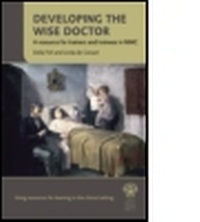
Developing the Wise Doctor: A resource for trainers and trainees in MMC
1st Edition
Published on 20. July 2007
Book
Paperback/Softback
240 pages
978-1-85315-618-2 (ISBN)
Description
Developing the Wise Doctor shows very clearly why the practice of medicine, like the practice of teaching, must be seen as an art as well as a science. 'Wise' doctors know that while the 'facts' of a case may be a necessary and useful starting point, they are seldom the be-all and end-all of medical encounters. The facts may in some limited sense 'speak for themselves', but what they 'say' is often less important than what they don't say. 'Wise' doctors know that much of importance remains unspoken, perhaps even unconscious: that many patients are silently seeking from their encounter with doctors something nebulous - care and healing - as well as something measurable - treatments and cures.
This book provides not only the language for 'wise' doctoring but also the practical exercises to master it. As when learning any new language, the authors stress the importance of practice through all four communication modes - speaking, listening, reading and writing. The second part of the book shows in detail how new doctors can best acquire the language of professional wisdom in the hospital context.
The book as a while makes a strong case for the total re-visioning of the postgraduate medical curriculum. In every chapter there is much for teacher educators, as well as for teachers engaged in their own continuing professional development, to reflect upon.
Developing the Wise Doctor offers a fresh and original approach to professional education and will be of enormous benefit for teaching and supervision. Essential reading for anyone engaged in postgraduate medicine as learner, teacher or manager.
This book provides not only the language for 'wise' doctoring but also the practical exercises to master it. As when learning any new language, the authors stress the importance of practice through all four communication modes - speaking, listening, reading and writing. The second part of the book shows in detail how new doctors can best acquire the language of professional wisdom in the hospital context.
The book as a while makes a strong case for the total re-visioning of the postgraduate medical curriculum. In every chapter there is much for teacher educators, as well as for teachers engaged in their own continuing professional development, to reflect upon.
Developing the Wise Doctor offers a fresh and original approach to professional education and will be of enormous benefit for teaching and supervision. Essential reading for anyone engaged in postgraduate medicine as learner, teacher or manager.
More details
Language
English
Place of publication
London
United Kingdom
Target group
Professional and scholarly
Dimensions
Height: 235 mm
Width: 159 mm
ISBN-13
978-1-85315-618-2 (9781853156182)
Copyright in bibliographic data and cover images is held by Nielsen Book Services Limited or by the publishers or by their respective licensors: all rights reserved.
Schweitzer Classification
Persons
Della Fish
Professor (postgraduate studies), School of Health Science, University of Wales, Swansea
Linda de Cossart
Consultant Vascular and General Surgeon, Countess of Chester NHS Foundation Trust and Council Member, The Royal College of Surgeons of England
Professor (postgraduate studies), School of Health Science, University of Wales, Swansea
Linda de Cossart
Consultant Vascular and General Surgeon, Countess of Chester NHS Foundation Trust and Council Member, The Royal College of Surgeons of England
Content
Figures, tables and resources
Glossary
Acknowledgements
Foreword by Professor Ian Gilmore, President, Royal College of Physicians
Introduction
PART ONE: Postgraduate medicine and medical education: Current disease and possible cure
1. Learning in clinical practice: Two visions for the future
2. Wise practice for better patient care: Introducing â?~the invisiblesâ?T and the heuristics
3. Principles for using learning resources: Teaching strategies, and the importance of talking and writing
PART TWO: Attending to the core of medicine: Key resources for exploring the invisibles
Introduction to Part Two
4. Being alert to the context of the patient case: Prompted by Heuristic 1
5. Exploring the doctorâ?Ts professionalism: Prompted by Heuristic 2
6. Understanding the forms of knowledge the doctor uses: Prompted by Heuristic 3
7. Illustrating the quality of the doctorâ?Ts clinical thinking: Prompted by Heuristic 4
8. Demonstrating the quality of the doctorâ?Ts professional judgements: Prompted by Heuristic 5
9. The therapeutic relationship of wise doctor and valued patient: Bringing the core together
10. Seeing the clinical setting anew: Broadening the vision, deepening the insight
Appendix: Enriching the postgraduate medical curriculum
References
Glossary
Acknowledgements
Foreword by Professor Ian Gilmore, President, Royal College of Physicians
Introduction
PART ONE: Postgraduate medicine and medical education: Current disease and possible cure
1. Learning in clinical practice: Two visions for the future
2. Wise practice for better patient care: Introducing â?~the invisiblesâ?T and the heuristics
3. Principles for using learning resources: Teaching strategies, and the importance of talking and writing
PART TWO: Attending to the core of medicine: Key resources for exploring the invisibles
Introduction to Part Two
4. Being alert to the context of the patient case: Prompted by Heuristic 1
5. Exploring the doctorâ?Ts professionalism: Prompted by Heuristic 2
6. Understanding the forms of knowledge the doctor uses: Prompted by Heuristic 3
7. Illustrating the quality of the doctorâ?Ts clinical thinking: Prompted by Heuristic 4
8. Demonstrating the quality of the doctorâ?Ts professional judgements: Prompted by Heuristic 5
9. The therapeutic relationship of wise doctor and valued patient: Bringing the core together
10. Seeing the clinical setting anew: Broadening the vision, deepening the insight
Appendix: Enriching the postgraduate medical curriculum
References