

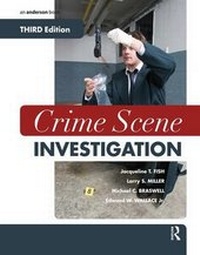
Crime Scene Investigation
3rd Edition
Published on 5. October 2015
Book
Hardback
460 pages
978-1-138-12973-3 (ISBN)
Description
Crime Scene Investigation offers an innovative approach to learning about crime scene investigation, taking the reader from the first response on the crime scene to documenting crime scene evidence and preparing evidence for courtroom presentation. It includes topics not normally covered in other texts, such as forensic anthropology and pathology, arson and explosives, and the electronic crime scene. Numerous photographs and illustrations complement text material, and a chapter-by-chapter fictional narrative also provides the reader with a qualitative dimension of the crime scene experience.
More details
Edition
3rd New edition
Language
English
Place of publication
London
United Kingdom
Publishing group
Taylor & Francis Ltd
Target group
College/higher education
Professional and scholarly
Edition type
New edition
Dimensions
Height: 239 mm
Width: 191 mm
Weight
1016 gr
ISBN-13
978-1-138-12973-3 (9781138129733)
Copyright in bibliographic data and cover images is held by Nielsen Book Services Limited or by the publishers or by their respective licensors: all rights reserved.
Schweitzer Classification
Persons
Jacqueline T. Fish is the Vice President for Academic Affairs at Charleston Southern University. A former crime scene investigator and Lieutenant in the Knox County, Tennessee, Sherriff's Department, Dr. Fish was also project manager of the National Forensic Academy and worked with the Louisiana State University's National Center for Biomedical Research and Training to develop Advanced Forensics Investigations for Hazardous Environments.
Larry S. Miller is Distinguished Professor and Chair of Criminal Justice and Criminology at East Tennessee State University (ETSU). He received his Bachelor of Science from ETSU, a Master of Science from Eastern Kentucky University, and his Ph.D. in Health & Safety with collaterals in Forensic Anthropology and Criminology from The University of Tennessee. Miller, who has worked as a police officer, criminal investigator, and crime laboratory director, teaches in the area of law enforcement and is the author of several books on topics including criminal investigation, criminal justice report writing, police photography, and more.
Dr. Michael C. Braswell is Professor Emeritus of Criminal Justice and Criminology at East Tennessee State University (ETSU). Braswell received his Bachelor of Arts in Psychology from Mercer University in 1969, a Master of Arts in Psychology from West Georgia College in 1970, his Ed.S. in Rehabilitation/Correctional Counseling from the University of Georgia in 1973, and his Doctorate in Counseling Psychology from the University of Southern Mississippi. A former prison psychologist, he taught ethics and human relations courses for more than 30 years at East Tennessee State University. He has published books on ethics, peacemaking, and correctional counseling as well as two novels and a short story collection.
Edward W. Wallace is Director of Forensic Training at the New York City Office of Chief Medical Examiner. Wallace is also Senior Adjunct Instructor and WMD Training Course Developer for Louisiana State University.
Larry S. Miller is Distinguished Professor and Chair of Criminal Justice and Criminology at East Tennessee State University (ETSU). He received his Bachelor of Science from ETSU, a Master of Science from Eastern Kentucky University, and his Ph.D. in Health & Safety with collaterals in Forensic Anthropology and Criminology from The University of Tennessee. Miller, who has worked as a police officer, criminal investigator, and crime laboratory director, teaches in the area of law enforcement and is the author of several books on topics including criminal investigation, criminal justice report writing, police photography, and more.
Dr. Michael C. Braswell is Professor Emeritus of Criminal Justice and Criminology at East Tennessee State University (ETSU). Braswell received his Bachelor of Arts in Psychology from Mercer University in 1969, a Master of Arts in Psychology from West Georgia College in 1970, his Ed.S. in Rehabilitation/Correctional Counseling from the University of Georgia in 1973, and his Doctorate in Counseling Psychology from the University of Southern Mississippi. A former prison psychologist, he taught ethics and human relations courses for more than 30 years at East Tennessee State University. He has published books on ethics, peacemaking, and correctional counseling as well as two novels and a short story collection.
Edward W. Wallace is Director of Forensic Training at the New York City Office of Chief Medical Examiner. Wallace is also Senior Adjunct Instructor and WMD Training Course Developer for Louisiana State University.
Content
1. Introduction 2. First Response 3. Documenting the Crime Scene 4. Fingerprints and Palmprints 5. Trace and Impression Evidence 6. Body Fluid Evidence 7. Blood Spatter Evidence 8. Firearms and Toolmark Evidence 9. Arson and Explosives 10. The Electronic Crime Scene 11. Documentary Evidence 12. Motor Vehicles as Crime Scenes 13. Death Investigation 14. Forensic Anthropology, Odontology, and Entomology 15. Documenting the Actions of the CSI