


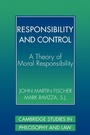
Responsibility and Control
A Theory of Moral Responsibility
Published on 13. February 1998
Book
Hardback
287 pages
978-0-521-48055-0 (ISBN)
Description
This book provides a comprehensive, systematic theory of moral responsibility. The authors explore the conditions under which individuals are morally responsible for actions, omissions, consequences, and emotions. The leading idea in the book is that moral responsibility is based on 'guidance control'. This control has two components: the mechanism that issues in the relevant behavior must be the agent's own mechanism, and it must be appropriately responsive to reasons. The book develops an account of both components. The authors go on to offer a sustained defense of the thesis that moral responsibility is compatible with causal determinism.
Reviews / Votes
' ... the most likely sophisticated of its kind to date and is likely to have considerable influence on future philosophical discussions of both moral and legal responsibility.' The Times Literary SupplementMore details
Series
Language
English
Place of publication
Cambridge
United Kingdom
Target group
College/higher education
Professional and scholarly
Dimensions
Height: 236 mm
Width: 160 mm
Thickness: 21 mm
Weight
581 gr
ISBN-13
978-0-521-48055-0 (9780521480550)
Copyright in bibliographic data is held by Nielsen Book Services Limited or its licensors: all rights reserved.
Schweitzer Classification
Other editions
New editions
Book
10/1999
Cambridge University Press
€69.00
Shipment within 15-20 days
Additional editions
Book
10/1999
Cambridge University Press
€69.00
Shipment within 15-20 days
Persons
Content
Acknowledgements; 1. Moral responsibility: the concepts and challenges; 2. Moral responsibility for actions: weak reasons-responsiveness; 3. Moral responsibility for actions: moderate reasons-responsiveness; 4. Responsibility for consequences; 5. Responsibility for omissions; 6. The direct argument for incompatibilism; 7. Responsibility and history; 8. Taking responsibility; 9. Conclusion; Bibliography.