

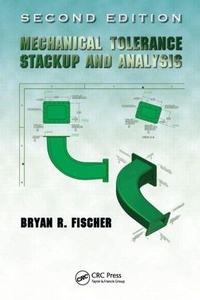
Mechanical Tolerance Stackup and Analysis
2nd Edition
Published on 26. April 2011
Book
Hardback
512 pages
978-1-4398-1572-4 (ISBN)
Description
Use Tolerance Analysis Techniques to Avoid Design, Quality, and Manufacturing Problems Before They Happen
Often overlooked and misunderstood, tolerance analysis is a critical part of improving products and their design processes. Because all manufactured products are subject to variation, it is crucial that designers predict and understand how these changes can affect form, fit, and function of parts and assemblies-and then communicate their findings effectively.
Written by one of the developers of ASME Y14.5 and other geometric dimension and tolerancing (GD&T) standards, Mechanical Tolerance Stackup and Analysis, Second Edition offers an overview of techniques used to assess and convey the cumulative effects of variation on the geometric relationship between part and assembly features. The book focuses on some key components: it explains often misunderstood sources of variation and how they contribute to this deviation in assembled products, as well as how to model that variation in a useful manner.
New to the Second Edition:
Explores ISO and ASME GD&T standards-including their similarities and differences
Covers new concepts and content found in ASME Y14.5-2009 standard
Introduces six-sigma quality and tolerance analysis concepts
Revamps figures throughout
The book includes step-by-step procedures for solving tolerance analysis problems on products defined with traditional plus/minus tolerancing and GD&T. This helps readers understand potential variations, set up the problem, achieve the desired solution, and clearly communicate the results.
With added application examples and features, this comprehensive volume will help design engineers enhance product development and safety, ensuring that parts and assemblies carry out their intended functions. It will also help manufacturing, inspection, assembly, and service personnel troubleshoot designs, verify that in-process steps meet objectives, and find ways to improve performance and reduce costs.
Often overlooked and misunderstood, tolerance analysis is a critical part of improving products and their design processes. Because all manufactured products are subject to variation, it is crucial that designers predict and understand how these changes can affect form, fit, and function of parts and assemblies-and then communicate their findings effectively.
Written by one of the developers of ASME Y14.5 and other geometric dimension and tolerancing (GD&T) standards, Mechanical Tolerance Stackup and Analysis, Second Edition offers an overview of techniques used to assess and convey the cumulative effects of variation on the geometric relationship between part and assembly features. The book focuses on some key components: it explains often misunderstood sources of variation and how they contribute to this deviation in assembled products, as well as how to model that variation in a useful manner.
New to the Second Edition:
Explores ISO and ASME GD&T standards-including their similarities and differences
Covers new concepts and content found in ASME Y14.5-2009 standard
Introduces six-sigma quality and tolerance analysis concepts
Revamps figures throughout
The book includes step-by-step procedures for solving tolerance analysis problems on products defined with traditional plus/minus tolerancing and GD&T. This helps readers understand potential variations, set up the problem, achieve the desired solution, and clearly communicate the results.
With added application examples and features, this comprehensive volume will help design engineers enhance product development and safety, ensuring that parts and assemblies carry out their intended functions. It will also help manufacturing, inspection, assembly, and service personnel troubleshoot designs, verify that in-process steps meet objectives, and find ways to improve performance and reduce costs.
Reviews / Votes
Praise for the First EditionWritten by one of the foremost authorities in the field, this reference presents proven and useful methods for determining whether selected dimensioning and tolerancing schemes will yield functional parts and assemblies. It also tells the most practical procedure to communicate the results.-Mechanical Engineering, Vol. 126, No. 11, Nov. 2004
More details
Series
Edition
2nd edition
Language
English
Place of publication
Bosa Roca
United States
Publishing group
Taylor & Francis Inc
Target group
Professional and scholarly
Professional Practice & Development
Product notice
sewn/stitched
Cloth over boards
Illustrations
350 s/w Abbildungen, 1 s/w Tabelle
1 Tables, black and white; 350 Illustrations, black and white
Dimensions
Height: 231 mm
Width: 155 mm
Thickness: 33 mm
Weight
839 gr
ISBN-13
978-1-4398-1572-4 (9781439815724)
Copyright in bibliographic data and cover images is held by Nielsen Book Services Limited or by the publishers or by their respective licensors: all rights reserved.
Schweitzer Classification
Other editions
Additional editions
Bryan R. Fischer
Mechanical Tolerance Stackup and Analysis
E-Book
04/2011
2nd Edition
CRC Press
€251.99
Available for download
Bryan R. Fischer
Mechanical Tolerance Stackup and Analysis
E-Book
04/2011
2nd Edition
CRC Press
€251.99
Available for download
Previous edition
Bryan R. Fischer
Mechanical Tolerance Stackup and Analysis
Book
06/2004
1st Edition
CRC Press
€151.03
Article exhausted; check for reprint
Person
Bryan R. Fischer is owner of Advanced Dimensional Management LLC, which provides consulting and training in GD&T, tolerance analysis, dimensional management, 3D model-based engineering, and related fields, including 3D MBD and MBE, product documentation quality, and engineering standards. Mr. Fischer is recognized as a leading expert with more than 25 years of industrial experience in these areas. Having worked as a GD&T expert, tolerance analyst, dimensional management engineer, and design lead, he has also been a designer, checker, design drafter, and CAD systems programmer, as well as a trainer and consultant in the areas of GD&T, drawing quality, dimensional management and tolerance analysis. He trains and consults in many industries, both commercial and government, with companies ranging from very small to the largest multi-national corporations. He has consulted with inspection and CAD software developers to help them improve their implementations of GD&T, 3D PMI, and model-based product definition practices. He also works with companies around the world helping them to understand and implement 3D model-based product definition and model-based enterprise methods. Bryan has been active in the area of corporate, national, and international standards development and standards management throughout his career, and a longtime member of several standards development committees. He is a member of the American Society of Mechanical Engineers (ASME), the American Society for Quality, and SAE International. He is also an ASME Certified Senior Level GD&T Professional.
Content
Background. Dimensioning and Tolerancing. Tolerance Format and Decimal Places. Converting Plus/Minus Dimensions and Tolerances into Equal Bilaterally Toleranced Dimensions. Variation and Sources of Variation. Tolerance Analysis. Worst-case Tolerance Stackups. Statistical Tolerance Stackups. Geometric Dimensioning and Tolerancing (GD&T). Converting Plus/Minus Tolerancing to Positional Tolerancing and Projected Tolerance Zones. Diametral and Radial Tolerance Stackups. Specifying Material Condition Modifiers and Their Effect on Tolerance Stackups. The Tolerance Stackup Sketch. The Tolerance Stackup Report Form. Tolerance Stackup Direction and Tolerance Stackups with Trigonometry. Putting it All Together: Tolerance Stackups with GD&T Solved Using the Advanced Dimensional Management Method. Calculating Component Tolerances Given a Final Assembly Tolerance Requirement. Floating-Fastener and Fixed-Fastener Formulas and Considerations. Fit Classifications. Form Tolerances in Tolerance Stackups. 3D Tolerance Analysis, 3D Tolerance Analysis Software, and Introduction to Six Sigma Concepts.