

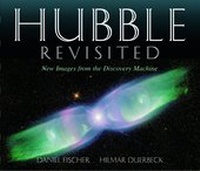
Hubble Revisited
New Images from the Discovery Machine
Published on 16. October 1998
Book
Hardback
216 pages
978-0-387-98551-0 (ISBN)
Description
Arguably the single most successful scientific instrument ever built, the Hubble Space Telescope continues to dazzle us. In recent months it has been at the front lines of all the most pressing questions in astrophysics. What is the age of the Universe? How are stars born? Are extrasolar planets similar to those in our galaxy? In Hubble Revisited: New Images from the Discovery Machine, the authors of the highly acclaimed Hubble: A New Window to the Universe present a new atlas of the latest full-color images, complete with easy-to-read explanatory text. This book provides readers with an exciting, detailed, and gorgeously illustrated account of Hubbles breathtaking new discoveries.
More details
Language
English
Place of publication
NY
United States
Target group
College/higher education
Professional and scholarly
Illustrations
93 farbige Abbildungen, 26 s/w Abbildungen
100 colour figures, references
Dimensions
Height: 250 mm
Width: 290 mm
Weight
1540 gr
ISBN-13
978-0-387-98551-0 (9780387985510)
DOI
10.1007/978-1-4612-2232-3
Schweitzer Classification
Other editions
Additional editions

E-Book
12/2012
Copernicus
€69.54
Available for download

Book
10/1999
Copernicus Books
€85.55
The article will not be published
Persons
Content
1. Telescopes on the Ground and in Space.- Telescopes in Orbit and NewTelescopes on Mountaintops.- The Long Road to Hubble's Launch.- In Orbit.- The First Servicing Mission.- The Second Servicing Mission.- 2. To the Edge of the Universe.- The Basic Questions of Cosmology.- A View into the Depths of Spaceand Time: The Hubble Deep Field.- The Search for Cosmic Numbers.- Searching for the Building Blocks of Galaxies.- Colliding Galaxies.- Quasars: Beacons at the Beginning of Time.- Active Galaxies: Nearby Mini-Quasars.- Gravitational Lenses: Hubble's Telephoto Lens.- Cosmic Gamma Ray Bursts.- 3. Stars.- Stellar Nurseries.- Giant Stars.- Globular Clusters, White Dwarfs, and Blue Stragglers.- Still Going Strong: Supernova 1987A.- Neutron Stars.- A Festival of Colors and Shapes.- Old Couples.- 4. Planets.- Planets around Other Stars.- At the Edge of the Solar System: Pluto and Trans-Neptunian Objects.- Neptune and Uranus.- Saturn.- Jupiter's Aurorae.- Jupiter's Moons.- Asteroids.- Comets.- Mars.- 5. Hubble's Future and ItsSuccessors.- Hubble's Second Decade.- The Next Two Shuttle Visits.- Hubble's Legacy: The Data Archive.- Hubble's Successors.- Europe as Partner.- 6. Appendix.- Want to See More? (World WideWeb Addresses).- Further Reading.