

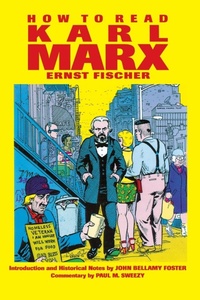
How to Read Karl Marx
Published on 1. January 1996
Book
Paperback/Softback
194 pages
978-0-85345-974-3 (ISBN)
Description
Has any major thinker been more poorly understood than Karl Marx? Over the last 150 years, his name has been invoked in connection with everything from unemployment insurance to Hollywood to guerrilla wars. Any number of international movements have claimed his teachings as their inspiration. Time after time, authorities have proclaimed the death of Marx's theories while new and old audiences continue to draw vital insight from the works of the most important philosopher and economist of the industrial era. Ernst Fischer has crafted a brief, clear, and faithful exposition of Marx's main premises, with particular emphasis on historical context. This new edition of the English translation of 'Was Marx wirklich sagte' (1968) includes new contributions by John Bellamy Foster that sharpen Fischer's focus for today's readers. Also included are a biographical chronology, extracts from major works of Marx, and "Marx's Method," a valuable essay by the political economist Paul M. Sweezy.
More details
Edition
New edition
Language
English
Place of publication
New York
United States
Target group
College/higher education
Professional and scholarly
Edition type
New edition
Product notice
Paperback (trade)
Illustrations
black & white illustrations
Dimensions
Height: 228 mm
Width: 153 mm
Thickness: 14 mm
Weight
272 gr
ISBN-13
978-0-85345-974-3 (9780853459743)
Copyright in bibliographic data and cover images is held by Nielsen Book Services Limited or by the publishers or by their respective licensors: all rights reserved.
Schweitzer Classification
Other editions
Additional editions
Ernst Fischer | Franz Marek
How To Read Karl Marx
E-Book
01/1996
Monthly Review Press
€14.49
Available for download
Persons
Content
The dream of the whole man; creative labour; division of labour and alienation; the fetish character of the commodity; classes and the class struggle; historical materialism; value and surplus value; profit and capital; the problem of increasing misery; the theory of revolution; dictatorship of the proletariat, socialism, communism; labour movement and international; the philosophy of practice; Marxism today.