

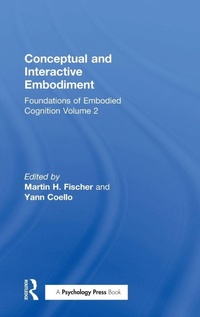
Conceptual and Interactive Embodiment
Foundations of Embodied Cognition Volume 2
1st Edition
Published on 15. December 2015
Book
Hardback
304 pages
978-1-138-80582-8 (ISBN)
Description
This two-volume set provides a comprehensive overview of the multidisciplinary field of Embodied Cognition. With contributions from internationally acknowledged researchers from a variety of fields, Foundations of Embodied Cognition reveals how intelligent behaviour emerges from the interplay between brain, body and environment.
Drawing on the most recent theoretical and empirical findings in embodied cognition, Volume 2 Conceptual and Interactive Embodiment is divided into four distinct parts, bringing together a number of influential perspectives and new ideas. Part one introduces the field of embodied language processing, before part two presents recent developments in our understanding of embodied conceptual understanding. The final two parts look at the applied nature of embodied cognition, exploring the embodied nature of social co-ordination as well as the emerging field of artificial embodiment.
Building on the idea that knowledge acquisition, retention and retrieval are intimately interconnected with sensory and motor processes, Foundations of Embodied Cognition is a landmark publication in the field. It will be of great interest to researchers and advanced students from across the cognitive sciences, including those specialising in psychology, neuroscience, intelligent systems and robotics, philosophy, linguistics and anthropology.
Drawing on the most recent theoretical and empirical findings in embodied cognition, Volume 2 Conceptual and Interactive Embodiment is divided into four distinct parts, bringing together a number of influential perspectives and new ideas. Part one introduces the field of embodied language processing, before part two presents recent developments in our understanding of embodied conceptual understanding. The final two parts look at the applied nature of embodied cognition, exploring the embodied nature of social co-ordination as well as the emerging field of artificial embodiment.
Building on the idea that knowledge acquisition, retention and retrieval are intimately interconnected with sensory and motor processes, Foundations of Embodied Cognition is a landmark publication in the field. It will be of great interest to researchers and advanced students from across the cognitive sciences, including those specialising in psychology, neuroscience, intelligent systems and robotics, philosophy, linguistics and anthropology.
More details
Language
English
Place of publication
London
United Kingdom
Publishing group
Taylor & Francis Ltd
Target group
College/higher education
Postgraduate
Illustrations
35 s/w Abbildungen, 8 s/w Photographien bzw. Rasterbilder, 27 s/w Zeichnungen, 8 farbige Zeichnungen
8 Line drawings, color; 27 Line drawings, black and white; 8 Halftones, black and white; 35 Illustrations, black and white
Dimensions
Height: 240 mm
Width: 161 mm
Thickness: 22 mm
Weight
643 gr
ISBN-13
978-1-138-80582-8 (9781138805828)
Copyright in bibliographic data and cover images is held by Nielsen Book Services Limited or by the publishers or by their respective licensors: all rights reserved.
Schweitzer Classification
Other editions
Additional editions
Martin Fischer | Yann Coello
Conceptual and Interactive Embodiment
Foundations of Embodied Cognition Volume 2
E-Book
12/2015
Routledge
€65.99
Available for download

Martin Fischer | Yann Coello
Conceptual and Interactive Embodiment
Foundations of Embodied Cognition Volume 2
Book
12/2015
1st Edition
Routledge
€72.90
Shipment within 10-20 days
Persons
Martin H. Fischer is Professor of Cognitive Sciences, University of Potsdam, Germany.
Yann Coello is Professor of Cognitive Psychology and Neuropsychology, University of Lille, France.
Yann Coello is Professor of Cognitive Psychology and Neuropsychology, University of Lille, France.
Content
Introduction Martin H. Fischer & Yann Coello I. Embodied Language 1. From modal brain structures to word-meaning, Raphael Fargier 2. Perceptual simulation of space, speed and time in language, Laura Speed & Gabriella Vigliocco 3. The role of sensorimotor processes in meaning composition, Barbara Kaup, Irmgard de la Vega, Jessica Strozyk & Carolin Dudschig 4. Embodied semantic effects in visual word recognition, Louise Connell & Dermot Lynott II. Embodied Concepts 5. Motor measures of embodiment - the case of number concepts, Claudia Gianelli & Martin H. Fischer 6. Grounded conceptual knowledge: Emergence from sensorimotor interactions, Lionel Brunel, Guillaume T. Vallet, Benoit Riou, Amandine Rey & Remy Versace 7. Role of action in conceptual object representation and organization, Solene Kalenine & Laurel Buxbaum III. Embodied Social Coordination 8. Motor Representation in Goal Ascription, Corrado Sinigaglia & Stephen Butterfill 9. A joint action perspective on embodiment, Rob van der Wel, Natalie Sebanz & Guenther Knoblich 10. The plasticity of self-other boundaries: From body-ownership to social cognition, Lara Maister & Manos Tsakiris 11. Embodied predictive processing in social understanding, Sasha Ondobaka, Lea Hald & Harold Bekkering 12. Embodied simulation: Building meaning through shared neural circuitry, Vesna Gamez-Djokic, Istvan Molnar-Szakacs, & Lisa Aziz-Zadeh IV. Artificial Embodiment 13. Robotics contribution to the sensory-motor approach of the cognition: from object perception to social interactions, Philippe Gaussier, Ali Karaouzene, Pierre Andry, Sofiane Boucenna, Antoine Rolland de Rengerve & Laurence Hafemeister 14. Embodied Language and Number Learning in Developmental Robots, Angelo Cangelosi, Anthony Morse, Alessandro Di Nuovo, Marek Rucinski, Francesca Stramandinoli, Davide Marocco, Vivian De La Cruz & Kerstin Fischer