

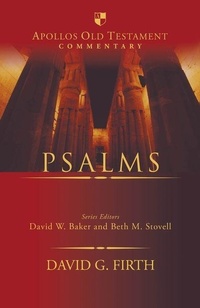
Psalms
Published on 23. October 2025
Book
Hardback
896 pages
978-1-78974-485-9 (ISBN)
Description
The Bible is both a divine and a human book. It is the inspired word of God for his people, whether in biblical times or for the church today. It is also a fully human book, written by different people in a variety of cultural settings. Knowledge of biblical language and society is essential if the meaning of the human writer is to be grasped fully.
The Apollos Old Testament Commentary aims to take with equal seriousness the divine and human aspects of Scripture. It expounds the books of the Old Testament in a scholarly manner accessible to non-experts and shows the relevance of the Old Testament to modern readers.
This commentary begins with an introduction, which gives an overview of the issues of date, authorship, sources and so on, but which also outlines more fully than usual the theology of the Psalms and provides pointers toward its interpretation and contemporary application.
The annotated translation of the Hebrew text by the author forms the basis for the subsequent commentary. The form and structure section examines the context of a passage, its use of rhetorical devices, and source and form-critical issues. The comment section is a thorough, detailed exegesis of the historical and theological meaning of the passage. The explanation - the goal of the commentary - offers a full exposition of the theological message within the framework of biblical theology, and a commitment to the inspiration and authority of the Old Testament.
The Apollos Old Testament Commentary aims to take with equal seriousness the divine and human aspects of Scripture. It expounds the books of the Old Testament in a scholarly manner accessible to non-experts and shows the relevance of the Old Testament to modern readers.
This commentary begins with an introduction, which gives an overview of the issues of date, authorship, sources and so on, but which also outlines more fully than usual the theology of the Psalms and provides pointers toward its interpretation and contemporary application.
The annotated translation of the Hebrew text by the author forms the basis for the subsequent commentary. The form and structure section examines the context of a passage, its use of rhetorical devices, and source and form-critical issues. The comment section is a thorough, detailed exegesis of the historical and theological meaning of the passage. The explanation - the goal of the commentary - offers a full exposition of the theological message within the framework of biblical theology, and a commitment to the inspiration and authority of the Old Testament.
More details
Series
Language
English
Place of publication
Nottingham
United Kingdom
Publishing group
Inter-Varsity Press
Dimensions
Height: 163 mm
Width: 242 mm
Thickness: 52 mm
Weight
1422 gr
ISBN-13
978-1-78974-485-9 (9781789744859)
Copyright in bibliographic data and cover images is held by Nielsen Book Services Limited or by the publishers or by their respective licensors: all rights reserved.
Schweitzer Classification
Other editions
Additional editions
Person
David G Firth (Author)
David G. Firth is Tutor in Old Testament and Undergraduate Academic Lead at Trinity College Bristol and a Research Associate of the University of the Free State.
David G. Firth is Tutor in Old Testament and Undergraduate Academic Lead at Trinity College Bristol and a Research Associate of the University of the Free State.
Content
Introduction 1
1. Name 1
2. Text 5
3. Psalms and Psalter 6
3.1. Interpreting the Psalms 6
3.1.1. Psalms as poetry 7
3.1.2. Standard forms of Psalms 9
3.1.3. The Psalms and Israel's worship 11
3.1.4. Reading Psalms 14
3.2. Interpreting the Psalter 14
3.2.1. Formation of the Psalter 15
3.2.2. Structure of the Psalter 17
3.2.2.1. Book 1 20
3.2.2.2. Book 2 20
3.2.2.3. Book 3 21
3.2.2.4. Book 4 22
3.2.2.5. Book 5 22
3.2.3. Grouping Psalms 23
3.2.4. Reading the Psalter 26
4. Psalm titles 26
4.1. Collection membership 27
4.2. Genre 29
4.3. Historical notes 30
4.4. Performative guidance 30
4.5. Characterizing notes 31
5. The Psalter as a theological compilation: a reading 31
Text and commentary 39
BOOK 1 (Pss 1 - 41) 39
BOOK 2 (Pss 42 - 72) 239
BOOK 3 (Pss 73 - 89) 391
BOOK 4 (Pss 90 - 106) 491
BOOK 5 (Pss 107 - 150) 581
Bibliography 799
Index of biblical and ancient texts 834
Index of authors 851
Index of subjects 858
1. Name 1
2. Text 5
3. Psalms and Psalter 6
3.1. Interpreting the Psalms 6
3.1.1. Psalms as poetry 7
3.1.2. Standard forms of Psalms 9
3.1.3. The Psalms and Israel's worship 11
3.1.4. Reading Psalms 14
3.2. Interpreting the Psalter 14
3.2.1. Formation of the Psalter 15
3.2.2. Structure of the Psalter 17
3.2.2.1. Book 1 20
3.2.2.2. Book 2 20
3.2.2.3. Book 3 21
3.2.2.4. Book 4 22
3.2.2.5. Book 5 22
3.2.3. Grouping Psalms 23
3.2.4. Reading the Psalter 26
4. Psalm titles 26
4.1. Collection membership 27
4.2. Genre 29
4.3. Historical notes 30
4.4. Performative guidance 30
4.5. Characterizing notes 31
5. The Psalter as a theological compilation: a reading 31
Text and commentary 39
BOOK 1 (Pss 1 - 41) 39
BOOK 2 (Pss 42 - 72) 239
BOOK 3 (Pss 73 - 89) 391
BOOK 4 (Pss 90 - 106) 491
BOOK 5 (Pss 107 - 150) 581
Bibliography 799
Index of biblical and ancient texts 834
Index of authors 851
Index of subjects 858