

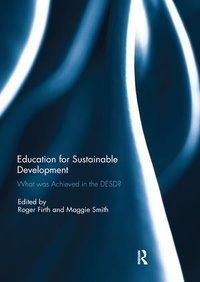
Education for Sustainable Development
What was achieved in the DESD?
1st Edition
Published on 17. July 2019
Book
Paperback/Softback
152 pages
978-0-367-22004-4 (ISBN)
Description
To integrate the principles, values, and practices of sustainable development into all aspects of education and learning was the overarching goal of the UN Decade of Education for Sustainable Development (2005-2014). This, it was believed, would 'save the planet', encouraging behaviour changes to allow for the development of a more sustainable and just society for all. Awareness of sustainable development has risen enormously in recent years, challenging us, as individuals and as families, workplaces, and communities (both local and global), to think about and act upon the major issue which we face.
The Decade reaffirmed the United Nations' commitment to the crucial role of education and learning in the pursuit of sustainable development, and the need for far-reaching changes in the way education is often practised. Of course, the very idea that education should be for something (whether sustainable development or anything else), remains as questionable as ever. Nevertheless the instigation of the Decade clearly recognised the need for intensified efforts to achieve sustainable development.
This book reflects on the role and impact of the Decade in helping to reorient education towards sustainability, and looks forward, beyond the end of the Decade and its achievements, to contemplate the way ahead, giving special attention to case studies and the state of affairs in England. The authors offer different perspectives on the effectiveness and value of particular initiatives and practices that are responses to the Decade. This book was originally published as a special issue of The Curriculum Journal.
The Decade reaffirmed the United Nations' commitment to the crucial role of education and learning in the pursuit of sustainable development, and the need for far-reaching changes in the way education is often practised. Of course, the very idea that education should be for something (whether sustainable development or anything else), remains as questionable as ever. Nevertheless the instigation of the Decade clearly recognised the need for intensified efforts to achieve sustainable development.
This book reflects on the role and impact of the Decade in helping to reorient education towards sustainability, and looks forward, beyond the end of the Decade and its achievements, to contemplate the way ahead, giving special attention to case studies and the state of affairs in England. The authors offer different perspectives on the effectiveness and value of particular initiatives and practices that are responses to the Decade. This book was originally published as a special issue of The Curriculum Journal.
More details
Language
English
Place of publication
London
United Kingdom
Publishing group
Taylor & Francis Ltd
Target group
College/higher education
Professional and scholarly
Dimensions
Height: 246 mm
Width: 174 mm
Weight
840 gr
ISBN-13
978-0-367-22004-4 (9780367220044)
Copyright in bibliographic data and cover images is held by Nielsen Book Services Limited or by the publishers or by their respective licensors: all rights reserved.
Schweitzer Classification
Other editions
Additional editions
E-Book
10/2018
1st Edition
Routledge
€59.49
Available for download
E-Book
10/2018
1st Edition
Routledge
€59.49
Available for download
Book
06/2017
1st Edition
Routledge
€215.41
Shipment within 10-20 days
Persons
Roger Firth is an Associate Professor of Geography Education in the Department of Education, and a Fellow of St Anne's College, at the University of Oxford, UK. He has written widely on geography in education, knowledge and its impacts on curriculum, and pedagogy and environmental education. His recent research interest is inferentialist perspectives on conceptual development in geography classrooms.
Maggie Smith is a lecturer on the PGCE course at Reading University, UK. Her research interests and publications focus on the practice of environmental and sustainable development education in schools. She is a past chair of the National Association of Environmental Education, and of the Geographical Association's special interest group on environmental education. She has worked widely with organisations linked to environmental education.
Maggie Smith is a lecturer on the PGCE course at Reading University, UK. Her research interests and publications focus on the practice of environmental and sustainable development education in schools. She is a past chair of the National Association of Environmental Education, and of the Geographical Association's special interest group on environmental education. She has worked widely with organisations linked to environmental education.
Content
Introduction - As the UN Decade of Education for Sustainable Development comes to an end: what has it achieved and what are the ways forward? 1. Developing the sustainable school: thinking the issues through 2. Eco-schooling and sustainability citizenship: exploring issues raised by corporate sponsorship 3. Exploring and developing student understandings of sustainable development 4. Sustainable development, environmental education, and the significance of being in place 5. Uncharted waters: voyages for Education for Sustainable Development in the higher education curriculum 6. A Practitioner's Perspective - Missing the wood for the trees: systemic defects and the future of education for sustainable development