

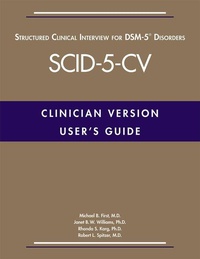
User's Guide for the Structured Clinical Interview for DSM-5 (R) Disorders-Clinician Version (SCID-5-CV)
Will be published approx. on 11. January 2016
Book
Paperback/Softback
176 pages
978-1-58562-524-6 (ISBN)
Description
The Structured Clinical Interview for DSM-5
Disorders-Clinician Version (SCID-5-CV) guides the clinician
step-by-step through the DSM-5 diagnostic process. Interview questions are
provided conveniently along each corresponding DSM-5 criterion, which aids
in rating each as either present or absent. A unique and valuable tool, the
SCID-5-CV covers the DSM-5 diagnoses most commonly seen in clinical
settings.
The User's Guide for the SCID-5-CV provides
comprehensive instructions on how to use the SCID-5-CV effectively and
accurately. It not only describes the rationale, structure, conventions, and
usage of the SCID-5-CV, but also discusses in detail how to interpret and
apply the specific DSM-5 criteria for each of the disorders included in the
SCID-5-CV. A number of sample role-play and homework cases are also included
to help clinicians learn how to use the SCID-5-CV.
Together with the
SCID-5-CV, the User's Guide for the SCID-5-CV will prove invaluable
to clinicians, researchers, interviewers, and students in the mental health
professions who seek to integrate time-tested interview questions
corresponding to the DSM-5 criteria into their DSM-5 diagnostic assessment
process.
Disorders-Clinician Version (SCID-5-CV) guides the clinician
step-by-step through the DSM-5 diagnostic process. Interview questions are
provided conveniently along each corresponding DSM-5 criterion, which aids
in rating each as either present or absent. A unique and valuable tool, the
SCID-5-CV covers the DSM-5 diagnoses most commonly seen in clinical
settings.
The User's Guide for the SCID-5-CV provides
comprehensive instructions on how to use the SCID-5-CV effectively and
accurately. It not only describes the rationale, structure, conventions, and
usage of the SCID-5-CV, but also discusses in detail how to interpret and
apply the specific DSM-5 criteria for each of the disorders included in the
SCID-5-CV. A number of sample role-play and homework cases are also included
to help clinicians learn how to use the SCID-5-CV.
Together with the
SCID-5-CV, the User's Guide for the SCID-5-CV will prove invaluable
to clinicians, researchers, interviewers, and students in the mental health
professions who seek to integrate time-tested interview questions
corresponding to the DSM-5 criteria into their DSM-5 diagnostic assessment
process.
More details
Language
English
Place of publication
VA
United States
Target group
Professional and scholarly
US School Grade: College Graduate Student and over
Product notice
Paperback (trade)
Illustrations
Not illustrated
Dimensions
Height: 271 mm
Width: 212 mm
Thickness: 10 mm
Weight
367 gr
ISBN-13
978-1-58562-524-6 (9781585625246)
Copyright in bibliographic data and cover images is held by Nielsen Book Services Limited or by the publishers or by their respective licensors: all rights reserved.
Schweitzer Classification
Other editions
Previous edition
Michael B. First | Robert L. Spitzer | Miriam Gibbon
Structured Clinical Interview for DSM-IV Axis I Disorders (SCID-I), Clinician Version, User's Guide
Book
01/1997
American Psychiatric Press Inc.
€86.85
Article exhausted; check for reprint
Persons
Michael B. First M.D., is a Professor of Clinical
Psychiatry at Columbia University and a Research Psychiatrist at the
Division of Clinical Phenomenology at the New York State Psychiatric
Institute.
Janet B.W. Williams, Ph.D., is Professor Emerita of
Clinical Psychiatric Social Work (in Psychiatry and Neurology), Columbia
University and Senior Vice President of Global Science, at MedAvante,
Inc.
Rhonda S. Karg, Ph.D., Research Psychologist, Division of
Behavioral Health and Criminal Justice Research, RTI International, Durham,
North Carolina
Robert L. Spitzer, M.D., is Professor Emeritus
of Psychiatry at Columbia University.
Psychiatry at Columbia University and a Research Psychiatrist at the
Division of Clinical Phenomenology at the New York State Psychiatric
Institute.
Janet B.W. Williams, Ph.D., is Professor Emerita of
Clinical Psychiatric Social Work (in Psychiatry and Neurology), Columbia
University and Senior Vice President of Global Science, at MedAvante,
Inc.
Rhonda S. Karg, Ph.D., Research Psychologist, Division of
Behavioral Health and Criminal Justice Research, RTI International, Durham,
North Carolina
Robert L. Spitzer, M.D., is Professor Emeritus
of Psychiatry at Columbia University.
Content
Introduction. History of the SCID. Versions of the SCID.
SCID-CV diagnostic coverage and time frame. Basic features of the SCID-5-CV.
Administration of the SCID. SCID conventions and usage. SCID dos and don'ts.
Differentiating general medical and substance/medication etiologies from
primary disorders. Special instructions for individual modules. SCID-CV
diagnostic summary score sheet. Overview. Module A: Evaluation of mood
episodes and persistent depressive disorder. Module B: Psychotic and
associated symptoms. Module C: Differential diagnosis of psychotic disorders
(c.1-c.30). Module D: Differential diagnosis of mood disorders. Module E:
Substance use disorders. Module F: anxiety disorders. Module G:
obsessive-compulsive and related disorders and PTSD. Module H:
attention-deficit/hyperactivity disorder. Module I: screening for other
disorders. Module J: adjustment disorder. Training. Psychometric issues.
References. Appendix A: DSM-5 criteria for screened disorders in module i.
Appendix B: training materials. Homework cases.
SCID-CV diagnostic coverage and time frame. Basic features of the SCID-5-CV.
Administration of the SCID. SCID conventions and usage. SCID dos and don'ts.
Differentiating general medical and substance/medication etiologies from
primary disorders. Special instructions for individual modules. SCID-CV
diagnostic summary score sheet. Overview. Module A: Evaluation of mood
episodes and persistent depressive disorder. Module B: Psychotic and
associated symptoms. Module C: Differential diagnosis of psychotic disorders
(c.1-c.30). Module D: Differential diagnosis of mood disorders. Module E:
Substance use disorders. Module F: anxiety disorders. Module G:
obsessive-compulsive and related disorders and PTSD. Module H:
attention-deficit/hyperactivity disorder. Module I: screening for other
disorders. Module J: adjustment disorder. Training. Psychometric issues.
References. Appendix A: DSM-5 criteria for screened disorders in module i.
Appendix B: training materials. Homework cases.