

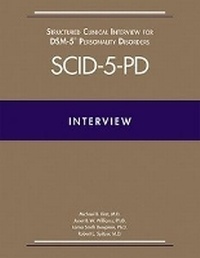
Structured Clinical Interview for DSM-5 (R) Personality Disorders (SCID-5-PD)
Published on 21. December 2015
Book
Paperback/Softback
52 pages
978-1-58562-474-4 (ISBN)
Description
The Structured Clinical Interview for DSM-5 Personality
Disorders (SCID-5-PD) is a semistructured diagnostic interview for
clinicians and researchers to assess the 10 DSM-5 Personality Disorders
across Clusters A, B, and C as well as Other Specified Personality Disorder.
Designed to build rapport, the SCID-5-PD can be used to make personality
disorder diagnoses, either categorically (present or absent) or
dimensionally. The SCID-5-PD includes interview and the handy self-report
screening questionnaire for patients or subjects, the Structured Clinical
Interview for DSM-5 Screening Personality Questionnaire
(SCID-5-SPQ).
The SCID-5-PD is the updated version of the former
Structured Clinical Interview for DSM-IV Axis II Personality Disorders
(SCID-II). The SCID-5-PD name reflects the elimination of the multiaxial
system in DSM-5. Although the DSM-IV Personality Disorder criteria are
unchanged in DSM-5, the SCID-5-PD interview questions have been thoroughly
reviewed and revised to optimally capture the construct embodied in the
diagnostic criteria. In addition, a dimensional scoring component has been
added to the SCID-5-PD.
The basic structure of the SCID-5-PD is
similar to the other SCID-5 interviews (such as the Research Version,
SCID-5-RV; and the Clinician Version, SCID-5-CV) that cover non-personality
DSM-5 disorders. Features include the following:
* Questions assessing the DSM-5 criteria for each of the 10 personality
disorders: Avoidant Personality Disorder, Dependent Personality Disorder,
Obsessive-Compulsive Personality Disorder, Paranoid Personality Disorder,
Schizotypal Personality Disorder, Schizoid Personality Disorder, Histrionic
Personality Disorder, Narcissistic Personality Disorder, Borderline
Personality Disorder, and Antisocial Personality Disorder.
* An optional
SCID-5-SPQ that serves as a brief, 20-minute self-report screening tool to
reduce the time of the SCID-5-PD clinical interview. The SCID-5-SPQ requires
an eighth grade or higher reading level (as determined by the Flesch-Kincaid
formula). Its 106 questions correspond directly to each first question in
the full SCID-5-PD.
The SCID-5-PD can be used in various types of
research studies, just as the SCID-II. It has been used to investigate
patterns of Personality Disorders co-occurring with other mental disorders
or medical conditions; select a group of study subjects with a particular
Personality Disorder; investigate the underlying structure of personality
pathology; and compare with other assessment methods for Personality
Disorders.
The SCID-5-PD will serve as a valuable resource to help
clinicians and researchers more accurately diagnose Personality
Disorders.
Disorders (SCID-5-PD) is a semistructured diagnostic interview for
clinicians and researchers to assess the 10 DSM-5 Personality Disorders
across Clusters A, B, and C as well as Other Specified Personality Disorder.
Designed to build rapport, the SCID-5-PD can be used to make personality
disorder diagnoses, either categorically (present or absent) or
dimensionally. The SCID-5-PD includes interview and the handy self-report
screening questionnaire for patients or subjects, the Structured Clinical
Interview for DSM-5 Screening Personality Questionnaire
(SCID-5-SPQ).
The SCID-5-PD is the updated version of the former
Structured Clinical Interview for DSM-IV Axis II Personality Disorders
(SCID-II). The SCID-5-PD name reflects the elimination of the multiaxial
system in DSM-5. Although the DSM-IV Personality Disorder criteria are
unchanged in DSM-5, the SCID-5-PD interview questions have been thoroughly
reviewed and revised to optimally capture the construct embodied in the
diagnostic criteria. In addition, a dimensional scoring component has been
added to the SCID-5-PD.
The basic structure of the SCID-5-PD is
similar to the other SCID-5 interviews (such as the Research Version,
SCID-5-RV; and the Clinician Version, SCID-5-CV) that cover non-personality
DSM-5 disorders. Features include the following:
* Questions assessing the DSM-5 criteria for each of the 10 personality
disorders: Avoidant Personality Disorder, Dependent Personality Disorder,
Obsessive-Compulsive Personality Disorder, Paranoid Personality Disorder,
Schizotypal Personality Disorder, Schizoid Personality Disorder, Histrionic
Personality Disorder, Narcissistic Personality Disorder, Borderline
Personality Disorder, and Antisocial Personality Disorder.
* An optional
SCID-5-SPQ that serves as a brief, 20-minute self-report screening tool to
reduce the time of the SCID-5-PD clinical interview. The SCID-5-SPQ requires
an eighth grade or higher reading level (as determined by the Flesch-Kincaid
formula). Its 106 questions correspond directly to each first question in
the full SCID-5-PD.
The SCID-5-PD can be used in various types of
research studies, just as the SCID-II. It has been used to investigate
patterns of Personality Disorders co-occurring with other mental disorders
or medical conditions; select a group of study subjects with a particular
Personality Disorder; investigate the underlying structure of personality
pathology; and compare with other assessment methods for Personality
Disorders.
The SCID-5-PD will serve as a valuable resource to help
clinicians and researchers more accurately diagnose Personality
Disorders.
More details
Language
English
Place of publication
VA
United States
Target group
Professional and scholarly
US School Grade: College Graduate Student and over
Product notice
Paperback (trade)
Illustrations
Not illustrated
Dimensions
Height: 279 mm
Width: 216 mm
Weight
930 gr
ISBN-13
978-1-58562-474-4 (9781585624744)
Copyright in bibliographic data and cover images is held by Nielsen Book Services Limited or by the publishers or by their respective licensors: all rights reserved.
Schweitzer Classification
Other editions
Previous edition
Michael B. First | Miriam Gibbon | Robert L. Spitzer
Structured Clinical Interview for DSM-IV Axis II Personality Disorders (SCID-II), Interview and Questionnaire
Book
08/1997
American Psychiatric Press Inc.
€79.42
Article exhausted; check for reprint
Persons
Michael B. First M.D., is a Professor of Clinical
Psychiatry at Columbia University and a Research Psychiatrist at the
Division of Clinical Phenomenology at the New York State Psychiatric
Institute.
Janet B.W. Williams, Ph.D., is Professor Emerita of
Clinical Psychiatric Social Work (in Psychiatry and Neurology), Columbia
University and Senior Vice President of Global Science, at MedAvante,
Inc.
Lorna Smith Benjamin, Ph.D., Adjunct Professor of
Psychiatry and Professor Emerita of Psychology, University of Utah, Salt
Lake City, Utah.
Robert L. Spitzer, M.D., is Professor Emeritus
of Psychiatry at Columbia University.
Psychiatry at Columbia University and a Research Psychiatrist at the
Division of Clinical Phenomenology at the New York State Psychiatric
Institute.
Janet B.W. Williams, Ph.D., is Professor Emerita of
Clinical Psychiatric Social Work (in Psychiatry and Neurology), Columbia
University and Senior Vice President of Global Science, at MedAvante,
Inc.
Lorna Smith Benjamin, Ph.D., Adjunct Professor of
Psychiatry and Professor Emerita of Psychology, University of Utah, Salt
Lake City, Utah.
Robert L. Spitzer, M.D., is Professor Emeritus
of Psychiatry at Columbia University.
Content
SCID-5-PD Diagnostic Summary Score Sheet
General
Overview
Overview for Assessment of Personality Disorders
General
Personality Disorder Criteria That Should Be Considered When Making a Rating
of "2"
Assessment Of DSM-5 Personality Disorders
General
Overview
Overview for Assessment of Personality Disorders
General
Personality Disorder Criteria That Should Be Considered When Making a Rating
of "2"
Assessment Of DSM-5 Personality Disorders