

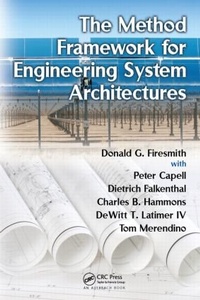
The Method Framework for Engineering System Architectures
1st Edition
Published on 20. November 2008
Book
Hardback
518 pages
978-1-4200-8575-4 (ISBN)
Description
The architects of today's large and complex systems all too often struggle with the lack of a consistent set of principles and practices that adequately address the entire breadth of systems architecture. The Method Framework for Engineering System Architectures (MFESA) enables system architects and process engineers to create methods for effectively and efficiently engineering high-quality architecture for systems, subsystems, and software components.
Meets the Needs of Specific Projects
The book begins by documenting the common challenges that must be addressed by system architecture engineering. It explores the major principles answering these challenges and forming the basis of MFESA. Next, the authors introduce MFESA, including its primary goals, inputs, tasks, outputs, and assumptions. Then they describe the fundamental concepts and terminology on which the systems architecture engineering is founded. This is followed by a description of each of the ten system architecture engineering tasks including associated goals and objectives, preconditions, inputs, steps, postconditions, work products, guidelines, and pitfalls.
Finally, the book documents the relationship between quality and architecture, explains the quality model underlying MFESA, and provides a summary of MFESA method framework, as well as a list of points to remember and future directions planned for MFESA.
Explains Specific Rationales
Organized as a handy desk reference, this book harnesses more than 100 years of the authors' combined professional experience to provide extensive guidelines, best practices, and tips on avoiding possible pitfalls. It presents a direct rationale of why steps are taken, how things can go wrong, and guidance for how and when to tailor the model for a system's specific context.
CRC Press is pleased to announce that The Method Framework for Engineering System Architectures has been added to Intel Corporation's Recommended Reading List. Intel's Recommended Reading program provides technical professionals a simple and handy reference list of what to read to stay abreast of new technologies. Dozens of industry technologists, corporate fellows, and engineers have helped by suggesting books and reviewing the list. This is the most comprehensive reading list available for professional computer developers.
Meets the Needs of Specific Projects
The book begins by documenting the common challenges that must be addressed by system architecture engineering. It explores the major principles answering these challenges and forming the basis of MFESA. Next, the authors introduce MFESA, including its primary goals, inputs, tasks, outputs, and assumptions. Then they describe the fundamental concepts and terminology on which the systems architecture engineering is founded. This is followed by a description of each of the ten system architecture engineering tasks including associated goals and objectives, preconditions, inputs, steps, postconditions, work products, guidelines, and pitfalls.
Finally, the book documents the relationship between quality and architecture, explains the quality model underlying MFESA, and provides a summary of MFESA method framework, as well as a list of points to remember and future directions planned for MFESA.
Explains Specific Rationales
Organized as a handy desk reference, this book harnesses more than 100 years of the authors' combined professional experience to provide extensive guidelines, best practices, and tips on avoiding possible pitfalls. It presents a direct rationale of why steps are taken, how things can go wrong, and guidance for how and when to tailor the model for a system's specific context.
CRC Press is pleased to announce that The Method Framework for Engineering System Architectures has been added to Intel Corporation's Recommended Reading List. Intel's Recommended Reading program provides technical professionals a simple and handy reference list of what to read to stay abreast of new technologies. Dozens of industry technologists, corporate fellows, and engineers have helped by suggesting books and reviewing the list. This is the most comprehensive reading list available for professional computer developers.
More details
Language
English
Place of publication
London
United Kingdom
Publishing group
Taylor & Francis Ltd
Target group
Professional and scholarly
Professional and Professional Practice & Development
Product notice
Paper over boards
Illustrations
78 s/w Abbildungen, 5 s/w Tabellen
5 Tables, black and white; 78 Illustrations, black and white
Dimensions
Height: 254 mm
Width: 178 mm
Weight
1120 gr
ISBN-13
978-1-4200-8575-4 (9781420085754)
Copyright in bibliographic data and cover images is held by Nielsen Book Services Limited or by the publishers or by their respective licensors: all rights reserved.
Schweitzer Classification
Other editions
Additional editions
Donald G. Firesmith | Peter Capell | Dietrich Falkenthal
The Method Framework for Engineering System Architectures
E-Book
11/2008
1st Edition
Auerbach
€145.99
Available for download
Donald G. Firesmith | Peter Capell | Dietrich Falkenthal
The Method Framework for Engineering System Architectures
E-Book
11/2008
1st Edition
Auerbach
€145.99
Available for download
Persons
Donald G. Firesmith, Peter Capell, Dietrich Falkenthal, Charles B. Hammons, DeWitt T. Latimer IV, Tom Merendino
Content
Introduction. System Architecture Engineering Challenges. System Architecture Engineering Principles. MFESA: An Overview. MFESA: The Ontology of Concepts and Terminology. Task 1: Plan and Resource the Architecture Engineering Effort. Task 2: Identify the Architectural Drivers. Task 3: Create the First Versions of the Most Important Architectural Models. Task 4: Identify Opportunities for the Reuse of Architectural Elements. Task 5: Create the Candidate Architectural Visions. Task 6: Analyze Reusable Components and Their Sources. Task 7: Select or Create the Most Suitable Architectural Vision. Task 8: Complete the Architecture and its Representations. Task 9: Evaluate and Accept the Architecture. Task 10: Maintain the Architecture and its Representations. MFESA Method Components: Architectural Workers. MFESA: The Metamethod for Creating Endeavor-Specific Methods. Architecture and Quality. Conclusions. Appendices. Annotated References/Bibliography. Index.