

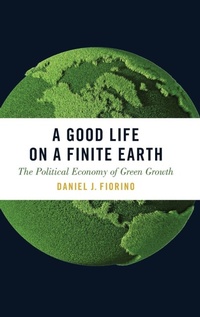
A Good Life on a Finite Earth
The Political Economy of Green Growth
Published on 8. February 2018
Book
Hardback
270 pages
978-0-19-060580-3 (ISBN)
Description
The potential conflict among economic and ecological goals has formed the central fault line of environmental politics in the United States and most other countries since the 1970s. The accepted view is that efforts to protect the environment will detract from economic growth, jobs, and global competitiveness. Conversely, much advocacy on behalf of the environment focuses on the need to control growth and avoid its more damaging effects. This offers a stark choice between prosperity and growth, on the one hand, and ecological degradation on the other. Stopping or reversing growth in most countries is unrealistic, economically risky, politically difficult, and is likely to harm the very groups that should be protected. At the same time, a strategy of unguided "growth above all" would cause ecological catastrophe.
Over the last decade, the concept of green growth -- the idea that the right mix of policies, investments, and technologies will lead to beneficial growth within ecological limits -- has become central to global and national debates and policy due to the financial crisis and climate change. As Daniel J. Fiorino argues, in order for green growth to occur, ecological goals must be incorporated into the structure of the economic and political systems. In this book, he looks at green growth, a vast topic that has heretofore not been systematically covered in the literature on environmental policy and politics. Fiorino looks at its role in global, national, and local policy making; its relationship to sustainable development; controversies surrounding it (both from the left and right); its potential role in ameliorating inequality; and the policy strategies that are linked with it. The book also examines the political feasibility of green growth as a policy framework. While he focuses on the United States, Fiorino will draw comparisons to green growth policy in other countries, including Germany, China, and Brazil.
Over the last decade, the concept of green growth -- the idea that the right mix of policies, investments, and technologies will lead to beneficial growth within ecological limits -- has become central to global and national debates and policy due to the financial crisis and climate change. As Daniel J. Fiorino argues, in order for green growth to occur, ecological goals must be incorporated into the structure of the economic and political systems. In this book, he looks at green growth, a vast topic that has heretofore not been systematically covered in the literature on environmental policy and politics. Fiorino looks at its role in global, national, and local policy making; its relationship to sustainable development; controversies surrounding it (both from the left and right); its potential role in ameliorating inequality; and the policy strategies that are linked with it. The book also examines the political feasibility of green growth as a policy framework. While he focuses on the United States, Fiorino will draw comparisons to green growth policy in other countries, including Germany, China, and Brazil.
Reviews / Votes
"In this well-written, well-researched book, Daniel Fiorino builds a compelling case for the kind of growth that will bolster our economy, improve incomes, protect the health of the American people, and ensure that the natural resources on which we depend, our economy included, remain productive. He does a superb job laying to rest the old canard that a healthy economy and a healthy environment are at odds."--William K. Reilly, Administrator, U.S. EPA, 1989-93
"This terrific and much-needed book provides a compelling analysis that should be essential reading for all students interested in the politics of decarbonizing the economy and greening of the state."
--Karin Baeckstrand, Stockholm University
"Fiorino makes a compelling case that green growth is an essential transformation of our political-economy and culture as we seek to mitigate the harmful effects of the depletion of nature resources, climate change, and growth of the human population. A must-read for any and all concerned about our future."
--Daniel A. Mazmanian, University of Southern California
More details
Series
Language
English
Place of publication
New York
United States
Target group
Professional and scholarly
Dimensions
Height: 240 mm
Width: 161 mm
Thickness: 19 mm
Weight
570 gr
ISBN-13
978-0-19-060580-3 (9780190605803)
Copyright in bibliographic data and cover images is held by Nielsen Book Services Limited or by the publishers or by their respective licensors: all rights reserved.
Schweitzer Classification
Other editions
Additional editions
Book
02/2018
Oxford University Press Inc
€53.00
Shipment within 15-20 days
E-Book
12/2017
OUP eBook
€23.99
Available for download
E-Book
12/2017
OUP eBook
€23.99
Available for download
Person
Daniel J. Fiorino is Director of the Center for Environmental Policy at American University's School of Public Affairs. He is the author of The New Environmental Regulation, Making Environmental Policy, and co-author of Environmental Governance Reconsidered and Managing for the Environment.
Content
Tables, Figures, and Boxes
Foreword
Preface
Chapter 1: Two Worlds Colliding
Chapter 2: What Is Green Growth?
Chapter 3: Ecology and Economy: Partners or Antagonists?
Chapter 4: Ecological Governance
Chapter 5: Inequality and Green Growth
Chapter 6: The Green Growth Policy Agenda
Chapter 7: Prospects and Politics in the US
Chapter 8: Can Change Happen?
Notes
References
Index
Foreword
Preface
Chapter 1: Two Worlds Colliding
Chapter 2: What Is Green Growth?
Chapter 3: Ecology and Economy: Partners or Antagonists?
Chapter 4: Ecological Governance
Chapter 5: Inequality and Green Growth
Chapter 6: The Green Growth Policy Agenda
Chapter 7: Prospects and Politics in the US
Chapter 8: Can Change Happen?
Notes
References
Index