

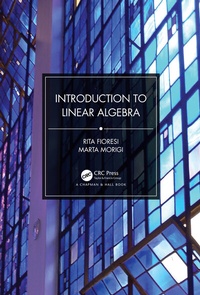
Introduction to Linear Algebra
1st Edition
Published on 2. September 2021
Book
Hardback
274 pages
978-0-367-62654-9 (ISBN)
Description
Linear algebra provides the essential mathematical tools to tackle all the problems in Science. Introduction to Linear Algebra is primarily aimed at students in applied fields (e.g. Computer Science and Engineering), providing them with a concrete, rigorous approach to face and solve various types of problems for the applications of their interest. This book offers a straightforward introduction to linear algebra that requires a minimal mathematical background to read and engage with.
Features
Presented in a brief, informative and engaging style
Suitable for a wide broad range of undergraduates
Contains many worked examples and exercises
Features
Presented in a brief, informative and engaging style
Suitable for a wide broad range of undergraduates
Contains many worked examples and exercises
Reviews / Votes
"With a brief, informative and engaging style, Introduction to Linear Algebra is an ideal curriculum textbook for a wide broad range of undergraduates and comprises many worked examples and exercises."- Midwest Books Review
More details
Language
English
Place of publication
Oxford
United Kingdom
Publishing group
Taylor & Francis Ltd
Target group
Professional and scholarly
Academic
Illustrations
21 s/w Abbildungen, 21 s/w Zeichnungen
21 Line drawings, black and white; 21 Illustrations, black and white
Dimensions
Height: 254 mm
Width: 178 mm
Weight
620 gr
ISBN-13
978-0-367-62654-9 (9780367626549)
Copyright in bibliographic data and cover images is held by Nielsen Book Services Limited or by the publishers or by their respective licensors: all rights reserved.
Schweitzer Classification
Other editions
Additional editions
Rita Fioresi | Marta Morigi
Introduction to Linear Algebra
Book
09/2023
1st Edition
Chapman & Hall/CRC
€71.60
Shipment within 15-20 days
Rita Fioresi | Marta Morigi
Introduction to Linear Algebra
E-Book
09/2021
1st Edition
Chapman & Hall/CRC
€67.49
Available for download
Rita Fioresi | Marta Morigi
Introduction to Linear Algebra
E-Book
09/2021
1st Edition
Chapman & Hall/CRC
€67.49
Available for download
Persons
Rita Fioresi and Marta Morigi are professors at the University of Bologna and teach linear
algebra courses to students of all majors. Their research publications are centered into algebra with some applications (R. Fioresi Lie theory & machine learning, M. Morigi Group theory).
algebra courses to students of all majors. Their research publications are centered into algebra with some applications (R. Fioresi Lie theory & machine learning, M. Morigi Group theory).
Content
1. Introduction to Linear Systems. 1.1. Linear systems: First Examples. 1.2. Matrices. 1.3. Matrices and Linear Systems. 1.4. The Gaussian Algorithm. 1.5. Exercises with Solutions. 1.6. Suggested Exercises. 2. Vector Spaces. 2.1. Introduction: The Set of Real Numbers. 2.2. The Vector Space Rn and the Vector Space of Matrices. 2.3. Vector Spaces. 2.4. SubSpaces. 2.5. Exercises with Solutions. 2.6. Suggested Exercises. 3. Linear Combination and Linear Independence. 3.1. Linear Combinations and Generators. 3.2. Linear Independence. 3.3. Exercises with Solutions. 3.4. Suggested Exercises. 4. Basis and Dimension. 4.1. Basis: Definition and Examples. 4.2. The Concept of Dimension. 4.3. Gaussian Algorithm. 4.4. Exercises with Solutions. 4.5. Suggested Exercises. 4.6. Appendix: The Completion Theorem. 5. Linear Transformations. 5.1. Linear Transformations: Definition. 5.2. Linear Maps and Matrices. 5.3. the Composition of Linear transformations. 5.4. Kernel and Image. 5.5. The Rank Nullity Theorem. 5.6. Isomorphism of Vector Spaces. 5.7. Calculation of Kernel and Image. 5.8. Exercises with Solutions. 5.9. Suggested Exercises. 6. Linear Systems. 6.1. Preimage. 6.2. Linear Systems. 6.3. Exercises with Solutions. 6.4. Suggested Exercises. 7. Determinant and Inverse. 7.1. Definition of Determinant. 7.2. Calculating the Determinant: Cases 2 _ 2 and 3 _ 3. 7.3. Calculating the Determinant with a Recursive Method. 7.4. Inverse of a Matrix. 7.5. Calculation of the Inverse with the Gaussian Algorithm. 7.6. The Linear Maps from Rn to Rn. 7.7. Exercises with Solutions. 7.8. Suggested Exercises. 7.9. Appendix. 8. Change of Basis. 8.1. Linear Transformations and Matrices. 8.2. The Identity Map. 8.3. Change of Basis for Linear Transformations. 8.4. Exercises with Solutions. 8.5. Suggested Exercises. 9. Eigenvalues and Eigenvectors. 9.1. Diagonalizability. 9.2. Eigenvalues and Eigenvectors. 9.3. Exercises with Solutions. 9.4. Suggested Exercises. 10. Scalar Products. 10.1. Bilinear Forms. 10.2. Bilinear Forms and Matrices. 10.3. Basis Change. 10.4. Scalar Products. 10.5. Orthogonal Subspaces. 10.6. Gram-Schmidt Algorithm. 10.7. Exercises with Solutions. 10.8. Suggested Exercises. 11. Spectral Theorem. 11.1. Orthogonal Linear Transformations. 11.2. Orthogonal Matrices. 11.3. Symmetric Linear Transformations. 11.4. The Spectral Theorem. 11.5. Exercises with Solutions. 11.6. Suggested Exercises. 11.7. Appendix: The Complex Case. 12. Applications of Spectral Theorem and Quadratic Forms. 12.1. Diagonalization of Scalar Products. 12.2. Quadratic Forms. 12.3. Quadratic Forms and in the Plane. 12.4. Exercises with Solutions. 12.5. Suggested Exercises. 13. Lines and Planes. 13.1. Points and Vectors in R3. 13.2. Scalar Product and Vector Product. 13.3. Lines in R3. 13.4. Planes in R3. 13.5. Exercises with Solutions. 13.6. Suggested Exercises. 14. Introduction to Modular Arithmetic. 14.1. The Principle of Induction. 14.2. The Division Algorithm and Euclid's Algorithm. 14.3. Congruence Classes. 14.4. Congruences. 14.5. Exercises with Solutions. 14.6. Suggested Exercises. 14.7. Appendix: Elementary Notions of Set Theory. Appendix A. Complex Numbers. A.1. Complex Numbers. A.2. Polar Representation. Appendix B. Solutions of Some Suggested Exercises. Bibliography. Index