

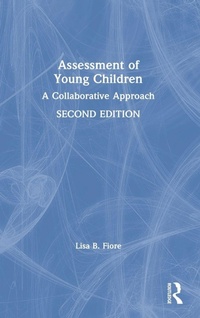
Assessment of Young Children
A Collaborative Approach
2nd Edition
Published on 30. December 2020
Book
Hardback
222 pages
978-0-367-36591-2 (ISBN)
Description
In an era where assessment mandates tend to minimize or dismiss individual differences and creativity, resulting in punitive outcomes or inertia, this essential guide provides teachers with a collaborative approach to assessment that emphasizes the importance of bringing children and families into the process.
Now in its second edition, Assessment of Young Children explores both standardized and authentic assessment, work sampling systems, and observation skills. Fully updated with current standards and research, this new edition also features an enhanced focus on trauma-informed practices, culturally and linguistically diverse learners, and family involvement. Lively and engaging, chapters help readers cultivate developmentally appropriate practice, create appropriate expectations, examine and celebrate children's work, interact in groups, and improve their reflective teaching. Accounts of real experiences from children, families, teachers, and administrators provide on-the-ground models of assessment strategies and demonstrate how children are affected.
Exploring a variety of ways to observe and assess young children in their natural environments, this critical volume encourages an assessment strategy where the child remains the focus and collaboration with children, families, and colleagues creates an image - not a diagnosis - of the child that is empowering rather than constraining.
Now in its second edition, Assessment of Young Children explores both standardized and authentic assessment, work sampling systems, and observation skills. Fully updated with current standards and research, this new edition also features an enhanced focus on trauma-informed practices, culturally and linguistically diverse learners, and family involvement. Lively and engaging, chapters help readers cultivate developmentally appropriate practice, create appropriate expectations, examine and celebrate children's work, interact in groups, and improve their reflective teaching. Accounts of real experiences from children, families, teachers, and administrators provide on-the-ground models of assessment strategies and demonstrate how children are affected.
Exploring a variety of ways to observe and assess young children in their natural environments, this critical volume encourages an assessment strategy where the child remains the focus and collaboration with children, families, and colleagues creates an image - not a diagnosis - of the child that is empowering rather than constraining.
More details
Edition
2nd edition
Language
English
Place of publication
London
United Kingdom
Publishing group
Taylor & Francis Ltd
Target group
College/higher education
Postgraduate and Undergraduate
Illustrations
35 s/w Abbildungen, 11 s/w Photographien bzw. Rasterbilder, 24 s/w Zeichnungen, 21 s/w Tabellen
21 Tables, black and white; 24 Line drawings, black and white; 11 Halftones, black and white; 35 Illustrations, black and white
Dimensions
Height: 235 mm
Width: 157 mm
Thickness: 18 mm
Weight
504 gr
ISBN-13
978-0-367-36591-2 (9780367365912)
Copyright in bibliographic data and cover images is held by Nielsen Book Services Limited or by the publishers or by their respective licensors: all rights reserved.
Schweitzer Classification
Other editions
Additional editions
Book
12/2020
2nd Edition
Routledge
€63.30
Shipment within 15-20 days
E-Book
12/2020
2nd Edition
Routledge
€55.49
Available for download
E-Book
12/2020
2nd Edition
Routledge
€55.49
Available for download
Previous edition
Book
06/2012
1st Edition
Routledge
€178.56
Withdrawn from sale
Person
Lisa B. Fiore is Professor of Education and Director of the Child Homelessness Initiative at Lesley University, USA.
Content
1. What Do You Notice? 2. Vive la Difference 3. Role of the Environment 4. Observation 5. Standardized Assessment 6. Authentic Assessment 7. The Purpose, Power, and 'Portance of Play 8. Putting It All Together 9. Teacher as Researcher