

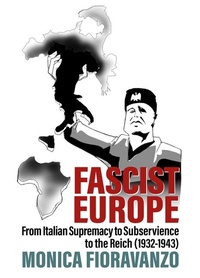
Fascist Europe
From Italian Supremacy to Subservience to the Reich (1932-1943)
Published on 2. February 2024
Book
Hardback
232 pages
978-1-80539-270-5 (ISBN)
Description
By shedding light on an often-overlooked aspect of Fascism and Nazism, this book examines the ambitious plans for a new European order conceived by Italian intellectuals, historians, geographers, politicians, and even student representative of the Fascist University Groups (GUF). Through expert reconstruction of the debate on this envisaged order's development, Monica Fioravanzo opens a window into the theoretical arena that shaped relationships between German, Italy and the other Axis nations and provides insight into how the project was anticipated to unite the Fascist regime in Italy and the Nazi Reich.
More details
Language
English
Place of publication
Oxford
United Kingdom
Target group
Professional and scholarly
Product notice
Library binding
Illustrations
Bibliography; Index
Dimensions
Height: 229 mm
Width: 152 mm
Thickness: 13 mm
Weight
435 gr
ISBN-13
978-1-80539-270-5 (9781805392705)
DOI
10.3167/9781805392705
Copyright in bibliographic data and cover images is held by Nielsen Book Services Limited or by the publishers or by their respective licensors: all rights reserved.
Schweitzer Classification
Other editions
Additional editions

E-Book
02/2024
1st Edition
Berghahn Books
€24.49
Available for download

E-Book
02/2024
1st Edition
Berghahn Books
€24.49
Available for download
Person
Monica Fioravanzo is Associate Professor of Contemporary History at University of Padua, specializing in Fascism and Italian German relations in the 1930s, and she is also a visiting scholar at FU Berlin, IFZ Munich and Columbia University.
Content
Note on Translations
Abbreviations
Introduction
Chapter 1. The Emergence of a Concept of Europe
A Cautious and Circuitous Start
The 1930s: the Prospect of a Fascist Europe
The Volta Conference on Europe
Orestano's Summary and the Reaction of the Foreign Press
Chapter 2. The Utopia of a Fascist Europe (1932-35)
Gerarchia and the Fascistization of Europe
The Myth of Rome
A Plan for Europe: History, Demographics and Politics
Italy, France and Germany
Chapter 3. From the African Dream to an Axis Europe
Africa in a Fascist Europe
ISPI and the Development of Eurafrica
The Path Towards an Axis Europe
A Fascist Europe or an Axis Europe?
An Axis Europe or a Nazi Europe?
The Axis as Seen by the Two Peoples'
Chapter 4. Towards a Nazi-Fascist Order? War as Opportunity
Europe in the 'War Magazines'
The Mediterranean, Eurafrica and Eurafroasia
A Time for Reflection
Youth in the New Europe Europe, Kultur and 'Greater Germanic' Ideology
Spiritual Dominance in the New Europe
To Win the War or 'Win Peace'?
The Decline of the Axis and a 'Europe of the Nations'
Postface
Bibliography
Index
Abbreviations
Introduction
Chapter 1. The Emergence of a Concept of Europe
A Cautious and Circuitous Start
The 1930s: the Prospect of a Fascist Europe
The Volta Conference on Europe
Orestano's Summary and the Reaction of the Foreign Press
Chapter 2. The Utopia of a Fascist Europe (1932-35)
Gerarchia and the Fascistization of Europe
The Myth of Rome
A Plan for Europe: History, Demographics and Politics
Italy, France and Germany
Chapter 3. From the African Dream to an Axis Europe
Africa in a Fascist Europe
ISPI and the Development of Eurafrica
The Path Towards an Axis Europe
A Fascist Europe or an Axis Europe?
An Axis Europe or a Nazi Europe?
The Axis as Seen by the Two Peoples'
Chapter 4. Towards a Nazi-Fascist Order? War as Opportunity
Europe in the 'War Magazines'
The Mediterranean, Eurafrica and Eurafroasia
A Time for Reflection
Youth in the New Europe Europe, Kultur and 'Greater Germanic' Ideology
Spiritual Dominance in the New Europe
To Win the War or 'Win Peace'?
The Decline of the Axis and a 'Europe of the Nations'
Postface
Bibliography
Index