

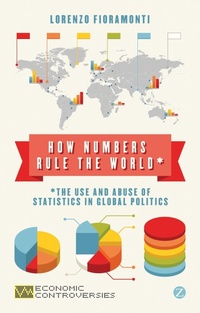
How Numbers Rule the World
The Use and Abuse of Statistics in Global Politics
Published on 16. January 2014
Book
Hardback
280 pages
978-1-78032-268-1 (ISBN)
Description
Numbers dominate global politics and, as a result, our everyday lives. Credit ratings steer financial markets and can make or break the future of entire nations. GDP drives our economies. Stock market indices flood our media and national debates. Statistical calculations define how we deal with climate change, poverty and sustainability. But what is behind these numbers?
In How Numbers Rule the World, Lorenzo Fioramonti reveals the hidden agendas underpinning the use of statistics and those who control them. Most worryingly, he shows how numbers have been used as a means to reinforce the grip of markets on our social and political life, curtailing public participation and rational debate.
An innovative and timely expose of the politics, power and contestation of numbers.
In How Numbers Rule the World, Lorenzo Fioramonti reveals the hidden agendas underpinning the use of statistics and those who control them. Most worryingly, he shows how numbers have been used as a means to reinforce the grip of markets on our social and political life, curtailing public participation and rational debate.
An innovative and timely expose of the politics, power and contestation of numbers.
Reviews / Votes
Lorenzo Fioramonti has written an urgent and highly accessible book, showing just how over-reliant our governance systems are on misleading numbers, which support market power and blur our understanding of the world. And it is also a better and more compelling read than exactly 95.4% of all other important books! * David Boyle, author of The Tyranny of Numbers * This book is a thoughtful political economic analysis of how our fates have come to be determined by a few numbers, and how these numbers have been shaped by a few people. If we want a vibrant and responsive politics, we'll need to know where it has been enclosed by the world's powerful accountants. Fioramonti's book provides an excellent map. * Raj Patel, author of The Value of Nothing: How to Reshape Market Society and Redefine Democracy * Timely and original, scholarly without ostentation, often scathing, Lorenzo Fioramonti's field guide to the prejudices, assumptions, financial interests and ideology that lurk behind the most innocent-seeming numbers equips us to challenge their spurious authority. Faith in numbers has helped to wreck the financial system, masked fraud and criminal activity, allowed the world's richest people to meddle in the "development" of societies they know nothing about and could lead us to damage our earthly habitat beyond recall. If you want to learn what numbers reveal and conceal; what can and, above all, can't be measured, don't trust the "experts" - read How Numbers Rule the World and become an expert yourself. * Susan George, author of Whose Crisis, Whose Future? and President of the Board, Transnational Institute *More details
Series
Language
English
Place of publication
United Kingdom
Publishing group
Bloomsbury Publishing PLC
Target group
College/higher education
Product notice
Paper over boards
Dimensions
Height: 222 mm
Width: 145 mm
Thickness: 20 mm
Weight
529 gr
ISBN-13
978-1-78032-268-1 (9781780322681)
Copyright in bibliographic data and cover images is held by Nielsen Book Services Limited or by the publishers or by their respective licensors: all rights reserved.
Schweitzer Classification
Other editions
Additional editions
E-Book
01/2014
1st Edition
Zed Books Ltd
€19.99
Available for download
Person
Lorenzo Fioramonti (@globalreboot) is associate professor and Jean Monnet chair in regional integration and governance studies at the University of Pretoria, South Africa, where he directs the Centre for the Study of Governance Innovation. He is also senior fellow at the Centre for Social Investment of the University of Heidelberg and at the Hertie School of Governance, Germany, as well as associate fellow at the United Nations University. He is the author of several books about development policies, global and regional governance, alternative economies and social progress indicators, including Gross Domestic Problem: The Politics Behind the World's Most Powerful Number (Zed Books, 2013). He blogs at www.globalreboot.org.
Content
Introduction: The politics of statistics
1. The power of numbers
2. New global rulers: the untameable power of credit rating
3. Fiddling while the planet burns: the marketization of climate change
4. Measuring the unmeasurable: the financialization of nature
5. Numbers for good? The quest for aid effectiveness and social impact
Conclusion: Rethinking numbers, rethinking governance
1. The power of numbers
2. New global rulers: the untameable power of credit rating
3. Fiddling while the planet burns: the marketization of climate change
4. Measuring the unmeasurable: the financialization of nature
5. Numbers for good? The quest for aid effectiveness and social impact
Conclusion: Rethinking numbers, rethinking governance