

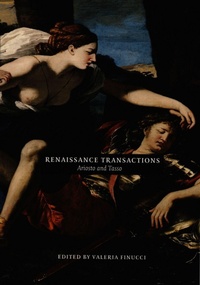
Renaissance Transactions
Ariosto and Tasso
Will be published approx. on 25. March 1999
Book
Hardback
336 pages
978-0-8223-2275-7 (ISBN)
Description
The controversy generated in Italy by the writings of Ludovico Ariosto and Torquato Tasso during the sixteenth century was the first historically important debate on what constitutes modern literature. Applying current critical theories and tools, the essays in Renaissance Transactions reexamine these two provocative poet-thinkers, the debate they inspired, and the reasons why that debate remains relevant today.
Resituating these writers' works in the context of the Renaissance while also offering appraisals of their uncanny "postmodernity," the contributors to this volume focus primarily on Ariosto's Orlando furioso and Tasso's Gerusalemme liberata. Essays center on questions of national and religious identity, performative representation, and the theatricality of literature. They also address subjects regarding genre and gender, social and legal anthropology, and reactionary versus revolutionary writing. Finally, they advance the historically significant debate about what constitutes modern literature by revisiting with new perspective questions first asked centuries ago: Did Ariosto invent a truly national, and uniquely Italian, literary genre-the chivalric romance? Or did Tasso alone, by equaling the epic standards of Homer and Virgil, make it possible for a literature written in Italian to attain the status of its classical Greek and Latin antecedents?
Arguing that Ariosto and Tasso are still central to the debate on what constitutes modern narrative, this collection will be invaluable to scholars of Italian literature, literary history, critical theory, and the Renaissance.Contributors. Jo Ann Cavallo, Valeria Finucci, Katherine Hoffman, Daniel Javitch, Constance Jordan, Ronald L. Martinez, Eric Nicholson, Walter Stephens, Naomi Yavneh, Sergio Zatti
Resituating these writers' works in the context of the Renaissance while also offering appraisals of their uncanny "postmodernity," the contributors to this volume focus primarily on Ariosto's Orlando furioso and Tasso's Gerusalemme liberata. Essays center on questions of national and religious identity, performative representation, and the theatricality of literature. They also address subjects regarding genre and gender, social and legal anthropology, and reactionary versus revolutionary writing. Finally, they advance the historically significant debate about what constitutes modern literature by revisiting with new perspective questions first asked centuries ago: Did Ariosto invent a truly national, and uniquely Italian, literary genre-the chivalric romance? Or did Tasso alone, by equaling the epic standards of Homer and Virgil, make it possible for a literature written in Italian to attain the status of its classical Greek and Latin antecedents?
Arguing that Ariosto and Tasso are still central to the debate on what constitutes modern narrative, this collection will be invaluable to scholars of Italian literature, literary history, critical theory, and the Renaissance.Contributors. Jo Ann Cavallo, Valeria Finucci, Katherine Hoffman, Daniel Javitch, Constance Jordan, Ronald L. Martinez, Eric Nicholson, Walter Stephens, Naomi Yavneh, Sergio Zatti
Reviews / Votes
"Most of the leading and well-known scholars of the Italian Renaissance are represented here with their sundry and complementary viewpoints. . . . The presence of so many different critical voices conveys a sense of this volume as a summa of current Renaissance criticism."-Giuseppe Mazzotta, Yale UniversityMore details
Series
Language
English
Place of publication
North Carolina
United States
Target group
Professional and scholarly
Product notice
Cloth over boards
Dimensions
Height: 226 mm
Width: 150 mm
Thickness: 20 mm
Weight
658 gr
ISBN-13
978-0-8223-2275-7 (9780822322757)
Copyright in bibliographic data and cover images is held by Nielsen Book Services Limited or by the publishers or by their respective licensors: all rights reserved.
Schweitzer Classification
Other editions
Additional editions
E-Book
03/1999
1st Edition
Duke University Press Books
€208.99
Available for download
Person
Valeria Finucci is Associate Professor of Italian at Duke University. She is the author of The Lady Vanishes: Subjectivity and Representation in Castiglione and Ariosto and the coeditor of Desire in the Renaissance: Psychoanalysis and Literature.
Content
Acknowledgments
Introduction: Ariosto, Tasso, and Storytelling / Valeria Finucci
I. Crossing Genres
Two Odysseys: Rinaldo's Po Journey and the Poet's Homecoming in Orlando furioso / Ronald L. Martinez
The Grafting of Virgilian Epic in Orlando furioso / Daniel Javitch
Tasso's Armida and the Victory of Romance / Jo Ann Cavallo
II. The Politics of Dissimulation
Epic in the Age of Dissimulation: Tasso's Gerusalemme liberata / Sergio Zatti
Trickster, Textor, Architect, Thief: Craft and Comedy in Gerusalemme liberata / Walter Stephens
"Un cosi valoroso cavalliero": Knightly Honor and Artistic Representation in Orlando furioso, Canto 26 / Katherine Hoffman
III. Acting Out Fantasies
The Masquerade of Masculinity: Astolfo and Jocondo in Orlando furioso, Canto 28 / Valeria Finucci
Romance as Role Model: Early Female Performances of Orlando furioso and Gerusalemme liberata / Eric Nicholson
"Dal rogo alle nozze": Tasso's Sofronia as Martyr Manque / Naomi Yavneh
Writing beyond the Querelle: Gender and History in Orlando furioso / Constance Jordan
Index
Contributors
Introduction: Ariosto, Tasso, and Storytelling / Valeria Finucci
I. Crossing Genres
Two Odysseys: Rinaldo's Po Journey and the Poet's Homecoming in Orlando furioso / Ronald L. Martinez
The Grafting of Virgilian Epic in Orlando furioso / Daniel Javitch
Tasso's Armida and the Victory of Romance / Jo Ann Cavallo
II. The Politics of Dissimulation
Epic in the Age of Dissimulation: Tasso's Gerusalemme liberata / Sergio Zatti
Trickster, Textor, Architect, Thief: Craft and Comedy in Gerusalemme liberata / Walter Stephens
"Un cosi valoroso cavalliero": Knightly Honor and Artistic Representation in Orlando furioso, Canto 26 / Katherine Hoffman
III. Acting Out Fantasies
The Masquerade of Masculinity: Astolfo and Jocondo in Orlando furioso, Canto 28 / Valeria Finucci
Romance as Role Model: Early Female Performances of Orlando furioso and Gerusalemme liberata / Eric Nicholson
"Dal rogo alle nozze": Tasso's Sofronia as Martyr Manque / Naomi Yavneh
Writing beyond the Querelle: Gender and History in Orlando furioso / Constance Jordan
Index
Contributors