

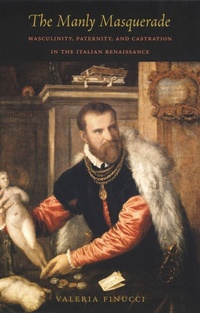
The Manly Masquerade
Masculinity, Paternity, and Castration in the Italian Renaissance
Will be published approx. on 19. March 2003
Book
Hardback
328 pages
978-0-8223-3054-7 (ISBN)
Description
The Manly Masquerade unravels the complex ways men were defined as men in Renaissance Italy through readings of a vast array of sixteenth- and seventeenth-century evidence: medical and travel literature; theology; law; myth; conduct books; and plays, chivalric romances, and novellas by authors including Machiavelli, Tasso, and Ariosto. Valeria Finucci shows how ideas of masculinity were formed in the midst of acute anxiety about paternity by highlighting the beliefs-widely held at the time-that conception could occur without a paternal imprimatur or through a woman's encounter with an animal, or even that a pregnant woman's imagination could erase the father's "signature" from the fetus. Against these visions of reproduction gone awry, Finucci looks at how concepts of masculinity were tied to issues of paternity through social standing, legal matters, and inheritance practices.Highlighting the fissures running through Italian Renaissance ideas of manliness, Finucci describes how, alongside pervasive images of the virile, sexually active man, early modern Italian culture recognized the existence of hermaphrodites and started to experiment with a new kind of sexuality by manufacturing a non-man: the castrato. Following the creation of castrati, the Church forbade the marriage of all non-procreative men, and, in this move, Finucci identifies a powerful legitimation of the view that what makes men is not the possession of male organs or the ability to have sex, but the capability to father. Through analysis, anecdote, and rich cultural description, The Manly Masquerade exposes the "real" early modern man: the paterfamilias.
Reviews / Votes
"Valeria Finucci's book questions the traditional concepts associated with the Italian Renaissance (harmony, spiritual perfection and beauty, etc.) and addresses much less 'luminous' aspects of sixteenth-century Italian culture."-Armando Maggi, author of Satan's Rhetoric: A Study of Renaissance Demonology "Valeria Finucci is at it again, patrolling and illuminating the unstable boundaries of sex and gender in early modern Italian culture and literature. Relating canonical literary texts to the medical and legal culture of their times, she explores the fascination that spontaneous generation, cuckoldry, the maternal imagination, androgyny, and the deliberate manufacture of castrati held for early modern Italians-and still hold for us."-Walter Stephens, author of Demon Lovers: Witchcraft, Sex, and the Crisis of BeliefMore details
Language
English
Place of publication
North Carolina
United States
Target group
Professional and scholarly
College/higher education
Product notice
Cloth over boards
Dimensions
Height: 248 mm
Width: 154 mm
Thickness: 28 mm
Weight
630 gr
ISBN-13
978-0-8223-3054-7 (9780822330547)
Copyright in bibliographic data and cover images is held by Nielsen Book Services Limited or by the publishers or by their respective licensors: all rights reserved.
Schweitzer Classification
Other editions
Additional editions

Valeria Finucci
The Manly Masquerade
Masculinity, Paternity, and Castration in the Italian Renaissance
E-Book
03/2003
1st Edition
De Gruyter
€208.99
Available for download
Person
Valeria Finucci is Associate Professor of Italian at Duke University. She is the author of The Lady Vanishes: Subjectivity and Representation in Castiglione and Ariosto. She is editor of Renaissance Transactions: Ariosto and Tasso and coeditor of Generation and Degeneration: Tropes of Reproduction in Literature and History from Antiquity to Early Modern Europe, both published by Duke University Press.
Content
Acknowledgments ix
Introduction: Body and Generation in the Early Modern Period 1
1. The Useless Genitor: Fantasies of Putrefaction and Nongenealogical Births 37
2. The Masquerade of Paternity: Cuckoldry and Baby M[ale] in Machiavelli's La mandragola 79
3. Performing Maternity: Female Imagination, Paternal Erasure, and Monstrous Birth in Tasso's Gerusalemme liberata 119
4. The Masquerade of Masculinity: Erotomania in Ariosto's Orlando furioso 159
5. Androgynous Doubling and Hermaphroditic Anxieties: Bibbiena's La calandria 189
6. The Masquerade of Manhood: The Paradox of the Castrato 225
Selected Bibliography 281
Index 307
Introduction: Body and Generation in the Early Modern Period 1
1. The Useless Genitor: Fantasies of Putrefaction and Nongenealogical Births 37
2. The Masquerade of Paternity: Cuckoldry and Baby M[ale] in Machiavelli's La mandragola 79
3. Performing Maternity: Female Imagination, Paternal Erasure, and Monstrous Birth in Tasso's Gerusalemme liberata 119
4. The Masquerade of Masculinity: Erotomania in Ariosto's Orlando furioso 159
5. Androgynous Doubling and Hermaphroditic Anxieties: Bibbiena's La calandria 189
6. The Masquerade of Manhood: The Paradox of the Castrato 225
Selected Bibliography 281
Index 307