

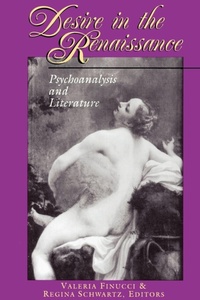
Desire in the Renaissance
Psychoanalysis and Literature
Published on 6. November 1994
Book
Paperback/Softback
272 pages
978-0-691-00100-5 (ISBN)
Description
Drawing on a variety of psychoanalytic approaches, ten critics engage in exciting discussions of the ways the "inner life" is depicted in the Renaissance and the ways it is shown to interact with the "external" social and economic spheres. Spurred by the rise of capitalism and the nuclear family, Renaissance anxieties over changes in identity emerged in the period's unconscious--or, as Freud would have it, in its literature. Hence, much of Renaissance literature represents themes that have been prominent in the discourse of psychoanalysis: mistaken identity, incest, voyeurism, mourning, and the uncanny. The essays in this volume range from Spenser and Milton to Machiavelli and Ariosto, and focus on the fluidity of gender, the economics of sexual and sibling rivalry, the power of the visual, and the cultural echoes of the uncanny. The discussion of each topic highlights language as the medium of desire, transgression, or oppression. The section "Faking It: Sex, Class, and Gender Mobility" contains essays by Marjorie Garber (Middleton), Natasha Korda (Castiglione), and Valeria Finucci (Ariosto).
The contributors to "Ogling: The Circulation of Power" include Harry Berger (Spenser), Lynn Enterline (Petrarch), and Regina Schwartz (Milton). "Loving and Loathing: The Economics of Subjection" includes Juliana Schiesari (Machia-velli) and William Kerrigan (Shakespeare). "Dreaming On: Uncanny Encounters" contains essays by Elizabeth J. Bellamy (Tasso) and David Lee Miller (Jonson).
The contributors to "Ogling: The Circulation of Power" include Harry Berger (Spenser), Lynn Enterline (Petrarch), and Regina Schwartz (Milton). "Loving and Loathing: The Economics of Subjection" includes Juliana Schiesari (Machia-velli) and William Kerrigan (Shakespeare). "Dreaming On: Uncanny Encounters" contains essays by Elizabeth J. Bellamy (Tasso) and David Lee Miller (Jonson).
Reviews / Votes
"Desire in the Renaissance is impressive in its range, and shows how comprehensive the use of psychoanalytic theory in literary criticism has become. At their best, the essays demonstrate the power of psychoanalysis to elucidate the convoluted workings of literary language, and argue for its peculiar compatibility with the dizzying gamesmanship of early modern texts."--Katy Emck, Times Literary SupplementMore details
Language
English
Place of publication
New Jersey
United States
Target group
Professional and scholarly
College/higher education
Product notice
Paperback (trade)
Dimensions
Height: 229 mm
Width: 152 mm
Thickness: 17 mm
Weight
465 gr
ISBN-13
978-0-691-00100-5 (9780691001005)
Copyright in bibliographic data and cover images is held by Nielsen Book Services Limited or by the publishers or by their respective licensors: all rights reserved.
Schweitzer Classification
Other editions
Additional editions
E-Book
10/1994
1st Edition
Princeton University Press
€257.95
Available for download
Persons
Valeria Finucci is Professor of Romance Studies and Regina Schwartz is Professor of English, both at Duke University.
Content
Introduction: Worlds Within and Without3The Insincerity of Women19Mistaken Identities: Castiglio(ne)'s Practical Joke39The Female Masquerade: Ariosto and the Game of Desire61Actaeon at the Hinder Gate: The Stag Party in Spenser's Gardens of Adonis91Embodied Voices: Petrarch Reading (Himself Reading) Ovid120Through the Optic Glass: Voyeurism and Paradise Lost146Libidinal Economies: Machiavelli and Fortune's Rape169Female Friends and Fraternal Enemies in As You Like It184From Virgil to Tasso: The Epic Topos as an Uncanny Return207Writing the Specular Son: Jonson, Freud, Lacan, and the (K)not of Masculinity233List of Contributors261Index263