

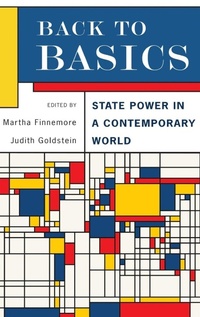
Back to Basics
State Power in a Contemporary World
Published on 25. April 2013
Book
Hardback
392 pages
978-0-19-997008-7 (ISBN)
Description
No scholar better exemplifies the intellectual challenges foisted on the Neorealist school of international relations than prominent scholar Stephen Krasner (Graham H. Stuart Professor of International Studies, the Senior Associate Dean for the Social Sciences, School of Humanities & Sciences, and Director of Policy Planning at the US State Department 2005-2007). Throughout his career he has wrestled with realism's promises and limitations. Krasner has always been a prominent defender of realism and the importance of power understood in material terms, whether military or economic. Yet realist frameworks rarely provided a complete explanation for outcomes, in Krasner's analyses, and much of his work involved understanding power's role in situations not well explained by realism. If states seek power, why do we see cooperation? If hegemony promotes cooperation why does cooperation continue in the face of America's decline? Do states actually pursue their national interests or do domestic structures and values derail the rational pursuit of material objectives? Krasner's explanations were as diverse as were the problems. They pushed, to use his phrase, "the limits of realism."
Edited by Martha Finnemore and Judith Goldstein, Back to Basics asks scholars to reflect on the role power plays in contemporary politics and how a power politics approach is influential today. The arguments made by the authors in this volume speak to one of three themes that run through Krasner's work: state power and hegemony; the relationship between states and markets; conceptions of the nation state in international politics. These themes appeared regularly in Krasner's scholarship as he wrestled, over his career, with fundamental questions of inter-state politics. Contributors largely agree on the centrality of power but diverge substantially on the ways power is manifest and should be measured and understood. Many of the contributors confronted the same intellectual dilemmas as Krasner in struggling to define power and its relationship to interests, yet their responses are different. Together, these essays explore new ways of thinking about power's role in contemporary politics and demonstrate the concepts continued relevance for both policy and theory.
Edited by Martha Finnemore and Judith Goldstein, Back to Basics asks scholars to reflect on the role power plays in contemporary politics and how a power politics approach is influential today. The arguments made by the authors in this volume speak to one of three themes that run through Krasner's work: state power and hegemony; the relationship between states and markets; conceptions of the nation state in international politics. These themes appeared regularly in Krasner's scholarship as he wrestled, over his career, with fundamental questions of inter-state politics. Contributors largely agree on the centrality of power but diverge substantially on the ways power is manifest and should be measured and understood. Many of the contributors confronted the same intellectual dilemmas as Krasner in struggling to define power and its relationship to interests, yet their responses are different. Together, these essays explore new ways of thinking about power's role in contemporary politics and demonstrate the concepts continued relevance for both policy and theory.
Reviews / Votes
Back to Basics maintains that state power is central to IR; however, each equally eminent contributing author proposes differing visions of the role of power in relation to interests and states... The book is significant for both policy and theory, and is sure to be required reading for international studies? * helping to put together the puzzle of IR... Highly recommended.CHOICE *More details
Language
English
Place of publication
New York
United States
Target group
College/higher education
Professional and scholarly
Dimensions
Height: 240 mm
Width: 161 mm
Thickness: 26 mm
Weight
752 gr
ISBN-13
978-0-19-997008-7 (9780199970087)
Copyright in bibliographic data and cover images is held by Nielsen Book Services Limited or by the publishers or by their respective licensors: all rights reserved.
Schweitzer Classification
Other editions
Additional editions
Book
04/2013
Oxford University Press Inc
€60.90
Shipment within 15-20 days
E-Book
04/2013
1st Edition
OUP eBook
€27.49
Available for download
E-Book
03/2013
1st Edition
OUP eBook
€27.49
Available for download
Persons
Martha Finnemore is University Professor of Political Science and International Affairs, The Elliot School of International Affairs, George Washington University. Judith Goldstein is Janet M. Peck Professor in International Communication, Stanford University.
Editor
University Professor of Political Science and International AffairsUniversity Professor of Political Science and International Affairs, The Elliot School of International Affairs, George Washington University
Janet M. Peck Professor in International CommunicationJanet M. Peck Professor in International Communication, Stanford University
Content
Contents ; Introductory Essays: Realism as an Intellectual Tradition ; 1 Puzzles about Power ; Martha Finnemore and Judith Goldstein ; 2 Power Politics in the Contemporary World: ; Lessons from the Scholarship of Stephen Krasner ; Martha Finnemore and Judith Goldstein ; 3 Stephen Krasner: Subversive Realist ; Robert O. Keohane ; Theoretical Reflections on Power, States, and Sovereignty ; 4 Authority, Coercion, and Power in International Relations ; David A. Lake ; 5 Governance under Limited Sovereignty ; Thomas Risse ; 6 Three Scenes of Sovereignty and Power ; Etel Solingen ; 7 States and Power as Ur-Force: Domestic Traditions and Embedded Actors in ; World Politics ; Peter J. Katzenstein ; State Power and the Global Economy ; 8 Currency and State Power ; Benjamin J. Cohen ; 9 International Trade Law as a Mechanism for State Transformation ; Richard H. Steinberg ; 10 Choice and Constraint in the Great Recession of 2008 ; Peter Gourevitch ; The Subversive Effects of Globalization ; 11 Power Politics and the Powerless ; Arthur A. Stein ; 12 Globalization and Welfare: Would a Rational Hegemon Still Prefer Openness? ; Lloyd Gruber ; 13 The Tragedy of the Global Institutional Commons ; Daniel W. Drezner ; Parting Thoughts: Causation and Complexity ; 14 Causation and Responsibility in a Complex World ; Robert Jervis ; 15 Power, Bargaining, and Persuasion: Unevenly Mapped Terrain ; Stephen D. Krasner