

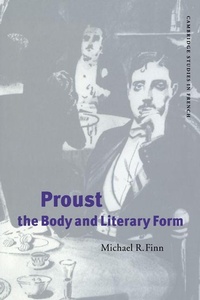
Proust, the Body and Literary Form
Published on 2. November 2006
Book
Paperback/Softback
228 pages
978-0-521-02754-0 (ISBN)
Description
This 1999 study examines the connections between Proust's fin-de-siecle 'nervousness' and his apprehensions regarding literary form. Michael Finn shows that Proust's anxieties both about bodily weakness and about novel-writing were fed by a set of intriguing psychological and medical texts, and were mirrored in the nerve-based afflictions of earlier writers including Flaubert, Baudelaire, Nerval and the Goncourt brothers. Finn argues that once Proust cast off his concerns about being a nervous weakling he was freed to poke fun both at the supposed purity of the novel form. Hysteria - as a figure and as a theme - becomes a key to the Proustian narrative, and a certain kind of wordless, bodily copying of gesture and event is revealed to be at the heart of a writing technique which undermines many of the conventions of fiction.
Reviews / Votes
'Finn has given us a splendid book.' Nineteenth-Century French StudiesMore details
Series
Language
English
Place of publication
Cambridge
United Kingdom
Target group
Professional and scholarly
Product notice
Paperback (trade)
Illustrations
Worked examples or Exercises
Dimensions
Height: 229 mm
Width: 152 mm
Thickness: 14 mm
Weight
377 gr
ISBN-13
978-0-521-02754-0 (9780521027540)
Copyright in bibliographic data and cover images is held by Nielsen Book Services Limited or by the publishers or by their respective licensors: all rights reserved.
Schweitzer Classification
Other editions
Additional editions
Michael R. Finn
Proust, the Body and Literary Form
E-Book
01/2005
1st Edition
Cambridge University Press
€32.49
Available for download
Michael R. Finn
Proust, the Body and Literary Form
Book
03/1999
Cambridge University Press
€122.50
Shipment within 15-20 days
Person
Content
Acknowledgements; Abbreviations; Introduction; 1. Proust between neurasthenia and hysteria; 2. An anxiety of language; 3. Transitive writing; 4. Form: from anxiety to play; Conclusion; Notes; Bibliography; Index.