

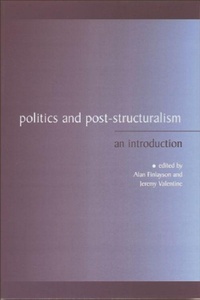
Politics and Post-Structuralism
An Introduction
Published on 3. April 2002
Book
Paperback/Softback
244 pages
978-0-7486-1296-3 (ISBN)
Description
Post-structuralism is recognised as a major force within literary and cultural studies. This book is the first to apply the theory to politics and to show the ways in which it can illuminate political theory and analysis. As such it is likely to become a key text in the development of this area, providing a stimulating introduction to the subject. Authors explore the two-way relationship, showing not only that post-structuralism can enhance the study of politics, but also that advocates of post-structuralism can benefit from being open to the lessons political studies can teach. The book aims to* Clarify the relationship of contemporary theory to politics* Open up a new intellectual interface* Create a space for exchange between disciplines* Provide a statement of the role of post-structuralist theory in politicsCovering three main sections - What is Post-structuralist Political Theory?; Post-structuralism and Political Analysis; and The Question of the Political - the authors draw on themes raised by Continental thinkers such as Derrida, Nancy and Deleuze, and Anglo-American thinkers such as Butler and Connolly in their questioning of the theoretical and empirical understanding of contemporary politics.Key Features:* First systematic examination of post-structuralism to see what it may mean for political studies* Advances its own rigorous and theoretically informed position* Cutting edge: provides a vibrant introduction to this area of political thought and analysis* Brings clarity to the two-way relationship between post-structuralism and politics
Reviews / Votes
An extremely admirable publication ! a great achievment by the editors. This is not least because Politics and Post-Structuralism will go a long way to redressing the misconstrual and general misrepresentation of post-structuralism, showing it (or them) to be both politically and intellectually vital and valuable. An intelligent, thought-provoking and lively collection which offers an insight into the ways in which post-structuralism might move us beyond the framework of mainstream political theory and political science. These wide-ranging contributions are suggestive of the scope and possibilities opened up by a post-structuralist approach to political theorizing and the analysis of contemporary politics. -- Aletta J. Norval Excellent ... I think it will serve a good function, become a state of the art kind of book appreciated by students and teachers alike ... I think the editors are correct in their appraisal that the impact of post-structuralism on theorizing and conceptualizing politics has not yet really begun and that now is a good time to carry this task out. -- Professor Keith Ansell-Pearson, University of Warwick Few volumes are as well put together, framing the key issues in ways accessible to both readers of post-structuralism and political studies alike. In rereading the questions of critique, community, subjectivity, the public and the state, and the policy process, the volume covers many of the most important contemporary issues of political studies in both the UK and the US and will make a useful introduction and companion to a reading of both post-structuralist thought and political practice. -- Professor Ian R. Douglas, The American University in Cairo An extremely admirable publication ! a great achievment by the editors. This is not least because Politics and Post-Structuralism will go a long way to redressing the misconstrual and general misrepresentation of post-structuralism, showing it (or them) to be both politically and intellectually vital and valuable. An intelligent, thought-provoking and lively collection which offers an insight into the ways in which post-structuralism might move us beyond the framework of mainstream political theory and political science. These wide-ranging contributions are suggestive of the scope and possibilities opened up by a post-structuralist approach to political theorizing and the analysis of contemporary politics. Excellent ... I think it will serve a good function, become a state of the art kind of book appreciated by students and teachers alike ... I think the editors are correct in their appraisal that the impact of post-structuralism on theorizing and conceptualizing politics has not yet really begun and that now is a good time to carry this task out. Few volumes are as well put together, framing the key issues in ways accessible to both readers of post-structuralism and political studies alike. In rereading the questions of critique, community, subjectivity, the public and the state, and the policy process, the volume covers many of the most important contemporary issues of political studies in both the UK and the US and will make a useful introduction and companion to a reading of both post-structuralist thought and political practice.More details
Language
English
Place of publication
Edinburgh
United Kingdom
Target group
Professional and scholarly
Product notice
Paperback (trade)
Unsewn / adhesive bound
Dimensions
Height: 235 mm
Width: 160 mm
Thickness: 14 mm
Weight
395 gr
ISBN-13
978-0-7486-1296-3 (9780748612963)
Copyright in bibliographic data and cover images is held by Nielsen Book Services Limited or by the publishers or by their respective licensors: all rights reserved.
Schweitzer Classification
Other editions
Additional editions
E-Book
07/2019
1st Edition
Edinburgh University Press
€0.00
Available for download
Persons
Alan Finlayson is professor of Political and Social Theory at the University of East Anglia. He is co-editor (with Jeremy Valentine) of Politics and Post-Structuralism: An Introduction (EUP, 2002) and co-author of Contemporary Social and Political Thought: An Introduction (1999) Jeremy Valentine is Lecturer in Media Studies at Queen Margaret University College, Edinburgh.
Content
Introduction: Post-structuralism and Politics, Alan Finlayson and Jeremy Valentine; Part 1: Politics and the Subject; 1. The Subject and Subjectivity, Caroline Williams; 2. The State and Sovereign Subjectivity, James Martin; 3. After The Subject of International Security, Jenny Edkins; Part 2: Doing Political Analysis; 4. Ideology and Social Movements: The case of the FN, Steve Bastow; 5. The Work of Ideas and Interests in Public Policy, Stephen Griggs and David Howarth; 6. Economic Subjectivity and Globalization, Glyn Daly; 7. Political Science and Complexity, Paul Haynes; Part 3. Critique and Political Thought; 8. The Horizon of Community, Alan Finlayson; 9. Public Reason Without a Public, Jeremy Valentine; 10. Critical Theory and Democracy, Mark Devenney; 11. The Singularity of the Political, Robert Porter; 12. Genres, Technologies and Spaces of Being-In-Common, Michael J. Shapiro; Bibliography.