

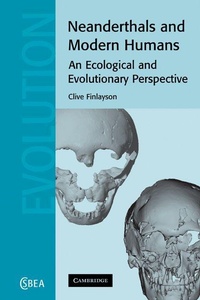
Neanderthals and Modern Humans
An Ecological and Evolutionary Perspective
Published on 17. September 2009
Book
Paperback/Softback
268 pages
978-0-521-12100-2 (ISBN)
Description
Neanderthals and Modern Humans develops the theme of the close relationship between climate change, ecological change and biogeographical patterns in humans during the Pleistocene. In particular, it challenges the view that Modern Human 'superiority' caused the extinction of the Neanderthals between 40 and 30 thousand years ago. Clive Finlayson shows that to understand human evolution, the spread of humankind across the world and the extinction of archaic populations, we must move away from a purely theoretical evolutionary ecology base and realise the importance of wider biogeographic patterns including the role of tropical and temperate refugia. His proposal is that Neanderthals became extinct because their world changed faster than they could cope with, and that their relationship with the arriving Modern Humans, where they met, was subtle.
Reviews / Votes
Review of the hardback: '... valuable for its synthesis of the climatic backdrop to later human evolution, which reminds us of the remarkable climatic challenges that our Pleistocene predecessors had to face.' Science Review of the hardback: '... an interesting and stimulating read ...' TRENDS in Ecology and Evolution Review of the hardback: '... an interesting and stimulating volume. I recommend this book for those interested in human evolution.' PalArch, Netherlands Scientific Journal Review of the hardback: '... it will help to shape the debates of the next decade.' Journal of Biosocial Science Review of the hardback: 'I'm sure that this study will have a great influence on many anthropologists and archaeologists.' Anthropological Science '... this book is certainly recommended, being a solitary volume giving the alternative environmentally driven perspective of Neanderthal extinction.' Journal of Quaternary Science 'I found this a fascinating book to read, almost like a detective story as various strands of evidence are assembled and combined.' Rezensionen 'The book is well laid out and the argument develops logically over the eight chapters ... this is a very erudite and worthwhile book that lays out a plausible set of testable conclusions.' Journal of Cambridge Archaeological JournalMore details
Series
Language
English
Place of publication
Cambridge
United Kingdom
Target group
Professional and scholarly
Product notice
Paperback (trade)
Illustrations
Worked examples or Exercises
Dimensions
Height: 229 mm
Width: 152 mm
Thickness: 16 mm
Weight
440 gr
ISBN-13
978-0-521-12100-2 (9780521121002)
Copyright in bibliographic data and cover images is held by Nielsen Book Services Limited or by the publishers or by their respective licensors: all rights reserved.
Schweitzer Classification
Other editions
Additional editions
E-Book
05/2006
1st Edition
Cambridge University Press
€38.49
Available for download
Person
Content
Preface and acknowledgements; 1. Human evolution in the Pleistocene; 2. Biogeographical patterns; 3. Human range expansions, contractions and extinctions; 4. The modern human-Neanderthal problem; 5. Comparative behaviour and ecology of Neanderthals and modern humans; 6. The conditions in Africa and Eurasia during the last Glacial Cycle; 7. The modern human colonization and the Neanderthal extinction; 8. The survival of the weakest; References; Index.