

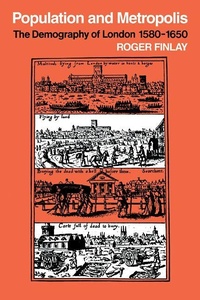
Population and Metropolis
The Demography of London 1580-1650
Published on 19. March 2009
Book
Paperback/Softback
204 pages
978-0-521-10314-5 (ISBN)
Description
This is a book about the population of London during the early modern period and a detailed book about the population of a European metropolitan city at that time. Much is now known about the historical demography of rural England, but very little is understood about the larger towns and cities. Roger Finlay applies new techniques in historical demography, principally family reconstitution and aggregative analysis of parish registers, to study the growth of population in London. He shows that parish registers are as reliable for the analysis of population trends in London as in rural England. The death rate was much higher in London than in the countryside, and this difference was not offset by a markedly higher birth rate, so the population would have declined but for migration. There were striking variations in both fertility and mortality between contrasting social areas of London.
More details
Series
Language
English
Place of publication
Cambridge
United Kingdom
Target group
Professional and scholarly
Product notice
Paperback (trade)
Illustrations
Worked examples or Exercises
Dimensions
Height: 229 mm
Width: 152 mm
Thickness: 12 mm
Weight
339 gr
ISBN-13
978-0-521-10314-5 (9780521103145)
Copyright in bibliographic data and cover images is held by Nielsen Book Services Limited or by the publishers or by their respective licensors: all rights reserved.
Schweitzer Classification
Other editions
Additional editions

Book
08/1981
Cambridge University Press
€6.19
Article exhausted; check for reprint
Previous edition
Book
08/1981
Cambridge University Press
€6.19
Article exhausted; check for reprint
Content
1. Introduction: The magnet of the metropolis; 2. The accuracy of the London parish registers; 3. The general growth of population in London; 4. London social structure in 1638; 5. The measurement of mortality rates; 6. The effect of plague on mortality experience; 7. Marriage and fertility; 8. Population and metropolis.