

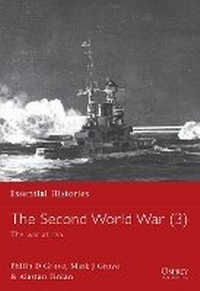
The Second World War (3)
The war at sea
Published on 25. August 2002
Book
Paperback/Softback
96 pages
978-1-84176-397-2 (ISBN)
Description
This volume provides a comprehensive guide to three major theatres of combat; the battles for the Atlantic, the war in the Mediterranean and the contest in the Indian Ocean. The war at sea was a vital contest, which if lost would have irreversibly altered the balance of the military forces on land. An island nation like Britain could not have sustained itself to triumph over Germany, Italy and Japan after five years of fighting without having first assured victory at sea. The sea lanes were the logistical arteries of British and subsequent Allied armies fighting on the three continents of Africa, Asia and Europe. The Second World War was ultimately won by land forces but it could always have been lost at sea.
More details
Series
Language
English
Place of publication
United Kingdom
Publishing group
Bloomsbury Publishing PLC
Target group
College/higher education
Illustrations
44 b/w; 14 col
Dimensions
Height: 248 mm
Width: 170 mm
Thickness: 7 mm
Weight
332 gr
ISBN-13
978-1-84176-397-2 (9781841763972)
Copyright in bibliographic data and cover images is held by Nielsen Book Services Limited or by the publishers or by their respective licensors: all rights reserved.
Schweitzer Classification
Persons
Alastair Finlan lectures in Strategic Studies at Britannia Royal Naval College. He has also taught at the universities of Keele and Plymouth. His PhD thesis was recently nominated by the School of Politics, International Relations and the Environment (SPIRE), Keele University, for a Political Studies award. Mark J Grove teaches naval and international history in the Department of Strategic Studies and International Affairs, Britannia Royal Naval College, and lectures part time in the Department of Politics, University of Plymouth. He has a particular interest in amphibious warfare. Philip D Grove joined the Department of Strategic Studies and International Affairs, Britannia Royal Naval College in 1993 following the completion of two degrees from Aberystwyth in the area of Strategic Studies. He is presently Senior Lecturer in the department and working on a series of articles and a MPhil thesis concerning naval aviation in the twentieth century.
Content
Introduction and Chronology *Warring sides *Outbreak *The fighting *Portrait of a soldier *The world around war *Portrait of a civilian *How the war ended *Conclusion and consequences