

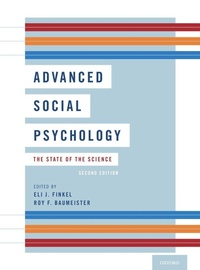
Advanced Social Psychology
The State of the Science
2nd Edition
Published on 9. May 2019
Book
Hardback
600 pages
978-0-19-063559-6 (ISBN)
Description
Social psychology uses clever, even ingenious, research methods to explore the most essential questions of the human psyche: Why do we help some people and harm others? Why do we pay so much more attention to high-powered people than they pay to us? If humans evolved from great apes, why are human selves so much more elaborate? How does our attachment to our parents when we are infants influence the success or failure of our romantic relationships when we are adults? Can behaving morally "license" us to behave immorally shortly afterward? How do social relationships make us more versus less prone toward physical illness?
This volume -- an update to the original, 2010 edition -- provides a graduate-level introduction to social psychology. The target audience consists of first-year graduate students (MA or PhD) in social psychology and related disciplines (marketing, organizational behavior, etc.), although it is also appropriate for upper-level undergraduate courses. The authors are world-renowned leaders on their topic, and they have written state-of-the-art overviews of the discipline's major research domains. The chapters are not only scientifically rigorous, but also accessible and engaging. They convey the joy, excitement, and promise of scientific investigations into human sociality.
This volume -- an update to the original, 2010 edition -- provides a graduate-level introduction to social psychology. The target audience consists of first-year graduate students (MA or PhD) in social psychology and related disciplines (marketing, organizational behavior, etc.), although it is also appropriate for upper-level undergraduate courses. The authors are world-renowned leaders on their topic, and they have written state-of-the-art overviews of the discipline's major research domains. The chapters are not only scientifically rigorous, but also accessible and engaging. They convey the joy, excitement, and promise of scientific investigations into human sociality.
Reviews / Votes
Now what do I teach?' is a common refrain among social psychologists taken aback by recent failures to replicate some prominent and classic findings. Updating a social psychology textbook is an unenviable task at a time of substantial uncertainty about theories and findings that seemed almost ordinary in the last edition. Admirably, Editors Finkel and Baumeister aim to address reproducibility directly in this 2nd Edition of Advanced Social Psychology. The first three chapters discuss replicability challenges and reforms to improve rigor and credibility. They also set the stage that science does not have a canon of inarguable facts. Scientific understanding is always in revision, and every finding, claim, and theory is open to confrontation. The other 18 substantive chapters approach replicability differently. Some highlight replicability success and challenges in their substantive domains; the chapters on Attraction, Morality, Health, and Computation stand out as effective examples. Others appear to address replicability implicitly by what is not said or cited. In those, the self-corrective process of science is working quietly by omission. Finally, a few chapters appear to have missed news of the "reproducibility crisis". These chapters treat each cited claim with the same enthusiastic certainty whether it is backed by a substantial body of evidence or a single paper with just significant effects. This diversity among contributed chapters reflects where we are today as a discipline * still wrestling, from many points of view, with the credibility of the rich theories and findings that comprise social psychology.Brian Nosek, Professor, Department of Psychology, University of Virginia *More details
Edition
2nd Revised edition
Language
English
Place of publication
New York
United States
Target group
College/higher education
Edition type
Revised edition
Dimensions
Height: 286 mm
Width: 221 mm
Thickness: 36 mm
Weight
1728 gr
ISBN-13
978-0-19-063559-6 (9780190635596)
Copyright in bibliographic data and cover images is held by Nielsen Book Services Limited or by the publishers or by their respective licensors: all rights reserved.
Schweitzer Classification
Other editions
Additional editions
E-Book
03/2019
2nd Edition
OUP eBook
€90.99
Available for download
E-Book
03/2019
2nd Edition
OUP eBook
€90.99
Available for download
Persons
Eli J. Finkel is Professor at Northwestern University, where he holds appointments in the psychology department and the Kellogg School of Management. He earned his BA in 1997 from Northwestern and his PhD in 2001 from the University of North Carolina at Chapel Hill. He has published more than 140 academic papers, is a frequent contributor to the Op-Ed page of the New York Times, and is the author of the bestselling book The All-Or-Nothing Marriage: How the Best Marriages Work (2017). He has received several career awards, including the SAGE Young Scholars Award from the Foundation for Social and Personality Psychology, the Caryl E. Rusbult Young Investigator Award from the Relationship Researchers Interest Group of the Society for Personality and Social Psychology, and the Gerald R. Miller Award for Early Career Achievement from the International Association for Relational Research. He has received dozens of teaching awards and recognitions, including recognition by College Magazine
as one of the Top 10 Professors at Northwestern.
Roy F. Baumeister is Professor of Psychology at the University of Queensland, in Australia, as well as Professor Emeritus at Florida State. He received his PhD in social psychology from Princeton University in 1978, having worked with the great Edward E. Jones as his mentor. He has published hundreds of articles and a couple dozen books on a broad range of topics, including self and identity, interpersonal belongingness and rejection, sexuality, evil and violence, emotion, self-regulation, free will, decision making, consciousness, and the meaning of life. He has received several lifetime achievement awards, including the William James Fellow award, which is the highest honor given by the Association for Psychological Science. As of 2018, his publications have been cited in the scientific journals over 150,000 times. Writing for publication and mentoring graduate students are his favorite parts of the job.
as one of the Top 10 Professors at Northwestern.
Roy F. Baumeister is Professor of Psychology at the University of Queensland, in Australia, as well as Professor Emeritus at Florida State. He received his PhD in social psychology from Princeton University in 1978, having worked with the great Edward E. Jones as his mentor. He has published hundreds of articles and a couple dozen books on a broad range of topics, including self and identity, interpersonal belongingness and rejection, sexuality, evil and violence, emotion, self-regulation, free will, decision making, consciousness, and the meaning of life. He has received several lifetime achievement awards, including the William James Fellow award, which is the highest honor given by the Association for Psychological Science. As of 2018, his publications have been cited in the scientific journals over 150,000 times. Writing for publication and mentoring graduate students are his favorite parts of the job.
Content
Chapter 1. Social Psychology: Crisis and Renaissance
Eli J. Finkel and Roy F. Baumeister
Chapter 2. A Brief History of Social Psychology
Harry Reis
Chapter 3. New Developments in Research Methods
Alison Ledgerwood
Chapter 4. Social Cognition
Susan Fiske
Chapter 5. Self
Roy F. Baumeister
Chapter 6. Attitude Structure and Change
Richard Petty, Pablo Brinol, Lee Fabrigar, and Duane Wegener
Chapter 7. Social Influence
Robert Cialdini and Vladas Griskevicius
Chapter 8. Aggression
Brad Bushman
Chapter 9. Attraction and Rejection
Eli J. Finkel and Roy F. Baumeister
Chapter 10. Close Relationships
Shelly Gable
Chapter 11. Intergroup Relations
Marilynn Brewer
Chapter 12. Prejudice, Stereotyping, and Discrimination
Jack Dovidio and James Jones
Chapter 13. Morality
Linda Skitka and Paul Conway
Chapter 14. Emotion
Wendy Berry Mendes
Chapter 15. Social Neuroscience
Thalia Wheatley
Chapter 16. Evolutionary Social Psychology
Jon Maner
Chapter 17. Cultural Psychology
Steve Heine
Chapter 18. Health, Stress, and Coping
Ted Robles
Chapter 19. Judgment and Decision-making
Kathleen Vohs and Mary Frances Luce
Chapter 20. Personality
Charles Carver
Chapter 21. Computational Psychology
Michal Kosinski
Eli J. Finkel and Roy F. Baumeister
Chapter 2. A Brief History of Social Psychology
Harry Reis
Chapter 3. New Developments in Research Methods
Alison Ledgerwood
Chapter 4. Social Cognition
Susan Fiske
Chapter 5. Self
Roy F. Baumeister
Chapter 6. Attitude Structure and Change
Richard Petty, Pablo Brinol, Lee Fabrigar, and Duane Wegener
Chapter 7. Social Influence
Robert Cialdini and Vladas Griskevicius
Chapter 8. Aggression
Brad Bushman
Chapter 9. Attraction and Rejection
Eli J. Finkel and Roy F. Baumeister
Chapter 10. Close Relationships
Shelly Gable
Chapter 11. Intergroup Relations
Marilynn Brewer
Chapter 12. Prejudice, Stereotyping, and Discrimination
Jack Dovidio and James Jones
Chapter 13. Morality
Linda Skitka and Paul Conway
Chapter 14. Emotion
Wendy Berry Mendes
Chapter 15. Social Neuroscience
Thalia Wheatley
Chapter 16. Evolutionary Social Psychology
Jon Maner
Chapter 17. Cultural Psychology
Steve Heine
Chapter 18. Health, Stress, and Coping
Ted Robles
Chapter 19. Judgment and Decision-making
Kathleen Vohs and Mary Frances Luce
Chapter 20. Personality
Charles Carver
Chapter 21. Computational Psychology
Michal Kosinski