

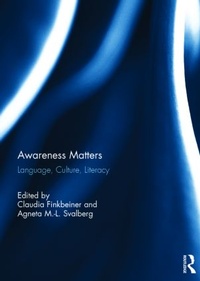
Awareness Matters
Language, Culture, Literacy
1st Edition
Published on 1. August 2014
Book
Hardback
252 pages
978-1-138-02142-6 (ISBN)
Description
This collection argues that being aware of and reflecting on language form and language use is a powerful tool, not only in language learning, but also in wider society. It adopts an interdisciplinary stance: one chapter argues the need for Language Awareness in business contexts, while another examines the role of critical cultural awareness and Language Awareness in education as 'bildung'. Others report on research studies in language classrooms and in teacher education. Language Awareness is interrogated from a range of perspectives such as peer interaction, teaching young learners, learner strategies and strategies for writing, online reading, and oral fluency training. The scope is global, including contributions from Canada, Germany, Iran, Japan, Spain, and the UK, and covers bilingual as well as multilingual contexts. The book will be of interest to language teachers, language teacher educators, other language professionals, and generally to the language aware.
This book was originally published as a special issue of Language Awareness.
This book was originally published as a special issue of Language Awareness.
More details
Language
English
Place of publication
London
United Kingdom
Publishing group
Taylor & Francis Ltd
Target group
College/higher education
Professional and scholarly
Academic, Postgraduate, and Undergraduate
Illustrations
7 s/w Abbildungen, 15 s/w Zeichnungen
15 Line drawings, black and white; 7 Illustrations, black and white
Dimensions
Height: 246 mm
Width: 174 mm
Weight
589 gr
ISBN-13
978-1-138-02142-6 (9781138021426)
Copyright in bibliographic data and cover images is held by Nielsen Book Services Limited or by the publishers or by their respective licensors: all rights reserved.
Schweitzer Classification
Other editions
Additional editions
Book
10/2024
1st Edition
Routledge
€68.27
Shipment within 10-20 days
E-Book
01/2016
1st Edition
Routledge
€53.99
Available for download
E-Book
01/2016
1st Edition
Routledge
€53.99
Available for download
Persons
Agneta Svalberg teaches and supervises on Master's and Doctoral courses in Applied Linguistics and TESOL at the University of Leicester, UK. She is particularly interested in grammar, both in language teaching and learning and from a theoretical perspective (in particular tense-modality-aspect). In her teaching of English grammar to English as a Foreign Language (EFL) teachers she uses a Language Awareness-raising approach. Her research focuses on Engagement with Language.
Claudia Finkbeiner is a full professor of EFL research and intercultural communication. Her research areas are EFL, multilingual and multicultural learning and teaching. She has conducted research projects, published and given lectures around the world on reading, reading strategies and reading interest, literacy development, intercultural communication, language awareness and cultural awareness, content and language integrated learning (CLIL), computer assisted and blended learning and has published in numerous journals and books She has been president of the Association for Language Awareness since 2006.
Claudia Finkbeiner is a full professor of EFL research and intercultural communication. Her research areas are EFL, multilingual and multicultural learning and teaching. She has conducted research projects, published and given lectures around the world on reading, reading strategies and reading interest, literacy development, intercultural communication, language awareness and cultural awareness, content and language integrated learning (CLIL), computer assisted and blended learning and has published in numerous journals and books She has been president of the Association for Language Awareness since 2006.
Content
1. Introduction Claudia Finkbeiner and Agneta M.-L. Svalberg 2. Language awareness and (critical) cultural awareness - relationships, comparisons and contrasts Michael Byram 3. Languages in primary classrooms: a study of new teacher capability and practice Wasyl Cajkler and Bernadette Hall 4. Coloured language: identity perception of children in bilingual programmes Beth Martin 5. Self-regulated cooperative EFL reading tasks: students' strategy use and teachers' support Claudia Finkbeiner, Markus Knierim, Marc Smasal and Peter H. Ludwig 6. Awareness development for online reading Victoria Zenotz 7. The impact of fluency strategy training on Iranian EFL learners' speech under online planning conditions Zohreh Seifoori and Zahra Vahidi 8. Teacher language awareness and cognitive linguistics (CL): building a CL-inspired perspective on teaching lexis in EFL student teachers Ralf Gie?ler 9. Peer interaction, cognitive conflict, and anxiety on a Grammar Awareness course for language teachers Agneta Marie-Louise Svalberg 10. Raising language awareness in peer interaction: a cross-context, cross-methodology examination Masatoshi Sato and Susan Ballinger 11. Cognate awareness -raising in late childhood: teachable and useful Joanna L. White and Marlise Horst 12. Grapho-morphological awareness in Spanish L2 reading: how do learners use this metalinguistic skill? Nausica Marcos Miguel 13. Language awareness as a challenge for business Reinhard Huenerberg and Andrea Geile