

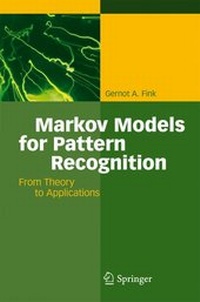
Markov Models for Pattern Recognition
Description
This comprehensive introduction to the Markov modeling framework describes the underlying theoretical concepts of Markov models as used for sequential data, covering Hidden Markov models and Markov chain models. It also presents the techniques necessary to build successful systems for practical applications. In addition, the book demonstrates the actual use of the technology in the three main application areas of pattern recognition methods based on Markov-Models: speech recognition, handwriting recognition, and biological sequence analysis. The book is suitable for experts as well as for practitioners.
Reviews / Votes
"The practice part makes the book unique among many other pattern recognition textbooks. It discusses implementation details that are often ignored in the literature, but are important in constructing a working system. . Overall, the book is well written and clear ... It is suited not to those who want to learn the basics of pattern recognition, but to those who want to learn the state of the art of speech, character, and DNA sequence recognition problems from the perspective of the practitioner and designer. . The depth and breadth of the treatment is right for the intent of the book."
(T. Kubota, Lewisburg, PA, in: Computing Reviews, May 2009)
More details
Other editions
Additional editions
Person
University of Erlangen-Nuremberg, Erlangen, Germany, in 1991.
He recieved a Ph.D. degree in computer science in 1995 and
the venia legendi in applied computer science in 2002 both
from Bielefeld University, Germany.
Currently, he is professor for Pattern Recognition in Embedded Systems
at the University of Dortmund, Germany, where he also heads the
Intelligent Systems Group at the Robotics Research Institute.
His reserach interests lie in the development and application of
pattern recognition methods in the fields of man machine interaction,
multimodal machine perception including speech and image processing,
statistical pattern recognition, handwriting recognition, and the
analysis of genomic data.
Content
1.1 Thematic Context
1.2 Capabilities of Markov Models
1.3 Goal and Structure 2. Application Areas
2.1 Speech
2.2 Handwriting
2.3 Biological Sequences
2.4 Outlook Part I: Theory 3. Foundations of Mathematical Statistics
3.1 Experiment, Event, and Probability
3.2 Random Variables and Probability Distributions
3.3 Parameters of Probability Distributions
3.4 Normal Distributions and Mixture Density Models
3.5 Stochastic Processes and Markov Chains
3.6 Principles of Parameter Estimation
3.7 Bibliographical Remarks 4. Vector Quantisation
4.1 Definition
4.2 Optimality
4.3 Algorithms for Vector Quantiser Design
(LLoyd, LBG, k-means)
4.4 Estimation of Mixture Density Models
4.5 Bibliographical Remarks 5. Hidden-Markov Models
5.1 Definition
5.2 Modeling of Output Distributions
5.3 Use-Cases
5.4 Notation
5.5 Scoring
(Forward algorithm)
5.6 Decoding
(Viterbi algorithm)
5.7 Parameter Estimation
(Forward-backward algorithm,
Baum-Welch, Viterbi, and segmental k-means training)
5.8 Model Variants
5.9 Bibliographical Remarks 6. n-Gram Models
6.1 Definition
6.2 Use-Cases
6.3 Notation
6.4 Scoring
6.5 Parameter Estimation
(discounting, interpolation and backing-off)
6.6 Model Variants
(categorial models, long-distance dependencies)
6.7 Bibliographical Remarks Part II: Practical Aspects 7. Computations with Probabilities
7.1 Logarithmic Probability Representation
7.2 Flooring of Probabilities
7.3 Codebook Evaluation in Tied-Mixture Models
7.4 Likelihood Ratios 8. Configuration of Hidden-Markov Models
8.1 Model Topologies
8.2 Sub-Model Units
8.3 Compound Models
8.4 Profile-HMMs
8.5 Modelling of Output Probability Densities 9. Robust Parameter Estimation
9.1 Optimization of Feature Representations
(Principle component analysis, whitening, linear discriminant
analysis)
9.2 Tying
(of model parameters, especially: mixture tying)
9.3 Parameter Initialization 10. Efficient Model Evaluation
10.1 Efficient Decoding of Mixture Densities
10.2 Beam Search
10.3 Efficient Parameter Estimation
(forward-backward pruning, segmental Baum-Welch,
training of model hierarchies)
10.4 Tree-based Model Representations 11. Model Adaptation
11.1 Foundations of Adaptation
11.2 Adaptation of Hidden-Markov Models
(Maximum-likelihood linear regression)
11.3 Adaptation of n-Gram Models
(cache models, dialog-step dependent models, topic-based
language models) 12. Integrated Search
12.1 HMM Networks
12.2 Multi-pass Search Strategies
12.3 Search-Space Copies
(context and time-based tree copying strategies,
language model look-ahead)
12.4 Time-synchronous Integrated Decoding Part III: Putting it All Together 13. Speech Recognition
13.1 Application-Specific Processing
(feature extraction, vocal tract length normalization, ...)
13.2 Systems
(e.g. BBN Byblos, SPHINX III, ...) 14. Text Recognition
14.1 Application-Specific Processing
(linearization of data representation for off-line applications,
preprocessing, normalization, feature extraction)
14.2 Systems for On-line Handwriting Recognition
14.3 Systems for Off-line Handwriting Recognition 15. Analysis of Biological Seq