

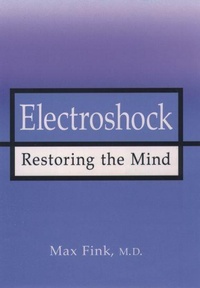
Electroshock
Restoring the Mind
Published on 4. November 1999
Book
Hardback
176 pages
978-0-19-511956-5 (ISBN)
Description
Electroshock therapy (ECT) has long suffered from a controversial and bizarre public image, a reputation that has effectively removed it as a treatment option for many patients. In Electroshock, Max Fink, M.D., draws on 45 years of clinical and research experience to argue that ECT is now a safe, effective, painless, and sometimes life-saving treatment for emotional and mental disorders.
Dr. Fink discusses the development of ECT from its discovery in 1934, its acceptance and widespread use for two decades until it was largely replaced by the introduction of psychotropic drugs in the 1950s, and its revival in the past twenty years as a viable treatment now that undesirable side-effects have been largely removed. He provides case studies of actual patients and the testimonies of their family members to illuminate successful responses. Many disorders, such as depression, mania, catatonia, and schizophrenia, respond well to ECT. We learn what the patient experiences, as the authoer explains the whole procedure from preparation to recovery. He also shows how anesthesia and muscle relaxation have refined ECT, minimizing discomfort and reducing its risks to a level far lower than many of the psychotropic drugs routinely prescribed for the same problems.
An excellent sourcebook for patients, their families, caretakers, and mental health professionals, Electroshock clarifies misconceptions about ECT. For those who suffer from mental and emotional disorders, it offers a safe and highly effective alternative to medication or psychotherapy.
Dr. Fink discusses the development of ECT from its discovery in 1934, its acceptance and widespread use for two decades until it was largely replaced by the introduction of psychotropic drugs in the 1950s, and its revival in the past twenty years as a viable treatment now that undesirable side-effects have been largely removed. He provides case studies of actual patients and the testimonies of their family members to illuminate successful responses. Many disorders, such as depression, mania, catatonia, and schizophrenia, respond well to ECT. We learn what the patient experiences, as the authoer explains the whole procedure from preparation to recovery. He also shows how anesthesia and muscle relaxation have refined ECT, minimizing discomfort and reducing its risks to a level far lower than many of the psychotropic drugs routinely prescribed for the same problems.
An excellent sourcebook for patients, their families, caretakers, and mental health professionals, Electroshock clarifies misconceptions about ECT. For those who suffer from mental and emotional disorders, it offers a safe and highly effective alternative to medication or psychotherapy.
Reviews / Votes
"Dr. Fink...writes about the use of electroshock in the treatment of depression, mania and schizophrenia, among other disorders. He cites numerous studies that he says demonstrate its effectiveness, its record in reducing the cost and length of inpatient treatment, and its ability to bring on antidepressant effects earlier 'and more robust than those of antidepressant drugs.' Dr. Fink's assessment is generally confirmed by the National Institute of MentalHealth, which characterizes electroshock therapy as 'one of the most effective yet most stigmatized treatments for depression.'"--The New York Times
"In an America long besotted with psychotherapy, Max Fink carried an often lonely torch for the physical treatment of psychiatric disorders . . . . Electroshock is a slim volume, packing a punch of controversy."--Nature
"This book, clearly written, concise, and assertive, should help balance the picture, educating mental health professionals and the general public alike"--Forward Magazine
"Dr. Fink...writes about the use of electroshock in the treatment of depression, mania and schizophrenia, among other disorders. He cites numerous studies that he says demonstrate its effectiveness, its record in reducing the cost and length of inpatient treatment, and its ability to bring on antidepressant effects earlier 'and more robust than those of antidepressant drugs.' Dr. Fink's assessment is generally confirmed by the National Institute of Mental
Health, which characterizes electroshock therapy as 'one of the most effective yet most stigmatized treatments for depression.'"--The New York Times
"In an America long besotted with psychotherapy, Max Fink carried an often lonely torch for the physical treatment of psychiatric disorders . . . . Electroshock is a slim volume, packing a punch of controversy."--Nature
"This book, clearly written, concise, and assertive, should help balance the picture, educating mental health professionals and the general public alike"--Forward Magazine
"Among many ECT books that cover similar content, this volume really stands out. It not only reviews evidence-based literature but also reflects the author's enormous amount of personal experience in taking care of severely ill and often treatment-resistant patients....This book is clearly written by a strong ECT advocate, but it presents a balanced view of concomitant treatment options and alternatives."--Ethiopian Reivew, part of DC's Health News
Forum
More details
Language
English
Place of publication
New York
United States
Product notice
sewn/stitched
Cloth over boards
With dust jacket
Dimensions
Height: 216 mm
Width: 140 mm
Thickness: 14 mm
Weight
358 gr
ISBN-13
978-0-19-511956-5 (9780195119565)
Copyright in bibliographic data and cover images is held by Nielsen Book Services Limited or by the publishers or by their respective licensors: all rights reserved.
Schweitzer Classification
Other editions
Additional editions
E-Book
12/2008
2nd Edition
OUP USA
€18.49
Available for download
Book
12/2002
Oxford University Press Inc
€54.10
Shipment within 15-20 days
E-Book
12/2002
2nd Edition
OUP USA
€18.49
Available for download
Person
Max Fink, M.D., is Professor of Psychiatry at the Albert Einstein College of Medicine and attending psychiatrist the Long Island Jewish Hillside Hospital Medical Center. He is the author of Convulsive Therapy: Theory and Practice, Psychobiology of Convulsive Therapy, and other books.
Author
Professor of Psychiatry and Neurology at State University of New York, Stony Brook; Professor of Psychiatry, Albert Einstein College of Medicine, and Attending Psychiatrist, Department of PsychiatryProfessor of Psychiatry and Neurology at State University of New York, Stony Brook; Professor of Psychiatry, Albert Einstein College of Medicine, and Attending Psychiatrist, Department of Psychiatry, Long Island Jewish-Hillside Hospital
Content
- 1: What is Electroshock?
- 2: The Patient's Experience
- 3: Risks and Contradictions
- 4: Technical Features of the Treatment
- 5: Depressive Mood Disorders
- 6: Manic Mood Disorders
- 7: Thought Disorders
- 8: Movement Disorders
- 9: How Does it Work?
- 10: The Origins of Electroshock Therapy
- 11: Controversies in Electroshock
- 12: Electroshock in the 1990s
- Appendix 1: Diagnoses in Which ECT is Considered Effective
- Appendix 2: Diagnoses in Which ECT is Considered Ineffective
- Appendix 3: Sample Consent Form for Electrotherapy
- Appendix 4: Medicines