

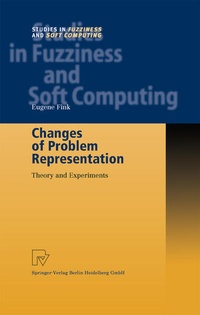
Changes of Problem Representation
Theory and Experiments
Published on 21. October 2010
Book
Paperback/Softback
XIII, 358 pages
978-3-7908-2518-3 (ISBN)
Description
The purpose of our research is to enhance the efficiency of AI problem solvers by automating representation changes. We have developed a system that improves the description of input problems and selects an appropriate search algorithm for each given problem. Motivation. Researchers have accumulated much evidence on the impor tance of appropriate representations for the efficiency of AI systems. The same problem may be easy or difficult, depending on the way we describe it and on the search algorithm we use. Previous work on the automatic im provement of problem descriptions has mostly been limited to the design of individual learning algorithms. The user has traditionally been responsible for the choice of algorithms appropriate for a given problem. We present a system that integrates multiple description-changing and problem-solving algorithms. The purpose of the reported work is to formalize the concept of representation and to confirm the following hypothesis: An effective representation-changing system can be built from three parts: a library of problem-solving algorithms; a library of algorithms that improve problem descriptions; a control module that selects algorithms for each given problem.
More details
Series
Edition
Softcover reprint of hardcover 1st ed. 2002
Language
English
Place of publication
Heidelberg
Germany
Target group
Professional and scholarly
Research
Illustrations
XIII, 358 p.
Dimensions
Height: 235 mm
Width: 155 mm
Thickness: 21 mm
Weight
563 gr
ISBN-13
978-3-7908-2518-3 (9783790825183)
DOI
10.1007/978-3-7908-1774-4
Schweitzer Classification
Other editions
Additional editions
Book
10/2002
Physica
€160.49
Shipment within 10-15 days
Person
Eugene Fink received his B.S. degree from Mount Allison University (Canada) in 1991, M.S. from the University of Waterloo (Canada) in 1992, and Ph.D. from Carnegie Mellon University (USA) in 1999. He has been an assistant professor in the Computer Science and Engineering Department at the University of South Florida (USA) since 1999. His research interests include computational geometry, artificial intelligence, machine learning, and e-commerce.
Derick Wood received his B.Sc. (1963) and Ph.D. (1968) from the University of Leeds (UK). He was a Postdoctoral Fellow at the Courant Institute, New York University (USA), from 1968 to 1970, and then joined McMaster University (Canada) in 1970. He was a professor at the University of Waterloo (Canada) from 1982 to 1992, at the University of Western Ontario (Canada) from 1992 to 1995, and at the Hong Kong University of Science and Technology since 1995. He has published widely in a number of research areas and written two textbooks, "Theory of Computation" (John Wiley, 1987) and "Data Structures, Algorithms, and Performance" (Addison-Wesley, 1993).
Content
I. Introduction.- 1. Motivation.- 2. Prodigy search.- II. Description changers.- 3. Primary effects.- 4. Abstraction.- 5. Summary and extensions.- III. Top-level control.- 6. Multiple representations.- 7. Statistical selection.- 8. Statistical extensions.- 9. Summary and extensions.- IV. Empirical results.- 10. Machining Domain.- 11. Sokoban Domain.- 12. Extended Strips Domain.- 13. Logistics Domain.- Concluding remarks.- References.