

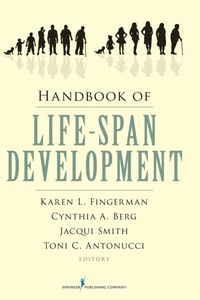
Handbook of Life-Span Development
Published on 25. December 2010
Book
Hardback
650 pages
978-0-8261-1079-4 (ISBN)
Description
The handbook is an impressive collection of research studies and theories provided by knowledgeable contributors on life-span development from conception to old age."--Anthropology and Aging Quarterly
The doubling of our average life span since the turn of the 20th century is considered by many scholars to be one of the most important changes in human existence. This definitive text is the only volume to fully address, through a multidisciplinary perspective, the biological, cognitive, and psychological development that occurs from infancy through old age, and how the sociocultural and institutional factors interface with these changes.
Edited by leading research scholars in the field of life-span development, the volume also includes contributions of specialists in behavioral genetics, socioemotional selectivity theory, neuroscience, ecological models, and more. It examines the dynamics of close relationships and informal ties among the elderly population, child-parent attachment relationships as a life-span phenomenon, developmental tasks across the lifespan, continuity and discontinuity in temperament and personality, the sociocultural context of cognition across the life span, and variability in approaches to social problem solving from early to later life. Given the number of recent demographic shifts, it also explores issues related to fertility, life expectancy, environmental contexts, technology, immigration, and public policy.
Key Features:
Integrates the full life span from infancy through old age in each chapter Considers multidisciplinary perspectives that address personal relationships, cognitive development, and social, emotional, and physical health across the life span Situates life-span development in ecological contexts (e.g., socioeconomic, neighborhood, and immigration status) Provides a concise but thorough resource for graduate seminars in life-span-related studies Highlights future issues in all areas of life-span study
The doubling of our average life span since the turn of the 20th century is considered by many scholars to be one of the most important changes in human existence. This definitive text is the only volume to fully address, through a multidisciplinary perspective, the biological, cognitive, and psychological development that occurs from infancy through old age, and how the sociocultural and institutional factors interface with these changes.
Edited by leading research scholars in the field of life-span development, the volume also includes contributions of specialists in behavioral genetics, socioemotional selectivity theory, neuroscience, ecological models, and more. It examines the dynamics of close relationships and informal ties among the elderly population, child-parent attachment relationships as a life-span phenomenon, developmental tasks across the lifespan, continuity and discontinuity in temperament and personality, the sociocultural context of cognition across the life span, and variability in approaches to social problem solving from early to later life. Given the number of recent demographic shifts, it also explores issues related to fertility, life expectancy, environmental contexts, technology, immigration, and public policy.
Key Features:
Integrates the full life span from infancy through old age in each chapter Considers multidisciplinary perspectives that address personal relationships, cognitive development, and social, emotional, and physical health across the life span Situates life-span development in ecological contexts (e.g., socioeconomic, neighborhood, and immigration status) Provides a concise but thorough resource for graduate seminars in life-span-related studies Highlights future issues in all areas of life-span study
More details
Language
English
Place of publication
New York
United States
Target group
Professional and scholarly
Illustrations
50 illustrations; 50 Illustrations
Dimensions
Height: 260 mm
Width: 183 mm
Thickness: 54 mm
Weight
1907 gr
ISBN-13
978-0-8261-1079-4 (9780826110794)
Copyright in bibliographic data and cover images is held by Nielsen Book Services Limited or by the publishers or by their respective licensors: all rights reserved.
Schweitzer Classification
Persons
Karen L. Fingerman is the Berner Hanley University Scholar and Associate Professor of Developmental and Family Studies at Purdue University. She is also Director of Purdue's Adult Family Research Center.
Jacqui Smith is Professor of Psychology at the University of Michigan, a Senior Research Scientist in the Centre for Lifespan psychology at the Max Planck Institute for Human Development in Berlin, and a Professor of Psychology at the Free University of Berlin.
Toni Antonucci, PhD, is Associate Dean for Academic Initiatives and Interdisciplinary Studies, Elizabeth M. Douvan Collegiate Professor of Psychology and Senior Research Scientist, Institute for Social Research Life Course Development Program, University of Michigan.
Jacqui Smith is Professor of Psychology at the University of Michigan, a Senior Research Scientist in the Centre for Lifespan psychology at the Max Planck Institute for Human Development in Berlin, and a Professor of Psychology at the Free University of Berlin.
Toni Antonucci, PhD, is Associate Dean for Academic Initiatives and Interdisciplinary Studies, Elizabeth M. Douvan Collegiate Professor of Psychology and Senior Research Scientist, Institute for Social Research Life Course Development Program, University of Michigan.
Content
1. Overview of lifespan development
PART I: Theory
2. Control and agency in development
3. Behavioral genetics
4. Attachment theory
5. Life Course
6. Selection, Optimization, and Compensation
7. Socioemotional selectivity theory
8. Convoy model
9. Ecological Models
10. Developmental trajectories: Stability and Change
PART II: Physical and Cognitive Development
11. Early precursors of later health
12. Brain development
13. Language development
14. Life narratives
15. Problem solving
16. Trajectories of intelligence
17. Developmental delays and late life cognitive impairment
18. Prenatal predictors of late life outcomes
PART III: Socioemotional Development
19. Close relationships
20. Peers and not so close ties
21. Temperament and personality
22. Emotions
23. Coping and stress
24. Psychopathology
25. Loss and disruptions
PART IV: Society and Culture
26. Demographic changes: Fertility, life expectancy, aging populations
27. Neighborhoods and environmental contexts
28. Social inequalities
29. Technology and relationships
30. Acculturation and socialization
31. Immigration
32. Public Policy
PART I: Theory
2. Control and agency in development
3. Behavioral genetics
4. Attachment theory
5. Life Course
6. Selection, Optimization, and Compensation
7. Socioemotional selectivity theory
8. Convoy model
9. Ecological Models
10. Developmental trajectories: Stability and Change
PART II: Physical and Cognitive Development
11. Early precursors of later health
12. Brain development
13. Language development
14. Life narratives
15. Problem solving
16. Trajectories of intelligence
17. Developmental delays and late life cognitive impairment
18. Prenatal predictors of late life outcomes
PART III: Socioemotional Development
19. Close relationships
20. Peers and not so close ties
21. Temperament and personality
22. Emotions
23. Coping and stress
24. Psychopathology
25. Loss and disruptions
PART IV: Society and Culture
26. Demographic changes: Fertility, life expectancy, aging populations
27. Neighborhoods and environmental contexts
28. Social inequalities
29. Technology and relationships
30. Acculturation and socialization
31. Immigration
32. Public Policy